Jurassic Dinos editorial · Updated · Source-based review
What is Stegosaurus?
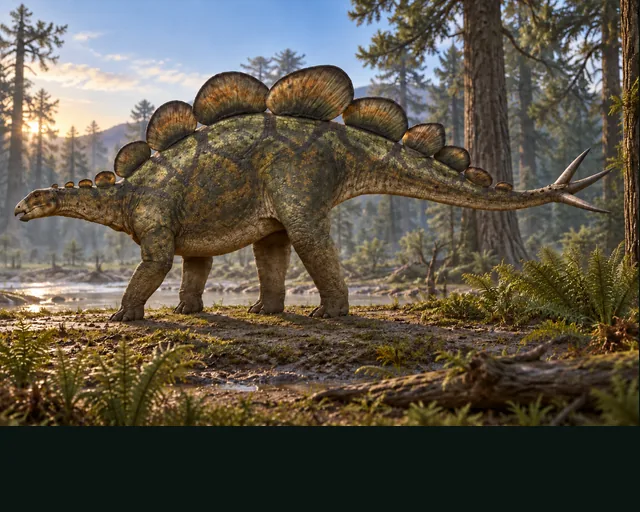
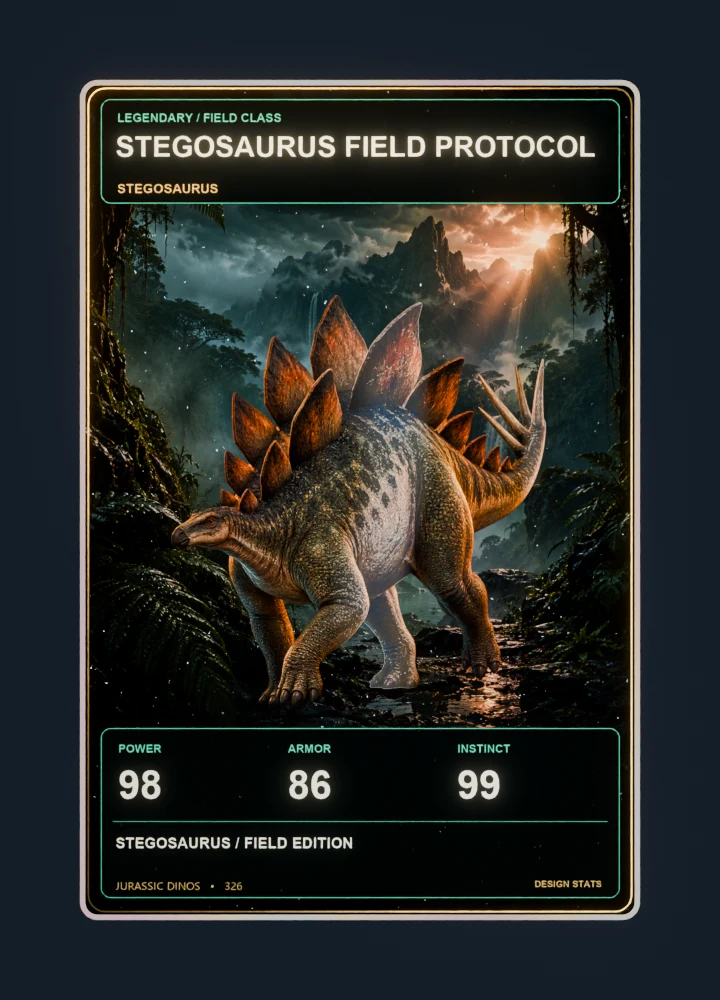
Stegosaurus was a Late Jurassic plant-eating dinosaur with upright back plates and tail spikes.
Distinctive features and evidence
North American and Portuguese fossils document the genus. The plates’ exact functions remain debated, while its Jurassic age makes a natural encounter with the much later Tyrannosaurus an inappropriate assumption.
Genus overview and research references.
Stegosaurus fossil discoveries
Stegosaurus came out of the “Bone Wars”, the nineteenth-century rivalry between the American palaeontologists Othniel Charles Marsh and Edward Drinker Cope. The first bones were found by Arthur Lakes and H. C. Beckwith near Morrison, Colorado, and Marsh described them as Stegosaurus armatus in 1877. He first thought the animal was something like a turtle, with plates lying flat across the back like roof tiles, which is how it got its name. The first bones were so poor that scientists later judged the type specimen too fragmentary to be useful, and in 2013 the naming commission replaced it with the better-known S. stenops as the type species.
The breakthrough came in 1885 to 1886, when Marshall Felch collected a nearly complete young skeleton in Garden Park, Colorado, which showed the skull and plates in place. Marsh named it S. stenops in 1887 and published the first reconstruction in 1891. Later finds include dozens of individuals at Dinosaur National Monument, and a skeleton nicknamed Sophie, about 85 per cent complete and on show at the Natural History Museum in London since 2014. More than 80 individuals are known, and a few fragmentary specimens come from Portugal.
How big was Stegosaurus?
Stegosaurus was a heavy four-legged animal with a rounded back, short front legs and a tail held clear of the ground. S. stenops reached about 6.5 metres and 3.5 tonnes, while the longer-legged S. ungulatus reached about 7 metres and 3.8 tonnes. Large individuals may have reached 7.5 to 9 metres. The Natural History Museum lists about 9 metres for the genus. The Sophie skeleton, a young adult, was about 5.8 metres long and 2.9 metres tall.
The head was small and held low, probably no more than a metre above the ground. The brain was tiny for such a large animal. The museum compares it to a plum, and another source gives a mass of no more than about 80 grams. This helped to spread the idea that dinosaurs were stupid, which is now largely rejected. Another old story, that Stegosaurus had a “second brain” in its hips, comes from an enlarged space in the spinal cord there, which birds also have and which probably served another purpose, not thinking.
What were the Stegosaurus plates for?
The kite-shaped plates are the most famous feature, but their purpose is still debated. There were between 17 and 22 plates and flat spines. They were bony-cored skin structures, not attached to the skeleton, which is why they are often found scattered. The largest plates, over the hips, were more than 60 centimetres wide and about a metre tall. A well-preserved relative with skin impressions shows they were likely covered in horn.
Marsh first thought they were armour, and some researchers still see a defensive role. Most now think display was the main use, either to impress rivals and mates or to help members of the species recognise each other. A 2015 study of the relative Hesperosaurus suggested that wide plates belonged to males and taller ones to females. Their blood-vessel grooves led to the idea that they helped control body heat, although this has been questioned and their keratin covering complicates it. Museum and review sources agree that the question is not settled.
How the plates were arranged also took decades to resolve. Marsh imagined them flat, later versions showed a single row, and then a paired double row. Today, articulated specimens of S. stenops support two staggered rows.
Stegosaurus tail spikes and the thagomizer
Stegosaurus carried four spikes at the end of its tail, each roughly 60 to 90 centimetres long in S. stenops. Finds of articulated armour suggest they stuck out sideways rather than pointing straight up as in many drawings. An early eight-spike count for S. ungulatus has been revised to four. The set of tail spikes is often called a thagomizer.
Were they weapons? One researcher argued that the tail was flexible enough to swing, while another noted that the overlapping plates would limit movement. A survey of specimens found damage to the spikes in nearly 10 per cent of them, consistent with use in fights. One Allosaurus tail vertebra has a hole that a Stegosaurus spike fits exactly, and bone remodelling plus signs of infection around the wound show that the injury was not instantly fatal. The Natural History Museum says Stegosaurus used its spiked tail to defend itself against predators such as Allosaurus and Ceratosaurus.
What did Stegosaurus eat and how did it live?
Stegosaurus ate plants. It lacked front teeth and probably had a horny beak, and its small, flat teeth show wear from contact with food. It probably browsed on ferns, cycads, conifers and other low plants. A 2010 computer model suggested a weak bite that could handle twigs up to about 12 millimetres thick, but a 2016 study of the Sophie skeleton found a stronger bite, similar to cattle and sheep, which may have allowed it to eat tougher plants such as cycads. Some researchers have suggested it could rear up on its hind legs to reach higher foliage, although others dispute this.
The short front legs and short lower hind legs suggest it was not fast, with an estimated top speed of about 15 to 18 kilometres an hour. Footprint finds reported by a Colorado museum have been read as showing groups that included juveniles and adults. A 2022 study of chemical signals in bone suggested that Stegosaurus had a cold-blooded or very large, slowly cooling body, similar to a modern reptile, though this is one study of an active debate.
Stegosaurus species and relatives
Stegosaurus belongs to the Stegosauridae, a group of plated dinosaurs that lived in the later Jurassic and Early Cretaceous across the Northern Hemisphere and Africa. It is placed in the thyreophorans, the armoured dinosaurs, and the plates and spines of stegosaurs are thought to have evolved from low-keeled armour in early members of the group. Other stegosaurs include Kentrosaurus, Huayangosaurus and Miragaia. Ankylosaurus belongs to Ankylosauria, the sister group of the stegosaurs.
In the Morrison Formation only three species are generally accepted: S. stenops, S. ungulatus and S. sulcatus, of which the first is the best known. Some scientists have suggested that stenops and ungulatus might be one species. A 2008 proposal to merge Hesperosaurus and Wuerhosaurus into Stegosaurus did not win wide support, and most researchers still treat them as separate genera.
Where and when Stegosaurus lived
Stegosaurus lived in the Late Jurassic, roughly 155 to 145 million years ago in one count and 152 to 145 million years ago in the museum’s. Nearly all fossils are from the Morrison Formation of the western United States, which records a semi-arid landscape with clear wet and dry seasons, flat floodplains, forests along rivers and open fern savanna with scattered conifers.
It shared the region with many other dinosaurs, including the huge sauropods Diplodocus, Apatosaurus and Camarasaurus, and meat-eaters such as Allosaurus, which may have hunted it. Stegosaurus is often found at the same sites as these animals, but may have preferred somewhat drier places.
Stegosaurus in the game
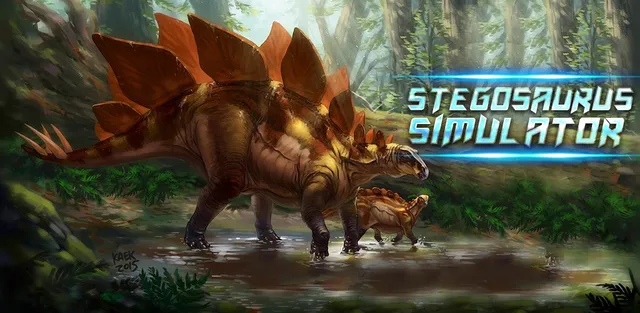
Stegosaurus: Plate Dino Sim is an Android game in which you play as a Stegosaurus. The store listing describes grazing on plants, swinging the tail at predators, using the back plates to intimidate enemies, defending a family, levelling up and completing quests. It names Allosaurus, Ceratosaurus and Spinosaurus among the enemies.
Allosaurus and Ceratosaurus lived in the Morrison Formation with Stegosaurus, but Spinosaurus lived in the Cretaceous, tens of millions of years later, so that match-up is only for fun. Stegosaurus also appears as an opponent in many other games on this site. Combat, plate abilities and enemy lists are entertainment and not evidence of how the animal behaved.
Classification and fossil record
The Paleobiology Database taxonomic record catalogues Stegosaurus under Stegosaurinae. This is the immediate parent in that catalogue, rather than a complete list of evolutionary relationships.
The corroborated occurrence sample includes United States; those are modern discovery locations, not a complete ancient geographic range.
The sourced length estimate for Stegosaurus is 6.5–9 metres. This is an estimate for the reconstructed animal, not a measurement shared by every individual. See the body-size discussion and linked evidence for context.
Research starting point
The catalogue links Stegosaurus to Marsh, 1877, published in American Journal of Science and Arts. This identifies a research starting point; the catalogue’s citation alone does not verify every later reconstruction or species assignment.
For the meaning of taxonomic terms and how evidence is checked, see the glossary and editorial policy.
Quick answers
- Is Stegosaurus a dinosaur?
- Yes. Stegosaurus was a plant-eating armoured dinosaur from the Late Jurassic, in the group Stegosauria within the Ornithischia.
- When did Stegosaurus live?
- Stegosaurus lived in the Late Jurassic, roughly 152 to 145 million years ago according to the Natural History Museum, or 155 to 145 million years ago in other counts.
- How big was Stegosaurus?
- Species reached about 6.5 to 7 metres and 3.5 to 3.8 tonnes, with some large individuals perhaps 7.5 to 9 metres long. The museum lists 9 metres.
- What were the plates on Stegosaurus for?
- Scientists still debate it. Display and species recognition are the leading ideas, with defence and temperature control also proposed, and none is proven.
- What did Stegosaurus eat?
- Stegosaurus ate low-growing plants such as ferns, cycads and conifers, using a beak and small, flat teeth. This comes from skull and tooth evidence, not from preserved stomach contents.
- Where was Stegosaurus found?
- Most Stegosaurus fossils come from the Morrison Formation of the western United States, mainly in Colorado, Wyoming and Utah, with a few tentative specimens from Portugal.