Jurassic Dinos editorial · Updated · Source-based review
What is Diplodocus?
Diplodocus was a Late Jurassic sauropod known especially from North America’s Morrison Formation.
Distinctive features and evidence
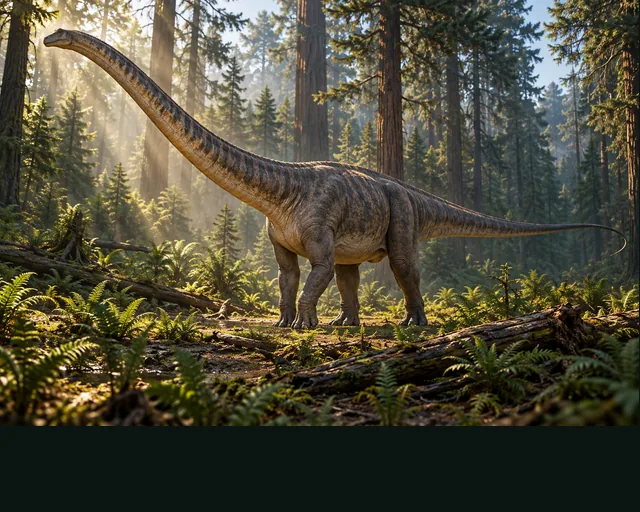
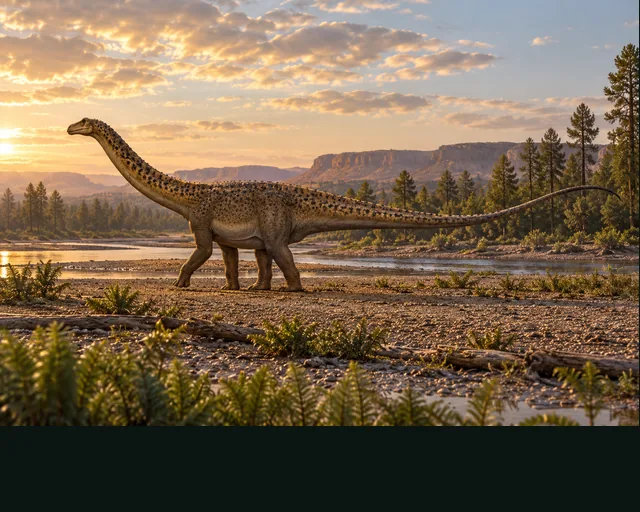
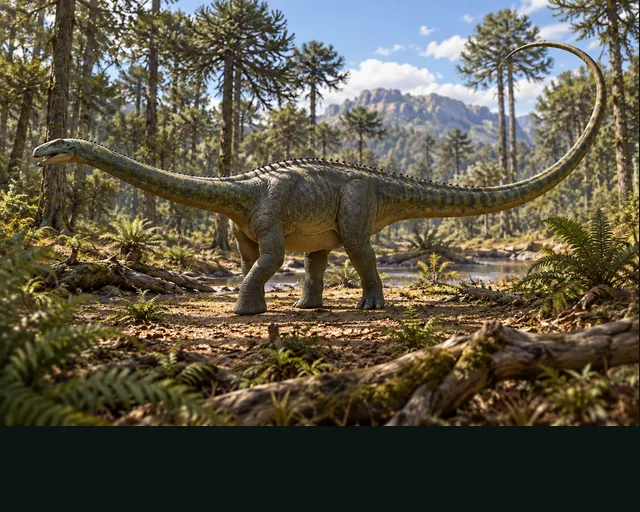
The double-beamed bones beneath the tail gave the genus its name. Its elongated body offers an anatomical comparison with the more robust Apatosaurus and taller-fronted Brachiosaurus without requiring an unsupported longest-dinosaur ranking.
Genus overview and research references.
Diplodocus fossil discoveries
The first Diplodocus bones came from Garden Park near Cañon City, Colorado, where Benjamin Mudge and Samuel Williston collected fossils in 1877. The specimen was incomplete, only a few tail vertebrae and a chevron, and Othniel Charles Marsh named it Diplodocus longus in 1878 during his rivalry with Edward Drinker Cope, now known as the Bone Wars. That fragmentary type is now considered too incomplete to compare reliably with other fossils, which is awkward for the type species of such a well-known genus.
The skeleton that made the genus famous was found in 1899 at Sheep Creek, Wyoming, by a Carnegie Museum crew. John Bell Hatcher described it in 1901 as Diplodocus carnegii, naming it after the museum’s patron, Andrew Carnegie. A strange gap remains: no skull has ever been confidently tied to Diplodocus itself, and skulls once assigned to it have since been reassigned to relatives or judged impossible to name to genus.
Why is Diplodocus called Dippy?
“Dippy” is the nickname of the Carnegie Museum mount of D. carnegii, built in 1907 from several specimens, and of the casts made from it for museums in London, Berlin, Paris and other cities between 1905 and 1928. The London cast was requested by King Edward VII after he saw a picture of the new find in Carnegie’s Scottish castle, and it was the first sauropod mount displayed outside the United States.
The Natural History Museum’s cast stood in its main hall from 1979 to early 2017, and its tail was lifted off the ground in 1993 after research showed that the tails of Diplodocus would have been held up. A full-size bronze version named Fern was unveiled in the museum’s gardens in 2024.
How big was Diplodocus?
Among dinosaurs known from a nearly complete skeleton, D. carnegii is one of the longest, at roughly 24 to 26 metres, with weight estimates of about 12 to 15 tonnes. About 55 percent of that length is tail, made up of around 80 vertebrae. The skull and braincase were small for the size of the body, and the teeth were pegs set only toward the front of the jaws.
A second species, D. hallorum, was first named Seismosaurus in 1991 from a partial skeleton found in New Mexico. Early length estimates were revised downward after some vertebrae were found to have been placed in the wrong order, and later estimates are about 29 to 33.5 metres. A 2024 study suggested that the holotype may have been about 60 years old when it died.
What did Diplodocus eat and how did it hold its neck?
Diplodocus teeth are long, slender and worn on the cheek side, a pattern unlike other sauropods. This suggests it stripped leaves off branches, and its teeth were replaced continually, often in less than 35 days. Wear patterns also suggest that it ate different plants from Camarasaurus, which may have reduced competition.
Neck posture is debated. Studies of the neck bones suggest a mostly horizontal neutral pose, with browsing from low levels up to about 4 metres, while others argue that soft tissue allowed a higher angle. A juvenile skull with a narrower snout suggests that young and adult animals ate differently.
Where and when Diplodocus lived
Diplodocus is common in the middle to upper Morrison Formation of the western United States, with most specimens dated to roughly 151.9 to 149.1 million years ago, in the late Kimmeridgian. The Morrison environment was semi-arid with distinct wet and dry seasons, with rivers, lakes and floodplains, and fern savannas with occasional trees.
The formation also holds Apatosaurus, Allosaurus and Stegosaurus. Diplodocus is often found at the same sites as these animals, which shows that they coexisted. Diplodocus belongs to the family Diplodocidae, along with Barosaurus and Apatosaurus.
Classification and fossil record
The Paleobiology Database taxonomic record catalogues Diplodocus under Diplodocinae. This is the immediate parent in that catalogue, rather than a complete list of evolutionary relationships.
The corroborated occurrence sample includes United States; those are modern discovery locations, not a complete ancient geographic range.
The sourced length estimate for Diplodocus is 24–26 metres. This is an estimate for the reconstructed animal, not a measurement shared by every individual. See the body-size discussion and linked evidence for context.
Research starting point
The catalogue links Diplodocus to Marsh, 1878, published in American Journal of Science and Arts. This identifies a research starting point; the catalogue’s citation alone does not verify every later reconstruction or species assignment.
For the meaning of taxonomic terms and how evidence is checked, see the glossary and editorial policy.
Quick answers
- Is Diplodocus a dinosaur?
- Yes. Diplodocus was a long-necked, long-tailed sauropod dinosaur, in the family Diplodocidae, that lived in western North America in the Late Jurassic.
- When did Diplodocus live?
- Most Diplodocus specimens come from rocks dated to about 151.9 to 149.1 million years ago, in the Late Jurassic Morrison Formation.
- How big was Diplodocus?
- D. carnegii was about 24 to 26 metres long and an estimated 12 to 15 tonnes. The other species, D. hallorum, may have been longer, perhaps 29 to 33.5 metres.
- What did Diplodocus eat?
- It ate plants. Its slender teeth and their wear pattern suggest it stripped leaves from branches, probably of ferns, conifers and similar vegetation, and its teeth were replaced regularly.
- Why is Diplodocus called double beam?
- Marsh named it for the double-beamed chevron bones on the underside of the tail, which he thought unique. Similar bones were later found in other sauropods.