Jurassic Dinos editorial · Updated · Source-based review
What is Apatosaurus?
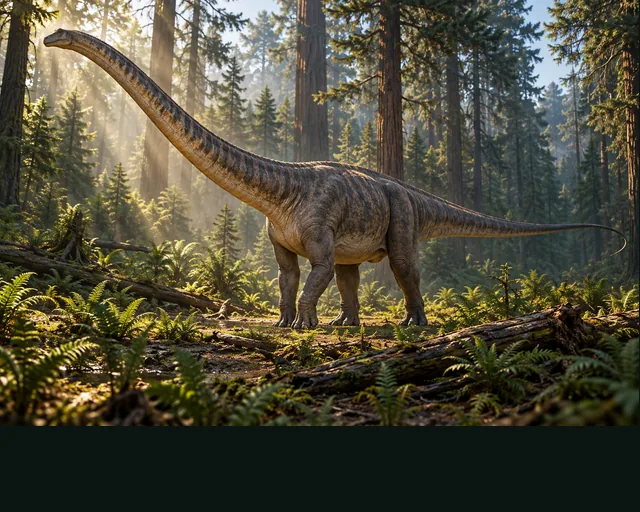
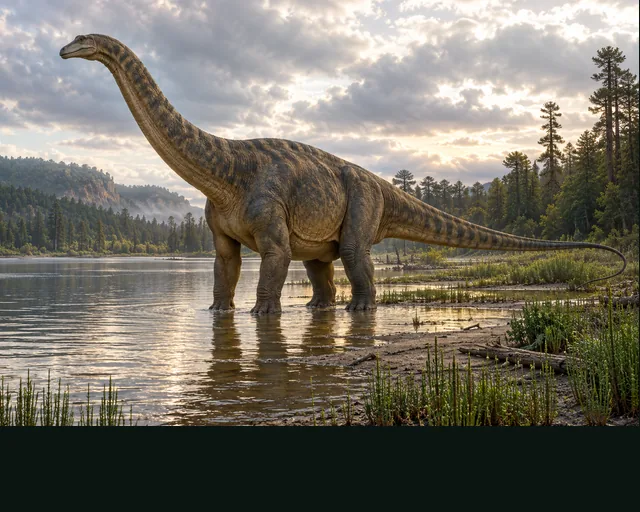
Apatosaurus was a robust, long-necked sauropod of the Late Jurassic Morrison Formation in North America.
Distinctive features and evidence
Its neck vertebrae and limb bones are more heavily built than those of Diplodocus. Apatosaurus ajax and Apatosaurus louisae have separate naming histories, and Brontosaurus should be discussed using an explicit taxonomic interpretation.
Genus overview and research references.
Apatosaurus fossil discoveries
The first Apatosaurus bones were found in the spring of 1877 by a local miner, Arthur Lakes, and his friend Henry Beckwith, near the town of Morrison in the Colorado foothills. Othniel Charles Marsh of Yale hired Lakes to collect more, and a partial skeleton of a young animal became Apatosaurus ajax that November. Marsh chose Greek words for “deception” and “lizard” because the chevrons, small bones under the tail, looked more like those of a sea reptile than of other dinosaurs.
The skull caused decades of confusion. Museums mounted Apatosaurus skeletons with casts of a heavier Camarasaurus skull, and one famous New York mount used a sculpted guess. In 1909 a skull turned up close to a skeleton at what is now Dinosaur National Monument, and it resembled the slender skull of Diplodocus. Some scientists rejected the link, and the matter was settled only in the 1970s. The first true Apatosaurus skull was mounted on a museum skeleton in 1979.
How big was Apatosaurus?
Most size figures come from one skeleton, CM 3018 of Apatosaurus louisae, estimated at 21 to 23 metres long and about 16 to 22 tonnes. The Natural History Museum lists a length of 21 metres. A 2015 volume-model study put the same skeleton heavier, at about 22 to 38 tonnes, so even the weight of a well-known specimen depends on the method.
A few bones from larger individuals suggest animals 11 to 30 per cent longer, though the largest early estimate for one of them was judged exaggerated and revised in 2020 to about 30 metres and 33 tonnes. Around 54 per cent of the length was tail.
Apatosaurus or Brontosaurus?
Marsh described Brontosaurus excelsus in 1879 from a larger Wyoming skeleton. In 1903 Elmer Riggs concluded that the differences were due to age and that Brontosaurus was only a later name for Apatosaurus, so the name was dropped from scientific use. It lived on in popular culture.
A 2015 study by Tschopp, Mateus and Benson compared hundreds of features across many specimens and argued that the species deserves its own genus again. The Natural History Museum now treats the two as separate, closely related dinosaurs. Not everyone agrees, and some specialists call the criteria somewhat arbitrary. When reading older books, check whether they mean A. ajax, A. louisae or what is now Brontosaurus.
What did Apatosaurus eat?
Apatosaurus ate plants. Its square snout and the fine scratches on its teeth suggest a browser that fed near ground level without being picky, perhaps on ferns, horsetails and cycad-like plants. How high it could reach is debated: some studies found the neck stiff and suited to low feeding, while others argued it was flexible and held up.
The long tail is also debated. A 1990s computer model suggested diplodocids could crack it like a whip, but a 2020 study thought that unlikely and proposed instead that it worked as a touch organ for animals moving together. Neither idea has direct fossil evidence. Bone studies suggest the young grew fast, reaching close to adult size in about a decade.
Where and when Apatosaurus lived
All the fossils come from the Morrison Formation of the western United States, including Colorado, Wyoming, Utah, New Mexico and Oklahoma. Apatosaurus ajax is known only from the upper part of the formation, about 152 to 151 million years ago, while the Natural History Museum gives a wider span of 152 to 145 million years for the genus. The climate was semi-arid with wet and dry seasons, with rivers, floodplains and forests of tree ferns.
Apatosaurus was the second most common sauropod there, after Camarasaurus, and is found at the same sites as Allosaurus, Diplodocus and Stegosaurus.
Is Apatosaurus a diplodocid?
Yes. Apatosaurus belongs to the family Diplodocidae, alongside Diplodocus and Barosaurus. It differs mainly in being more heavily built, with shorter, sturdier neck bones and very stout leg bones. Its closest relative is Brontosaurus.
Classification and fossil record
The Paleobiology Database taxonomic record catalogues Apatosaurus under Apatosaurinae. This is the immediate parent in that catalogue, rather than a complete list of evolutionary relationships.
Discovery and naming history
Marsh introduced Apatosaurus ajax in 1877. Confusion about sauropod skulls and the later treatment of Brontosaurus are part of its research history, making species and specimen identification especially useful when comparing older illustrations. Historical overview.
The corroborated occurrence sample includes United States; those are modern discovery locations, not a complete ancient geographic range.
Research starting point
The catalogue links Apatosaurus to Marsh, 1877, published in American Journal of Science and Arts. This identifies a research starting point; the catalogue’s citation alone does not verify every later reconstruction or species assignment.
For the meaning of taxonomic terms and how evidence is checked, see the glossary and editorial policy.
Quick answers
- Is Apatosaurus a dinosaur?
- Yes. Apatosaurus was a large plant-eating sauropod dinosaur from the Late Jurassic of North America, in the family Diplodocidae.
- When did Apatosaurus live?
- About 152 to 151 million years ago for the best-dated species, in the Late Jurassic. The Natural History Museum gives a broader range of 152 to 145 million years ago.
- How big was Apatosaurus?
- Typical estimates are about 21 to 23 metres long and roughly 16 to 22 tonnes, though other methods give higher weights. A few bigger individuals are known but their size is debated.
- Is Apatosaurus the same as Brontosaurus?
- For over a century most scientists said yes. A 2015 study argued that Brontosaurus is a separate, closely related genus, which the Natural History Museum accepts, though not all specialists agree.
- What did Apatosaurus eat?
- Plants. Its tooth and snout shape suggest it browsed low-growing vegetation such as ferns and horsetails, though how high it could reach is still debated.