Jurassic Dinos editorial · Updated · Source-based review
What is Brontosaurus?
Brontosaurus was a Late Jurassic North American sauropod long involved in a naming debate with Apatosaurus.
Distinctive features and evidence
A 2015 anatomical analysis supported recognizing Brontosaurus separately. This history is worth explaining directly: a change in classification concerns which fossils belong together, not whether the familiar animal ever existed.
Genus overview and research references.
Brontosaurus fossil discoveries
The first Brontosaurus fossil was a large partial skeleton, without a skull, dug up at Como Bluff in Wyoming by the collector William Harlow Reed. Othniel Charles Marsh of Yale announced it in 1879 as Brontosaurus excelsus. For its time it was a remarkably complete sauropod, and it is still the name-bearing specimen of the genus.
Other skeletons followed. In 1902 Peterson and Gilmore named a young animal and an adult found together as Elosaurus parvus, and in 1994 another Wyoming skeleton was named as a species of Apatosaurus. Both names were moved into Brontosaurus in 2015. No fully described skull has been tied to a Brontosaurus skeleton.
Is Brontosaurus the same as Apatosaurus?
This is the question that made the name famous. In 1903 the palaeontologist Elmer Riggs argued that Marsh’s Brontosaurus was so close to Apatosaurus that they belonged in one genus. Under the rules of scientific naming the older name wins, so Brontosaurus was dropped from formal use for most of the twentieth century. It lived on in museums, books and films, partly because the American Museum of Natural History kept the label on its mounted skeleton.
In 2015 Tschopp, Mateus and Benson published a specimen-by-specimen comparison of diplodocid sauropods, scoring 81 specimens for 477 anatomical features. Using numerical methods to set limits for genera and species, they concluded that Brontosaurus was distinct enough to be a valid genus again. Some palaeontologists criticised how the result was reported, and others still prefer to treat the two names as one genus. So the 2015 view is widely cited but not unanimous.
Neither view means the animal was imaginary. The argument is about how the real fossils should be grouped.
The Brontosaurus head mistake
For decades, mounted skeletons wore the wrong head. No Brontosaurus skull was known, so museums sculpted one, often modelled on the thick, boxy skull of Camarasaurus. A skull that Marsh had matched to Brontosaurus has since been suggested to belong to Brachiosaurus instead.
In 1975 McIntosh and Berman argued that apatosaurine skeletons carried a lighter skull like that of Diplodocus. The first Apatosaurus skull mounted on a skeleton went up at the Carnegie Museum in 1979. Scientists still infer the Brontosaurus head from its close relative Apatosaurus.
How big was Brontosaurus and what did it eat?
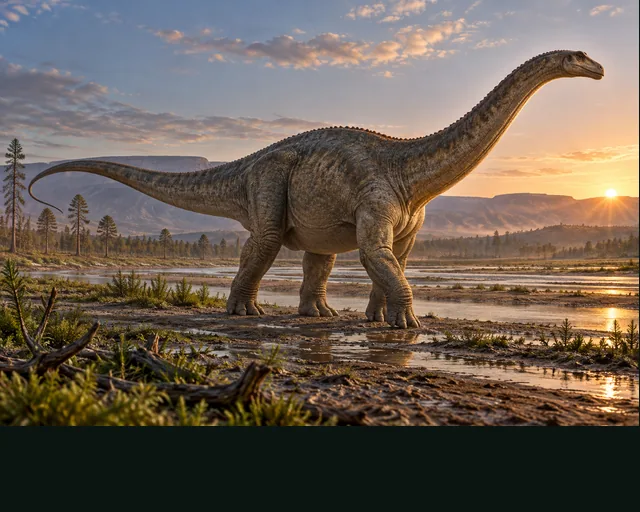
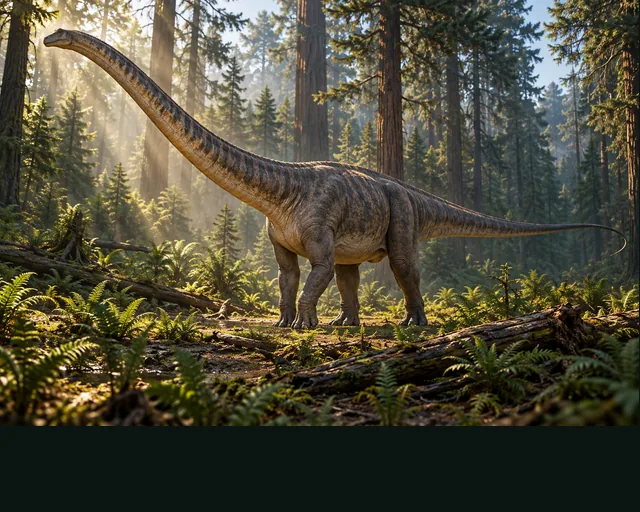
Brontosaurus was a four-legged plant-eater with a long neck and a tail that thinned to a whip-like tip. Its neck bones were unusually heavy compared with those of lightly built relatives such as Diplodocus and Barosaurus. Published estimates for the biggest species, B. excelsus, reach about 21 to 23 metres in length and 15 to 20 tonnes in weight. These are scaled estimates, so treat them as ranges, not measurements.
Sauropods like this probably browsed low-growing plants such as ferns, horsetails and cycad-like plants. The teeth of its relative Apatosaurus were thick and cylindrical, which suggests tougher food than the thinner teeth of Diplodocus.
Where and when Brontosaurus lived
Brontosaurus is known from the Morrison Formation of the western United States, mainly Wyoming, with sites also reported in Utah, Colorado and Oklahoma. It lived in the Late Jurassic, during the Kimmeridgian and Tithonian ages. The oldest species, B. yahnahpin, comes from rock about 155 million years old, while B. excelsus is dated to roughly 152 million years ago.
The Morrison landscape is reconstructed as semi-arid, with wet and dry seasons. Brontosaurus shared it with plant-eaters such as Stegosaurus and predators such as Allosaurus.
Classification and fossil record
The Paleobiology Database taxonomic record catalogues Brontosaurus under Apatosaurinae. This is the immediate parent in that catalogue, rather than a complete list of evolutionary relationships.
Discovery and naming history
Marsh named Brontosaurus in 1879 from a partial Wyoming skeleton without a skull. Its later synonymy with Apatosaurus and subsequent revival illustrate how anatomical reassessment can change a familiar genus name. Historical overview.
The corroborated occurrence sample includes United States; those are modern discovery locations, not a complete ancient geographic range.
Research starting point
The catalogue links Brontosaurus to Marsh, 1879, published in The American Journal of Science and Arts, series 3. This identifies a research starting point; the catalogue’s citation alone does not verify every later reconstruction or species assignment.
For the meaning of taxonomic terms and how evidence is checked, see the glossary and editorial policy.
Quick answers
- Is Brontosaurus a dinosaur?
- Yes. Brontosaurus was a long-necked, plant-eating sauropod dinosaur that lived in what is now the western United States during the Late Jurassic.
- Is Brontosaurus the same as Apatosaurus?
- Scientists disagree. Brontosaurus was merged into Apatosaurus in 1903, but a 2015 study argued it is a separate genus. Some palaeontologists still treat the two names as one.
- When did Brontosaurus live?
- Brontosaurus lived in the Late Jurassic, during the Kimmeridgian and Tithonian ages. Its oldest species dates to roughly 155 million years ago.
- What did Brontosaurus eat?
- Brontosaurus ate plants. It probably browsed low vegetation such as ferns, horsetails and cycad-like plants, though no stomach contents are known.
- How big was Brontosaurus?
- Published estimates put the largest species at about 21 to 23 metres long and 15 to 20 tonnes, but these are scaled estimates, not measurements.