Jurassic Dinos editorial · Updated · Source-based review
What is Allosaurus?
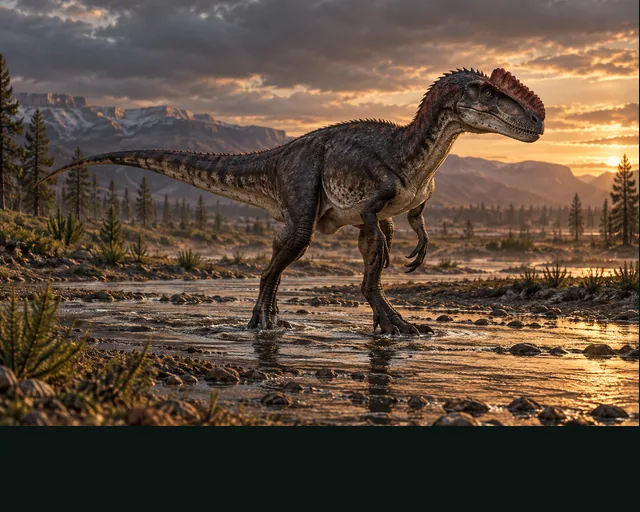
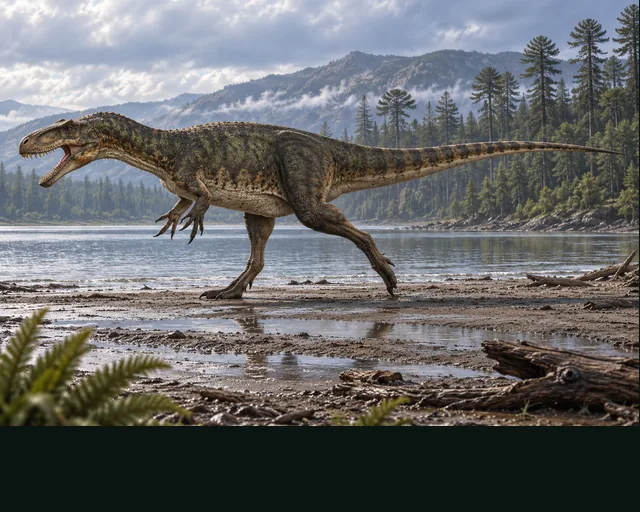
Allosaurus was a Late Jurassic predatory theropod known especially from North America’s Morrison Formation.
Distinctive features and evidence
Multiple specimens and species make Allosaurus a useful comparison with the horned Ceratosaurus. Portuguese material extends the research beyond North America, while older references using Antrodemus reflect a complicated naming history.
Genus overview and research references.
Allosaurus fossil discoveries
The name Allosaurus was created in 1877 by the American palaeontologist Othniel Charles Marsh. It was based on a small, fragmentary set of bones from Garden Park, Colorado: a few back and tail bones, a rib piece, one tooth, a toe bone and part of an arm bone. Better material came later. A skeleton from the same area was eventually chosen as the neotype, meaning the replacement reference specimen, and this choice was ratified by the international naming commission in 2023.
For over half of the 20th century the animal went by another name, Antrodemus, which was based on a single tail bone. Work on the huge Cleveland-Lloyd Dinosaur Quarry in Utah in the 1960s led researchers back to Allosaurus. At least 46 of the minimum of 73 dinosaurs there were Allosaurus fragilis, and the bones range from animals less than a metre long to very large ones, which has made this one of the best-known theropods.
Other famous finds include the 95 percent complete skeleton nicknamed Big Al, found in Wyoming in 1991. It was a subadult, thought to be about 87 percent grown, and about 8 metres long. It also carries 19 recorded injuries and infections. In Portugal, the first Allosaurus specimen found outside North America was uncovered in 1988 during the building of a warehouse.
How big was Allosaurus?
The best-known species, Allosaurus fragilis, is estimated at about 7 to 9 metres long, with an estimated weight of 1.7 to 2.7 tonnes. The Natural History Museum lists 9.7 metres and 2.7 tonnes. Weight estimates for dinosaurs are debated, and published modal adult estimates since 1980 have ranged between 1 and 4 tonnes. One specialist considered about 1 tonne reasonable for large adults and 700 kilograms for an average one. A computer-modelling study of Big Al arrived at a best estimate of 1.5 tonnes, within a possible range of 1.4 to 2 tonnes.
Bones from some individuals hint at bigger animals, with one estimate running up to 12 to 13 metres, and several giant specimens once attached to the genus may belong to other animals. This is a good example of why published size figures differ.
What did Allosaurus eat?
Most palaeontologists treat Allosaurus as a predator that actively attacked big animals. The evidence is unusually direct. One Allosaurus tail vertebra has a partly healed puncture that fits the spike of a Stegosaurus tail, and a Stegosaurus neck plate has a U-shaped wound that matches an Allosaurus snout. Scrape marks on sauropod bones fit Allosaurus teeth, and shed teeth have been found among sauropod bones, but experts are unsure whether the sauropods were killed or scavenged. Calcium isotope values point to a flexible feeder whose menu included Camarasaurus, Camptosaurus and Diplodocus, taking mainly flesh and little bone.
How it killed is debated. A computer study of the skull suggested a light but strong skull used like a machete, slashing with the teeth, though other researchers disagreed. Another idea is that it took bites out of living sauropods, a strategy called flesh grazing. The skull could open very wide, with one study giving a gape up to 92 degrees. Estimated top speeds have been published, but they are modelled estimates, not measurements.
Did Allosaurus hunt in packs?
Pack hunting has been suggested since the 1970s and is common in popular books, but the evidence is thin. The Natural History Museum notes that many Allosaurus have been found in the same bone beds, though this might have other causes, and that some bones show what may be bite marks from other Allosaurus. Researchers have proposed that bones accumulated at Cleveland-Lloyd because animals were drawn together at carcasses or trapped there, not because they hunted together.
Others point out that conflict does not exclude cooperation, since modern social hunters also fight each other. Scientists cannot say whether Allosaurus cooperated, and both views are still discussed.
Allosaurus horns, hands and skin
Allosaurus had a big but light skull with dozens of serrated teeth. Above and in front of the eyes were small horns, formed by the lacrimal bones, probably covered in keratin. Researchers have suggested they were used for species recognition, display, shading the eyes or perhaps combat, but they were fragile and no one knows. The arms were short for a large theropod and bore three fingers with big curved claws. The neck and trunk vertebrae had hollow spaces that are thought to have held air sacs, as in birds.
Skin impressions from several specimens show small scales only a few millimetres across, though one larger scale patch may belong to another animal found with it. No feather impressions are reported for Allosaurus.
Where and when Allosaurus lived
Allosaurus lived during the Late Jurassic, roughly 155 to 143 million years ago, and its remains are known mostly from the Morrison Formation across the American West, with more from Portugal. It was the most abundant large predator there, making up 70 to 75 percent of theropod specimens. The Morrison was a semi-arid region with wet and dry seasons, river forests of conifers and ferns, and open fern savannas.
Its neighbours included the plant-eaters Stegosaurus, Diplodocus and Camptosaurus, and the large predator Ceratosaurus. Portuguese rocks of the same age hold many of the same genera, which suggests that animals could still move between Europe and North America. Whether the Portuguese Allosaurus is a separate species is still argued.
Is Allosaurus related to T. rex?
Not closely. Allosaurus belongs to the family Allosauridae, in a group that also includes the carcharodontosaurians, while Tyrannosaurus belongs to the tyrannosaurids, a separate branch of theropods called the coelurosaurs. They look alike because both were large, two-legged predators, but the Natural History Museum notes that Allosaurus lived roughly 145 million years ago and Tyrannosaurus at around 66 million years ago. A rival name, Saurophaganax, was once proposed for a giant allosaurid from Oklahoma, but a 2024 reassessment suggested it mixed Allosaurus with sauropod bones.
Allosaurus in the game
Dinosaur Simulator: Allosaurus is an Android game in which you play as an Allosaurus. The store listing describes hunting for prey and finding water to keep health and energy up, an open world with a day-night cycle and 11 weather types, levelling up with quests, and unlockable combat skills.
The game is entertainment. Its fights, abilities and the animals you meet are game design and not scientific evidence about how real Allosaurus behaved.
Classification and fossil record
The Paleobiology Database taxonomic record catalogues Allosaurus under Allosauroidea. This is the immediate parent in that catalogue, rather than a complete list of evolutionary relationships.
Discovery and naming history
The genus dates to Othniel Charles Marsh’s 1877 description. Later Morrison Formation discoveries added far more anatomy than the original naming material, while individual species assignments continued to change. Historical overview.
The corroborated occurrence sample includes United States, Portugal; those are modern discovery locations, not a complete ancient geographic range.
The sourced length estimate for Allosaurus is 7–9.7 metres. This is an estimate for the reconstructed animal, not a measurement shared by every individual. See the body-size discussion and linked evidence for context.
Research starting point
The catalogue links Allosaurus to Marsh, 1877, published in American Journal of Science and Arts. This identifies a research starting point; the catalogue’s citation alone does not verify every later reconstruction or species assignment.
For the meaning of taxonomic terms and how evidence is checked, see the glossary and editorial policy.
Quick answers
- Is Allosaurus a dinosaur?
- Yes. Allosaurus was a large, two-legged, meat-eating theropod dinosaur from the Late Jurassic of North America and Portugal.
- When did Allosaurus live?
- Allosaurus lived in the Late Jurassic, roughly 155 to 143 million years ago, in the Oxfordian to Tithonian ages, based on current estimates.
- How big was Allosaurus?
- The best-known species is estimated at about 7 to 9 metres long and 1.7 to 2.7 tonnes, though weight estimates are debated and range more widely.
- Is Allosaurus related to T. rex?
- Not closely. Allosaurus belongs to a different branch of theropods and lived about 80 million years before Tyrannosaurus, though both were large two-legged predators.
- What did Allosaurus eat?
- It ate other dinosaurs. Stegosaurus bones with bite wounds and sauropod bones with tooth marks suggest it both hunted and scavenged, though the exact balance is debated.
- Where was Allosaurus found?
- Most fossils come from the Morrison Formation in the western United States, such as Utah, Colorado and Wyoming, with more from Portugal.