Jurassic Dinos editorial · Updated · Source-based review
What was Asfaltovenator?
Asfaltovenator was a large predatory dinosaur from Jurassic Patagonia. Its fossil combines skeletal features that researchers otherwise associate with different branches of large theropods. This mixture makes it especially useful for investigating how those branches are related.
What makes the fossil distinctive?
The specimen preserves much of the head and front part of the body, including the arms, as well as other skeletal material. It is far more informative than an isolated tooth. Nevertheless, a reconstruction still includes missing parts, and not every body measurement is directly preserved.
Where was it found and how was it named?
The fossil was discovered in 2002 in the Cañadón Asfalto Formation and formally named in 2019. Excavating and preparing the hard rock took years. Later geological work places this part of the formation in the Early Jurassic; older accounts used a younger age. Geological dates can change when the rocks themselves are studied more closely.
What can we infer, and what remains uncertain?
Asfaltovenator illustrates why evolutionary trees are hypotheses tested with many anatomical characters. A mosaic of features can change which groupings are recovered in an analysis. It does not mean the animal was a hybrid between the familiar dinosaurs used for comparison. Allosaurus and Megalosaurus are reference points for anatomy, not identified parents.
Was Asfaltovenator a hybrid dinosaur?
No. A mixture of anatomical features reflects evolution and the way relationships are reconstructed, not hybrid parentage.
How can you check the evidence?
The Paleobiology Database record catalogues Asfaltovenator under Allosauroidea. Its linked bibliography identifies this research starting point: O. W. M. Rauhut and D. Pol. 2019. Probable basal allosauroid from the early Middle Jurassic Cañadón Asfalto Formation of Argentina highlights phylogenetic uncertainty in tetanuran theropod dinosaurs. Scientific Reports 9:18826:1-7. Open the bibliographic record. A catalogue entry establishes the source trail; it does not independently verify every later illustration or behavioural claim.
Use the dated genus overview to follow the references behind the discovery and anatomy discussed above. When sources disagree, compare which specimen and rock layer each author studied. A reconstructed whole animal can combine original bones with comparisons to relatives; those two kinds of evidence should not be confused. The account above explains the particular limits that matter for Asfaltovenator, rather than supplying unsupported size, speed or lifespan figures.
Read the image and keep exploring
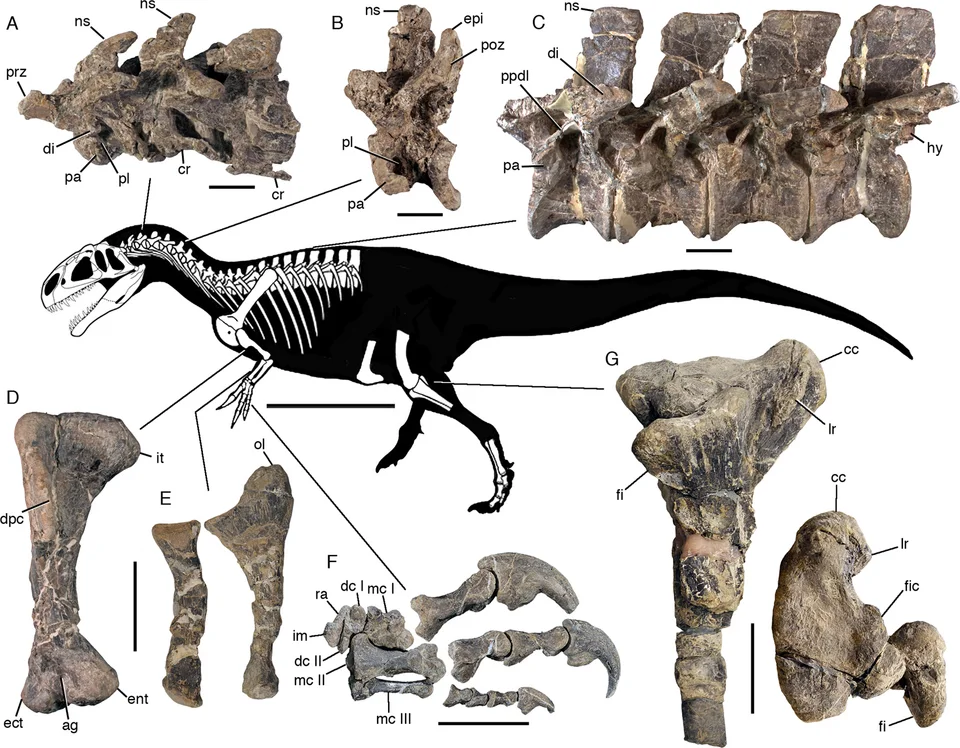
A published Asfaltovenator diagram places preserved vertebrae and limb elements around a reconstructed skeletal outline. This diagram explains the stated evidence; schematic elements are not additional fossil observations.
Compare Allosaurus, Megalosaurus, Piatnitzkysaurus. Find more names in the A index and explore theropod field notes. The glossary explains unfamiliar fossil terms.
Quick answers
- Where have Asfaltovenator fossils been found?
- The discoveries discussed here come from Argentina. Modern place names describe discovery locations, not a complete ancient geographic range.
- When did Asfaltovenator live?
- It is placed in the Jurassic period. See the discovery discussion for qualifications about the particular rock layers and dating.
- Where can I compare Asfaltovenator with related dinosaurs?
- Follow the related field notes below. Comparisons explain shared anatomy; they do not imply that all the animals lived together.