Jurassic Dinos editorial · Updated · Source-based review
What is Piatnitzkysaurus?
Piatnitzkysaurus was an Argentine Jurassic theropod with a lightly built, two-legged body.
Distinctive features and evidence
It provides a southern comparison with other early tetanuran predators. An exact numerical age or adult maximum should follow the geological and specimen evidence, rather than be inferred from its general body plan.
Genus overview and research references.
Piatnitzkysaurus fossil discoveries
Field teams recovered the type specimen over three expeditions, in 1977, 1982 and 1983, from the Cañadón Asfalto Formation of Chubut, Argentina. It includes part of the skull and the front half of the skeleton, kept in partial articulation, and it belonged to a subadult, an animal not yet fully grown. In 1986 some bones from an adult were also referred to the species, and these are the only other described remains.
José Bonaparte named Piatnitzkysaurus floresi in 1979, honouring the Russian-born Argentine geologist Alejandro Piatnitzky. The first paper described it briefly alongside two sauropods from the same rocks; the full description of the theropod followed in 1986. Two partial skeletons are known, and the genus is described as one of the best-known Jurassic theropods of the Southern Hemisphere.
What did Piatnitzkysaurus look like?
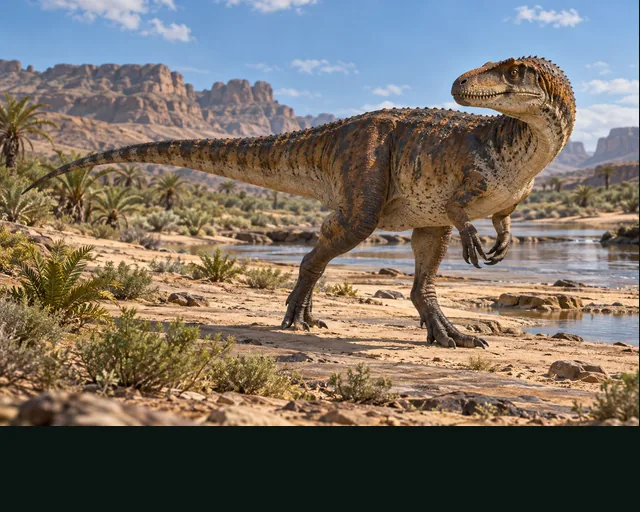
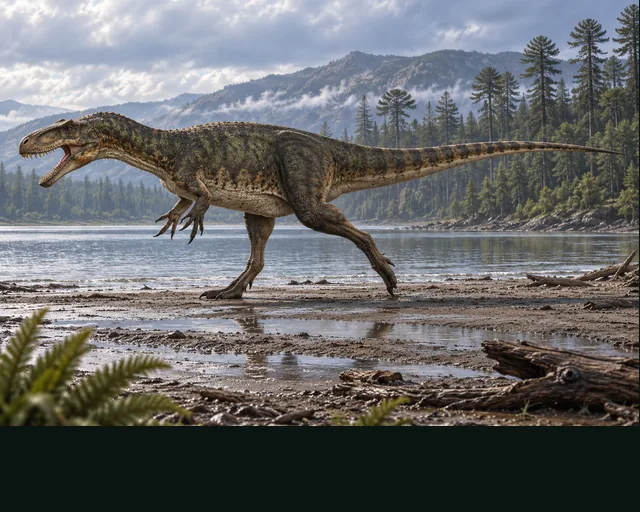
Piatnitzkysaurus was a lightly built, two-legged predator with strong arms and powerful hind legs. The type specimen is estimated at about 4.3 metres long and 450 kilograms, but because it was a subadult, a full-grown animal could have been larger; the museum listing gives 4.2 metres.
It has been compared with Allosaurus, but there are clear differences. The upper arm bone is only half as long as the thigh bone, and the forelimbs are proportionally longer than those of Allosaurus. The wide contact between two of the hip bones, the pubis and ischium, is also a primitive trait that Allosaurus has lost.
The braincase has been studied in detail by Oliver Rauhut and is one of the few well-described braincases of early theropods. It has an unusual recess in its base that is otherwise reported in only two much more advanced theropods, which scientists interpret as convergence, not close kinship.
Is Piatnitzkysaurus an allosaur?
No, although it was once classified as one. Bonaparte’s 1986 description placed it in the Allosauridae with Allosaurus and several other theropods. Later analyses moved it around, calling it an abelisaurid, a primitive carnosaur, a primitive tetanuran and a megalosauroid outside the Megalosauridae. In 2012 it was given its own family, Piatnitzkysauridae.
In current family trees it sits among the most primitive megalosauroids, in a group with Marshosaurus, Xuanhanosaurus and Condorraptor. Even that placement is weakly supported, and future studies may move these animals out of the Megalosauroidea. Because the skeleton is both early and fairly complete, it helps researchers understand the first steps in the evolution of the tetanurans, a large branch of theropods. Another early branch of the group includes Monolophosaurus.
When did Piatnitzkysaurus live?
Sources disagree. Current accounts of the Cañadón Asfalto Formation date the type specimen’s rock to the middle to late Toarcian, about 179 to 177 million years ago, in the Early Jurassic. The Paleobiology Database also lists the Toarcian. The Natural History Museum, however, lists the Late Jurassic, 164 to 159 million years ago, and some descriptions call it a Middle to Late Jurassic dinosaur. This page follows the more recent geological dating.
Classification and fossil record
The Paleobiology Database taxonomic record catalogues Piatnitzkysaurus under Piatnitzkysauridae. This is the immediate parent in that catalogue, rather than a complete list of evolutionary relationships.
The corroborated occurrence sample includes Argentina; those are modern discovery locations, not a complete ancient geographic range.
The sourced length estimate for Piatnitzkysaurus is 4.2–4.3 metres. This is an estimate for the reconstructed animal, not a measurement shared by every individual. See the body-size discussion and linked evidence for context.
Research starting point
The catalogue links Piatnitzkysaurus to Bonaparte, 1979, published in Science. This identifies a research starting point; the catalogue’s citation alone does not verify every later reconstruction or species assignment.
For the meaning of taxonomic terms and how evidence is checked, see the glossary and editorial policy.
Quick answers
- Is Piatnitzkysaurus a dinosaur?
- Yes. Piatnitzkysaurus was a theropod dinosaur, a meat-eating, two-legged type, that lived in what is now Argentina during the Jurassic.
- How big was Piatnitzkysaurus?
- About 4.2 to 4.3 metres long, based on a subadult skeleton, with a mass estimated at around 450 kilograms. A full-grown adult may have been larger.
- Is Piatnitzkysaurus an allosaur?
- No. It was placed with Allosaurus in 1986, but later studies moved it to the megalosauroids and gave it its own family, Piatnitzkysauridae, in 2012.
- When did Piatnitzkysaurus live?
- Current dating puts it in the Toarcian, about 179 to 177 million years ago, though some sources, such as the Natural History Museum, give a Late Jurassic age.
- Where was Piatnitzkysaurus found?
- In the Cañadón Asfalto Formation in Chubut Province, Argentina, by expeditions in 1977, 1982 and 1983.