Jurassic Dinos editorial · Updated · Source-based review
What is Afrovenator?
Afrovenator was a megalosaurid theropod from Niger, known from Jurassic deposits of the Sahara region.
Distinctive features and evidence
Its African record makes it useful for studying the distribution of megalosaurids beyond northern continents. Published age assignments for the Tiouraren deposits have changed; a broad Jurassic label is safer than a single exact date.
Genus overview and research references.
Afrovenator fossil discoveries
Afrovenator was found in 1993 in the Tiourarén Formation in the Agadez region of Niger, in the Sahara. It is known from one relatively complete skeleton, kept at the University of Chicago. The skeleton includes most of the skull except the top, parts of the backbone and forelimbs, part of the pelvis and most of the hind limbs. The lower jaws are mostly missing. Paul Sereno and colleagues named it in a short 1994 paper in the journal Science. The species name, abakensis, refers to Abaka, the Tuareg name for the area where it was found.
More material has turned up since. This includes a few teeth from an older rock unit, a piece of snout from the Tiourarén Formation, and newly recovered partial skeletons from a locality called Tawachi, which contain parts of the body not known before.
How big was Afrovenator?
Estimates vary because they all start from one skeleton. Gregory Paul suggested about 8 metres and a weight near 1 tonne, Thomas Holtz estimated about 7.6 metres, and a 2016 study gave a lower figure of about 6.8 metres and 790 kilograms. The Natural History Museum lists 9 metres. A fair summary is a theropod of roughly 7 to 9 metres.
Sereno stressed that the build was slim. The arm bones and lower leg bones were comparatively long, with an upper arm bone of about 40 centimetres and a thigh bone of about 76 centimetres.
How old is Afrovenator?
The age of Afrovenator has been revised. The original 1994 work thought the Tiourarén Formation was Early Cretaceous, about 132 to 125 million years old, and the Natural History Museum directory still lists an Early Cretaceous age. Later study of the sediments pointed to the Middle to Late Jurassic, between roughly 167 and 161 million years ago, and the Paleobiology Database range for Afrovenator is wider still, from about 171 to 143 million years ago. Because of this disagreement, a broad Jurassic label is safer than an exact date. The sauropod Jobaria comes from the same formation.
What did Afrovenator look like?
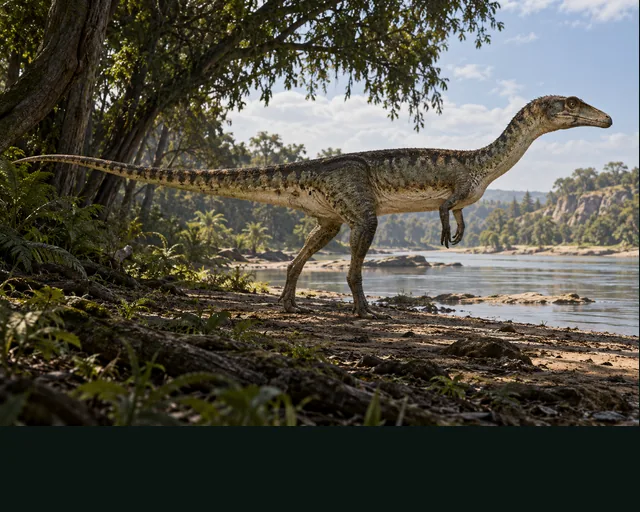
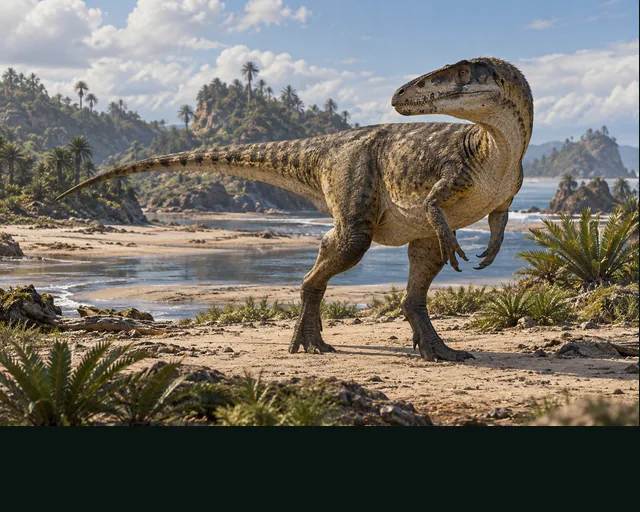
The skull was fairly flat. The upper jaw bone held 14 teeth on each side, judging from the sockets, and there was a distinctive rounded horn above the eye on the lacrimal bone. The neck was flexible and S-shaped, and probably had well-developed muscles. Newer specimens show a slightly larger nostril than was first reconstructed, and hind limbs that were a little shorter than those of the first skeleton.
A nearly complete foot found later was described as better suited to running than that of Allosaurus, though not as well suited as in abelisaurids such as Aucasaurus. That compares bone shapes only and does not give a speed.
Is Afrovenator a megalosaurid?
Most analyses say yes. Afrovenator belongs to Megalosauridae, a family that is the sister group of the spinosaurids, the group that includes Spinosaurus, within a wider group called Megalosauroidea. The family once contained many large, hard-to-classify theropods, but it has since been redefined. Analyses often group Afrovenator with Eustreptospondylus and Dubreuillosaurus, while for the classic member of the family see Megalosaurus.
There is disagreement on the details. Sereno first treated Afrovenator as an early spinosauroid outside both families, and a 2023 study of Irritator placed it in a megalosauroid group separate from Eustreptospondylus, Dubreuillosaurus and a few other genera, which that analysis placed closer to the spinosaurids. It is also described as the only definite Gondwanan megalosaur, although possible material has been reported from Uruguay and Tanzania.
Classification and fossil record
The Paleobiology Database taxonomic record catalogues Afrovenator under Eustreptospondylinae. This is the immediate parent in that catalogue, rather than a complete list of evolutionary relationships.
The corroborated occurrence sample includes Niger; those are modern discovery locations, not a complete ancient geographic range.
The sourced length estimate for Afrovenator is 6.8–9 metres. This is an estimate for the reconstructed animal, not a measurement shared by every individual. See the body-size discussion and linked evidence for context.
Research starting point
The catalogue links Afrovenator to Sereno and Wilson, 1994, published in Science. This identifies a research starting point; the catalogue’s citation alone does not verify every later reconstruction or species assignment.
For the meaning of taxonomic terms and how evidence is checked, see the glossary and editorial policy.
Quick answers
- Is Afrovenator a dinosaur?
- Yes. Afrovenator was a meat-eating theropod dinosaur in the megalosaurid family, known from a single relatively complete skeleton found in Niger.
- When did Afrovenator live?
- Probably in the Middle to Late Jurassic, around 167 to 161 million years ago. Early studies suggested Early Cretaceous, and some sources still list that, so the date is debated.
- How big was Afrovenator?
- Published estimates range from about 6.8 to 9 metres long, and about 790 kilograms to 1 tonne. They come from one skeleton, so they are uncertain.
- Is Afrovenator a megalosaurid?
- Most analyses place it in Megalosauridae, close to Eustreptospondylus and Dubreuillosaurus, though some studies give it a different position among Megalosauroidea.
- Where was Afrovenator found?
- In the Tiourarén Formation of the Agadez region of Niger, in the Sahara. The first skeleton was found in 1993 and described in 1994.