Jurassic Dinos editorial · Updated · Source-based review
What is Eustreptospondylus?
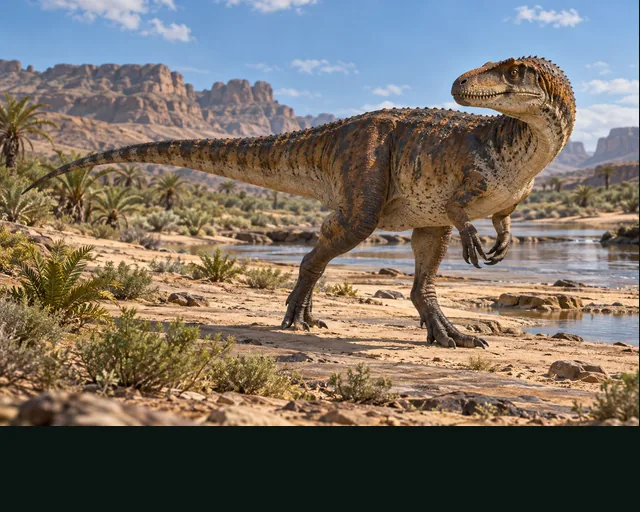
Eustreptospondylus was a Jurassic megalosaurid theropod from southern England.
Distinctive features and evidence
Its fossils belong to a time when European geography included island environments. A modern British location should therefore be kept distinct from the animal’s ancient landmass and habitat.
Genus overview and research references.
Eustreptospondylus fossil discoveries
The story begins in 1870, when quarry workers digging clay at Summertown, just north of Oxford, uncovered a large theropod skeleton. A local bookseller, James Parker, obtained it and showed it to Oxford professor John Phillips, who described it in 1871 but gave it no name. At the time it was the most complete skeleton of a large meat-eating dinosaur found anywhere, and it is still described as the most complete large Jurassic theropod from Europe.
The specimen, OUM J13558, came from a marine layer of the Oxford Clay Formation. It includes much of the skeleton, though the skull lacks several bones and the lower arms and end of the tail are missing. It is a subadult, not fully grown. The only other specimen ever linked to the genus is a left hip bone. Oxford University bought the skeleton in 1890, and it was put on display in 1924 in a fairly upright pose, which was later changed to a horizontal one.
Why did Eustreptospondylus take so long to get a name?
After Phillips, scientists kept filing the skeleton under other names. Arthur Smith Woodward referred it to Megalosaurus in 1890. In 1905 and 1906 Franz Nopcsa assigned it to Streptospondylus cuvieri, a species based on a lost vertebra, which was a troublesome choice for such a complete fossil.
In 1964, Alick Walker finally created a separate genus, Eustreptospondylus oxoniensis, meaning roughly “true Streptospondylus” from Oxford. The name is still debated. Oliver Rauhut found only minor hip differences from Magnosaurus in 2000 and suggested in 2003 that they could be one genus, while Gregory Paul in 2010 considered it the same as Streptospondylus altdorfensis. Many accounts still treat Eustreptospondylus as a valid genus.
How big was Eustreptospondylus?
Because the skeleton is subadult, sizes vary. Gregory Paul estimated in 1988 that it was about 4.6 metres long and 218 kilograms when it died, and a hypothetical adult might reach about 6 metres and half a tonne. The Natural History Museum gives about 7 metres.
The skull had a rather pointed snout, a big, horizontal nostril and no horn in front of the eye. Grooves in the jaw joint widened the mouth as the lower jaw opened. No teeth were preserved, but the tooth sockets show that one lower tooth, the third, was larger than its neighbours.
Could Eustreptospondylus swim?
The skeleton was found in a marine layer, and because Europe was then a chain of islands, some researchers have suggested that Eustreptospondylus could swim from island to island, as modern Komodo dragons can. Others disagree. They think its carcass was swept out to sea in a flood, or carried down a river after it died on land. The fossil alone cannot settle this.
It has also been described as an island dwarf. David Martill and Darren Naish argued in 2000 that this idea came from overlooking that the skeleton is a subadult. Scientists think it fed on smaller dinosaurs and pterosaurs and may have scavenged dead fish and marine reptiles, possibly foraging along shorelines. This is an inference from its group, not from direct evidence.
Is Eustreptospondylus a megalosaurid?
Yes. Walker placed it in the Megalosauridae in 1964, and today it is usually put in the subfamily Eustreptospondylinae within that family. Its relatives include Megalosaurus, the genus that Woodward once thought the skeleton belonged to.
It lived in the Callovian stage of the Middle Jurassic. The main skeleton is dated to about 162 million years ago, and the Natural History Museum gives about 165 million years ago, so the exact age depends on the source.
Classification and fossil record
The Paleobiology Database taxonomic record catalogues Eustreptospondylus under Eustreptospondylinae. This is the immediate parent in that catalogue, rather than a complete list of evolutionary relationships.
Research starting point
The catalogue links Eustreptospondylus to Walker, 1964, published in Philosophical Transactions of the Royal Society of London, Series B, Biological Sciences. This identifies a research starting point; the catalogue’s citation alone does not verify every later reconstruction or species assignment.
For the meaning of taxonomic terms and how evidence is checked, see the glossary and editorial policy.
Quick answers
- Is Eustreptospondylus a dinosaur?
- Yes. Eustreptospondylus was a large meat-eating theropod dinosaur, a member of the family Megalosauridae, found in southern England.
- What does Eustreptospondylus mean?
- It means "well-twisted vertebra", and was meant as a "true Streptospondylus". The name refers to the shape of its back vertebrae.
- How big was Eustreptospondylus?
- The known skeleton is a subadult of about 4.6 metres by one estimate. A full adult might reach about 6 metres, and the Natural History Museum gives 7 metres.
- When did Eustreptospondylus live?
- It lived in the Callovian stage of the Jurassic, roughly 162 to 165 million years ago depending on the source.
- Where was Eustreptospondylus found?
- In a brick pit at Summertown, just north of Oxford, England, in 1870. The rock layer formed on the sea floor.