Jurassic Dinos editorial · Updated · Source-based review
What is Elaphrosaurus?
Elaphrosaurus was a lightly built Late Jurassic Tanzanian theropod generally placed among ceratosaurs.
Distinctive features and evidence
Its unusually shallow body and limb proportions have complicated comparisons. Earlier coelophysoid interpretations have been challenged; comparisons with Limusaurus reflect more recent relationship hypotheses.
Genus overview and research references.
Elaphrosaurus fossil discovery
The type specimen of Elaphrosaurus was collected in 1910 at Tendaguru in what is now Tanzania, by a German expedition team that included Werner Janensch, who described and named the genus in 1920. The bones came from grey, green and red marls of the Middle Dinosaur Member of the Tendaguru Formation, laid down in the Kimmeridgian stage of the Late Jurassic, about 157 to 152 million years ago according to one summary. They are kept at the Natural History Museum in Berlin.
The skeleton includes 18 vertebrae in front of the hips, five hip (sacral) vertebrae, 20 tail vertebrae, the pelvis, a nearly complete left hind leg and some hand and arm bones. No skull has been found. The species name bambergi honours the industrialist Paul Bamberg, who funded the Tendaguru expeditions.
What did Elaphrosaurus look like?
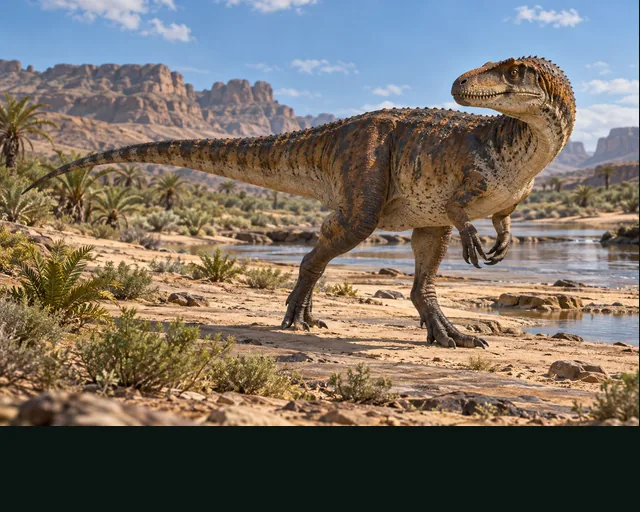
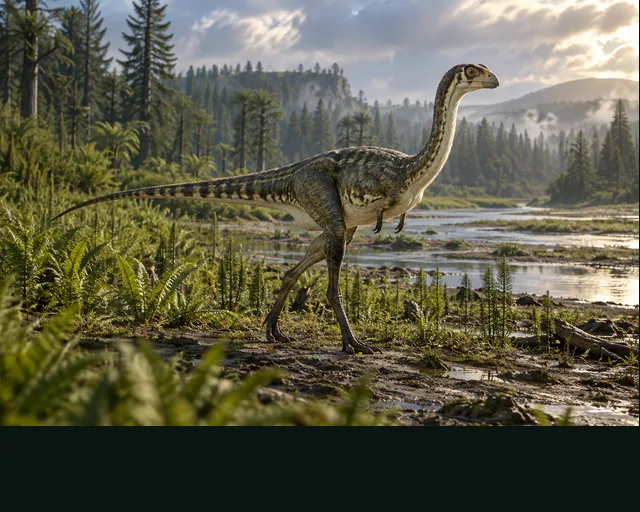
Elaphrosaurus was slender, with a long neck and tail and a body that was long for a theropod but unusually shallow from back to belly. Gregory S. Paul noted in 1988 that it was the longest-bodied and shallowest-chested theropod he had examined. Its hind legs were short for the length of its body, but the shin bone was longer than the thigh bone and the foot bones were long, proportions that can indicate a runner.
The tail ended in a rare downward bend. Its neck bones were thin and lacked certain projections for muscle attachment, which suggests the neck was stiffer than in other theropods and may have carried only a fairly small head. The animal is estimated at roughly 6 metres long and about 1.5 metres tall at the hip.
Is Elaphrosaurus a ceratosaur?
Yes, it is now placed among the ceratosaurs, the group that also includes Ceratosaurus. This took decades to settle. Janensch thought it was a coelurosaur, Franz Nopcsa linked it to the ostrich-like Ornithomimus family in 1928, and in 1988 Paul compared its limbs with those of Coelophysis. Later analyses put it in Ceratosauria, and a 2016 re-study by Rauhut and Carrano concluded it was an early noasaurid, naming the group Elaphrosaurinae.
It is considered a close relative of the beaked Limusaurus from China, which is the reason for the diet debate below.
What did Elaphrosaurus eat?
This is unsettled. The Natural History Museum lists it as a meat-eater, and Paul argued that it was too small to attack the big sauropods and stegosaurs of Tendaguru but could have chased small, fast plant-eaters. Newer studies instead suggest a plant-eating or mixed diet. The reasons are its close kinship with Limusaurus, which may have been herbivorous or omnivorous, and its stiff neck, which does not fit a predator of large prey. Because the skull is missing, the question cannot be tested directly.
Species once assigned to Elaphrosaurus
Several fossils were given the name Elaphrosaurus in the past and later removed. An Early Cretaceous species from North Africa was based on material from three localities that probably does not belong together. A Niger species became Spinostropheus. A Colorado specimen was reassigned to a different theropod, Tanycolagreus, in 2005. Footprints from Niger and from Beit Zayit were attributed to Elaphrosaurus, though that link is considered inconclusive. The Tendaguru skeleton is therefore the only secure basis for the genus.
Classification and fossil record
The Paleobiology Database taxonomic record catalogues Elaphrosaurus under Elaphrosaurinae. This is the immediate parent in that catalogue, rather than a complete list of evolutionary relationships.
The corroborated occurrence sample includes Tanzania, Morocco; those are modern discovery locations, not a complete ancient geographic range.
The sourced length estimate for Elaphrosaurus is about 6.2 metres. This is an estimate for the reconstructed animal, not a measurement shared by every individual. See the body-size discussion and linked evidence for context.
Research starting point
The catalogue links Elaphrosaurus to Janensch, 1920, published in Sitzungsberichte der Gesellschaft Naturforschender Freunde zu Berlin. This identifies a research starting point; the catalogue’s citation alone does not verify every later reconstruction or species assignment.
For the meaning of taxonomic terms and how evidence is checked, see the glossary and editorial policy.
Quick answers
- Is Elaphrosaurus a dinosaur?
- Yes. Elaphrosaurus was a lightly built theropod dinosaur from the Late Jurassic of Tanzania, usually placed among the ceratosaurs.
- How big was Elaphrosaurus?
- It was about 6 metres long, around 1.5 metres tall at the hip, and slender for its length. The figure comes from a single partial skeleton without a skull.
- Where was Elaphrosaurus found?
- Its type skeleton was dug up in 1910 at Tendaguru in Tanzania, in the Tendaguru Formation. Other fossils once named Elaphrosaurus from Africa and North America have been reassigned.
- What did Elaphrosaurus eat?
- Nobody knows for certain. Older work suggested it hunted small prey, but newer studies point to a plant-eating or omnivorous diet because of its stiff neck and its relationship to Limusaurus.