Jurassic Dinos editorial · Updated · Source-based review
What is Limusaurus?
Limusaurus was a small Late Jurassic Chinese theropod from the Shishugou Formation.
Distinctive features and evidence
Its slender body and reduced forelimbs distinguish it from many familiar predators. The name refers to the proposed circumstances of burial, but a naming story does not establish a universal behavior for the living population.
Genus overview and research references.
Limusaurus fossil discoveries at Wucaiwan
Limusaurus comes from Wucaiwan, a fossil site in the Junggar Basin of Xinjiang, northwestern China, in rock called the Shishugou Formation. A Chinese-American team found three bone beds there between 2001 and 2006, packed with small theropod skeletons, and most of them belonged to one small animal. Xu Xing and colleagues described it in 2009 from two skeletons: a subadult that is nearly complete, and a larger adult that lacks its skull. In 2017 Wang Shuo and colleagues added seventeen more individuals, ranging from juveniles to a single adult, from the same blocks.
This large growth series revealed an early mix-up. The toothed young and the toothless adults had at first been studied as if they were two different dinosaurs, until researchers realised they were the same animal at different ages.
Why is Limusaurus called the mud lizard?
The skeletons lay in narrow pits of soft mud, each about 2 metres across and 1 to 2 metres deep. The describers took the animals to have died after becoming stuck, hence “mud lizard” and a species name meaning “impossible to extricate”. The pits are thought to be giant footprints, probably made by a sauropod such as Mamenchisaurus found in the same formation, which loosened the wet ground. A 2010 study concluded that the bodies built up over an extended period, though probably within a single year, rather than in one catastrophe.
How did Limusaurus change as it grew?
Young Limusaurus had teeth, at least 42 of them in the youngest specimens. The teeth were lost gradually, and in animals older than about a year all had gone, replaced by a beak. Researchers describe this as the most extreme change of tooth form with age yet recorded in a dinosaur. Bone growth rings suggest the animal grew fast and reached skeletal maturity at about six years old.
How big was Limusaurus and what did it eat?
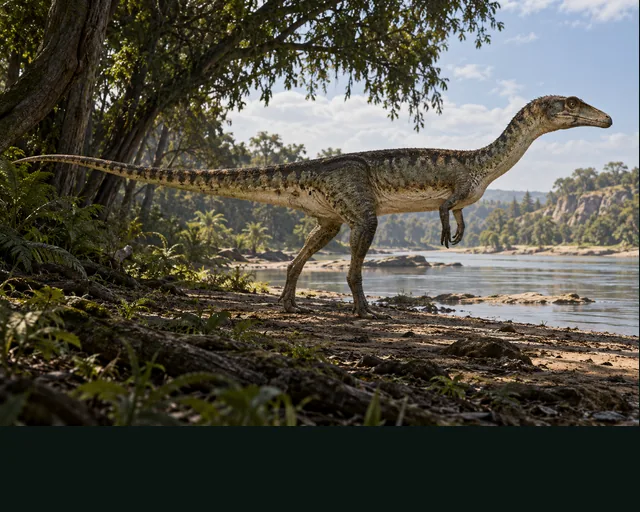
The subadult type specimen was about 1.7 metres long and is estimated at 15 kilograms, and one adult may have been about 15 percent larger. It had a small head, a long neck, long legs built for running and tiny arms with only three fingers. These features resemble those of the ornithomimids, a group of theropods from the later Cretaceous, which is an example of convergent evolution. There is no direct evidence of feathers, although it is sometimes drawn with them.
Adults carried gastroliths, stomach stones used by many plant-eating animals, and their chemistry matches that of other herbivores. The young varied more, so they were probably omnivores that later switched to plants.
Is Limusaurus a ceratosaur?
Yes. Limusaurus was the first ceratosaur found in Asia, and most analyses place it in the family Noasauridae, small, light ceratosaurs, with Elaphrosaurus as its closest relative. Its reduced hand has also been argued over: Xu and colleagues used the missing first finger to support the idea that bird-line theropods lost their outer fingers on both sides, but other researchers think ceratosaurs lost fingers independently, so its relevance to bird hands remains contested.
Where and when Limusaurus lived
Limusaurus lived in the Oxfordian age of the Late Jurassic, about 161 to 157 million years ago. The area was relatively warm and dry, with strongly seasonal, monsoon-driven rainfall, and it supported forests of araucaria trees with ferns beneath. Its neighbours included the theropod Guanlong, the sauropod Mamenchisaurus and the ornithischian Yinlong. Since many Limusaurus were found together, some researchers think they lived in groups, but the bone beds alone cannot show social behaviour.
Classification and fossil record
The Paleobiology Database taxonomic record catalogues Limusaurus under Elaphrosaurinae. This is the immediate parent in that catalogue, rather than a complete list of evolutionary relationships.
The corroborated occurrence sample includes China; those are modern discovery locations, not a complete ancient geographic range.
Research starting point
The catalogue links Limusaurus to Xu and Clark, 2009, published in Nature. This identifies a research starting point; the catalogue’s citation alone does not verify every later reconstruction or species assignment.
For the meaning of taxonomic terms and how evidence is checked, see the glossary and editorial policy.
Quick answers
- Is Limusaurus a dinosaur?
- Yes. Limusaurus was a small ceratosaur, a type of theropod dinosaur, from the Late Jurassic of Xinjiang in northwestern China.
- When did Limusaurus live?
- Limusaurus lived in the Oxfordian age of the Late Jurassic, roughly 161 to 157 million years ago, based on the dating of the Shishugou Formation.
- How big was Limusaurus?
- The best skeleton was about 1.7 metres long and is estimated to have weighed about 15 kilograms, and one adult specimen may have been about 15 percent larger.
- Did Limusaurus have teeth?
- Only when young. Juveniles had many teeth, but they were gradually lost and replaced by a beak, so adults older than about a year were toothless.
- What did Limusaurus eat?
- Adults appear to have eaten plants, based on their toothless beaks, stomach stones and chemistry, while juveniles were probably omnivores that ate both animals and plants.