Jurassic Dinos editorial · Updated · Source-based review
What is Guanlong?
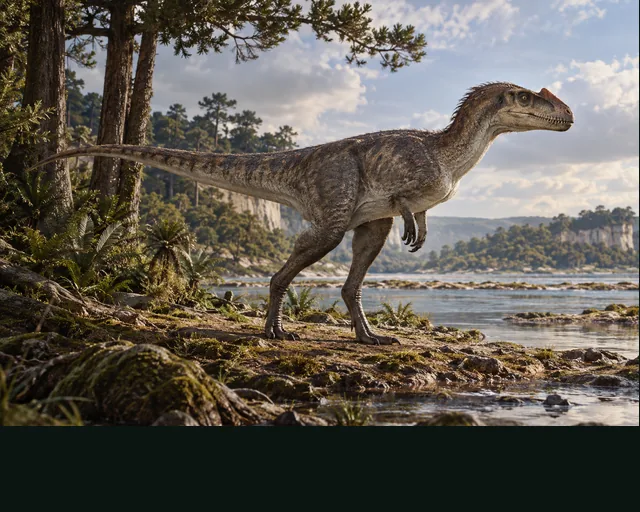
Guanlong was a crested Late Jurassic Chinese tyrannosauroid from the Shishugou Formation.
Distinctive features and evidence
A partially preserved adult and a more complete juvenile support comparisons of growth and anatomy. Its early place in the tyrannosaur story helps explain why the lineage cannot be represented solely by giant, deep-skulled T. rex.
Genus overview and research references.
Guanlong fossil discoveries
The fossils came from the Dzungaria area of China, collected by a team that combined a Chinese palaeontology institute with George Washington University in the United States. Xu Xing and colleagues named it in 2006. The species name, wucaii, means “multicoloured” and refers to the Wucaiwan badlands, whose rocks are banded in many colours.
Two individuals are known. They were found one on top of the other, together with three other theropods, in the Shishugou Formation. The upper one is the holotype, a fairly complete adult that was only partly articulated. Below it was a nearly complete and fully articulated young animal. Scientists think the juvenile was trampled by the adult after both had died, which is an interpretation of how the bones lay.
What was the crest of Guanlong for?
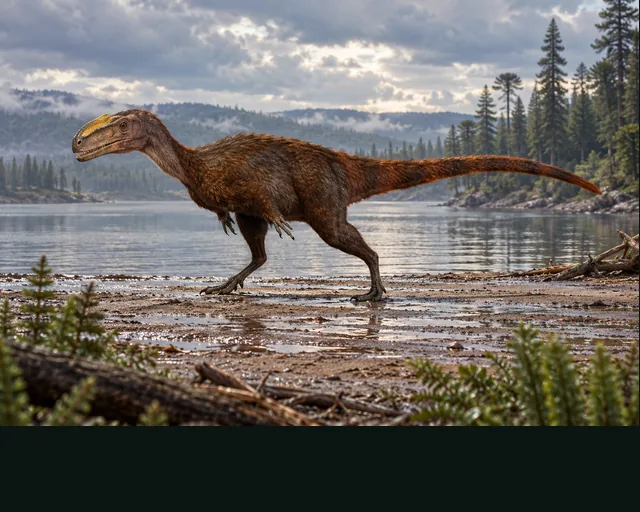
The crest on the skull gave Guanlong its name. It was thin and delicate and filled with air spaces, a bit like the crests of Dilophosaurus and Monolophosaurus but more fragile, proportionally larger and more elaborate. Because it was so fragile, researchers think it was a display structure, possibly used in mating, rather than a weapon or a tool.
The two skeletons show how the crest changed with age. In the juvenile it was small and confined to the front of the snout, while the adult carried a larger crest over much more of the skull. This is a good reminder that some features seen in adult dinosaurs developed only as the animals grew up.
How big was Guanlong and how fast did it grow?
Guanlong was a small theropod of about 3 to 3.5 metres in length. One published estimate gives a body mass of around 125 kilograms, but that is a single estimate. Bone histology, the study of growth rings in thin slices of bone, suggests that the adult was 12 years old at death and had reached maturity at 7, while the younger animal was only 6 when it died and had not finished growing.
Compared with the adult, the juvenile had a shorter snout, a bigger eye socket, a proportionally larger hand and a longer lower leg. Each hand bore three long fingers, whereas later tyrannosaurs are known for much shorter, two-fingered arms. Because its close relative Dilong preserves primitive feathers, Guanlong may also have had a coat of simple feathers, but none is known from the fossils.
Is Guanlong a tyrannosaur?
Guanlong is usually placed in Tyrannosauroidea, the wider tyrannosaur group, in a family called Proceratosauridae with Proceratosaurus, Kileskus and others. The exact membership of the family has changed between studies, and a 2024 analysis even recovered proceratosaurids and Dilong outside Tyrannosauroidea. The Natural History Museum calls it the earliest known tyrannosauroid, and it lived roughly 90 million years before Tyrannosaurus. The two share the same family tree, but Guanlong looked very different, being small, long-handed and crested rather than massive and deep-skulled.
Its age is given in different ways. The fossils are Oxfordian, in the Late Jurassic, and sources range from about 161 to 154 million years ago, so a single exact date is not claimed here.
Classification and fossil record
The Paleobiology Database taxonomic record catalogues Guanlong under Proceratosauridae. This is the immediate parent in that catalogue, rather than a complete list of evolutionary relationships.
The corroborated occurrence sample includes China; those are modern discovery locations, not a complete ancient geographic range.
The sourced length estimate for Guanlong is 3–3.5 metres. This is an estimate for the reconstructed animal, not a measurement shared by every individual. See the body-size discussion and linked evidence for context.
Research starting point
The catalogue links Guanlong to Xu and Clark, 2006, published in Nature. This identifies a research starting point; the catalogue’s citation alone does not verify every later reconstruction or species assignment.
For the meaning of taxonomic terms and how evidence is checked, see the glossary and editorial policy.
Quick answers
- Is Guanlong a dinosaur?
- Yes. Guanlong was a small theropod dinosaur from the Late Jurassic of China, usually classed as an early member of the tyrannosaur lineage.
- Is Guanlong a tyrannosaur?
- Usually yes, as an early tyrannosauroid in the family Proceratosauridae, though a 2024 analysis placed proceratosaurids outside Tyrannosauroidea. Placement is still debated.
- How big was Guanlong?
- About 3 to 3.5 metres long. One estimate suggests around 125 kilograms for the adult, but that is only a published estimate.
- What was the crest on Guanlong for?
- It was thin, fragile and air-filled, so scientists think it was for display, possibly in mating. Its exact use cannot be tested directly.
- When did Guanlong live?
- In the Oxfordian stage of the Late Jurassic, roughly 161 to 155 million years ago, in what is now China.