Jurassic Dinos editorial · Updated · Source-based review
What is Proceratosaurus?
Proceratosaurus was a Middle Jurassic English theropod known from a mostly complete skull and lower jaw.
Distinctive features and evidence
The original comparison with Ceratosaurus was based on an apparent crest resemblance and later rejected. A familiar name can preserve an obsolete relationship hypothesis, so identification should follow the anatomy rather than the name.
Genus overview and research references.
Proceratosaurus fossil discoveries
Proceratosaurus is known from a single skull, with its lower jaw and one tongue bone. F. Lewis Bradley found it during work on a reservoir near Minchinhampton in Gloucestershire, England. Arthur Smith Woodward described it in 1910 as a species of Megalosaurus, naming it M. bradleyi after the finder. At that time Megalosaurus was used as a catch-all name for many theropod fragments.
It has been in the Natural History Museum in London since 1942. Friedrich von Huene gave it a genus of its own in 1923 and made the name valid in 1926, because he thought the low crest on the snout was the base of a horn like that of Ceratosaurus. That relationship turned out to be wrong. In 2010 a team led by Oliver Rauhut cleaned the skull further and CT scanned it, revealing much more detail.
What does the Proceratosaurus skull show?
The preserved skull is 26.9 centimetres long and rather low and long, more than three times as long as it is high. The upper part is missing, so the crest along the snout is incomplete. The teeth varied in shape from front to back: those at the front of the upper jaw were D-shaped in cross-section, while the others were flattened and serrated like blades. Oddly for a theropod, the lower jaw is a little shorter than the skull.
It is one of the best-preserved Middle Jurassic theropod skulls in the world, but there is no neck, body, arm or leg, so everything about the rest of the animal is inferred from relatives.
Is Proceratosaurus a tyrannosaur?
It is a tyrannosauroid, an early member of the line that led to Tyrannosaurus, but it was not itself a tyrannosaurid. Rauhut and colleagues showed in 2010 that its closest relative is Guanlong from China, and named the family Proceratosauridae for the two. With Kileskus from Siberia, Proceratosaurus is the oldest known tyrannosauroid, which suggests that the first coelurosaurs were already diversifying in the early Middle Jurassic.
Before 2010 it had been called a Megalosaurus, a ceratosaur relative and a primitive allosauroid.
How big was Proceratosaurus?
It was small to medium in size. The 2010 redescription estimated about 3 metres for the type individual, which was probably at least a subadult, and a mass of 28 to 36 kilograms. Other sources give 3 to 4 metres and 50 to 100 kilograms, and the Natural History Museum lists 4.1 metres.
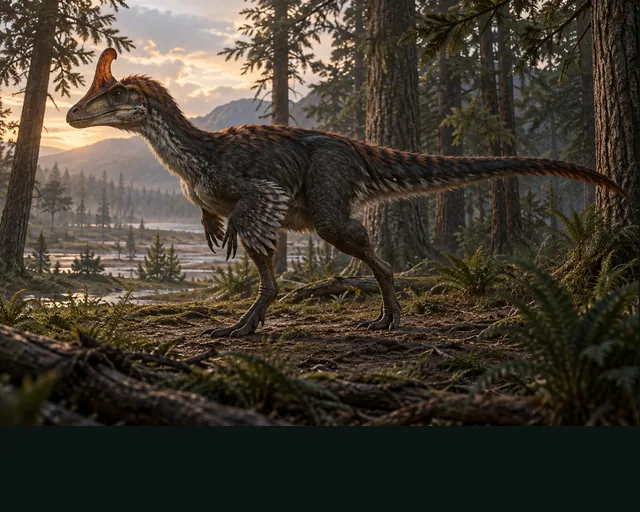
Relatives such as Yutyrannus and Dilong were covered in simple, down-like feathers, and a palaeontologist has said it is reasonable to infer the same for all tyrannosauroids. No feathers are known from Proceratosaurus itself.
What did Proceratosaurus eat?
It is thought to have been a meat eater, and a 2023 computer study suggested it ate small animals. Researchers combined the Proceratosaurus and Guanlong skulls into a virtual model and estimated a bite force of about 390 newtons, far lower than that of adult tyrannosaurids. Some teeth on the lower jaw show damage that probably came from feeding.
The crest was probably used for display. Unlike later tyrannosaurids, relatives such as Guanlong had large arms, so Proceratosaurus may have grabbed prey with its hands, but that is an inference, since no arm bones of Proceratosaurus have been found.
Where and when Proceratosaurus lived
Proceratosaurus lived in the Bathonian age of the Middle Jurassic, about 168 to 165 million years ago according to the Paleobiology Database. Britain then formed part of a subtropical archipelago of islands separated by shallow seas, with a seasonally dry climate. The skull was found in limestone that formed in a very shallow sea. Other British dinosaurs of this age include the large theropod Megalosaurus and the sauropod Cetiosaurus.
Classification and fossil record
The Paleobiology Database taxonomic record catalogues Proceratosaurus under Proceratosauridae. This is the immediate parent in that catalogue, rather than a complete list of evolutionary relationships.
Discovery and naming history
The skull was initially described in 1910 as a species of Megalosaurus. Its later name reflected a proposed resemblance to Ceratosaurus, but subsequent research placed it among early tyrannosauroids instead. Historical overview.
The sourced length estimate for Proceratosaurus is 3–4.1 metres. This is an estimate for the reconstructed animal, not a measurement shared by every individual. See the body-size discussion and linked evidence for context.
Research starting point
The catalogue links Proceratosaurus to Huene, 1926, published in Annals and Magazine of Natural History, series 9. This identifies a research starting point; the catalogue’s citation alone does not verify every later reconstruction or species assignment.
For the meaning of taxonomic terms and how evidence is checked, see the glossary and editorial policy.
Quick answers
- Is Proceratosaurus a dinosaur?
- Yes. Proceratosaurus was a small meat-eating theropod dinosaur from the Middle Jurassic of England, and an early member of the tyrannosauroid line.
- When did Proceratosaurus live?
- In the Bathonian age of the Middle Jurassic, roughly 168 to 165 million years ago, according to the Paleobiology Database.
- How big was Proceratosaurus?
- About 3 to 4 metres long, based on scaling from a single skull. A 2010 estimate gave about 3 metres and 28 to 36 kilograms for the type animal.
- Is Proceratosaurus related to Tyrannosaurus?
- Yes, but distantly. It is an early tyrannosauroid, closest to Guanlong, and not a tyrannosaurid like Tyrannosaurus.
- What was found of Proceratosaurus?
- Only one specimen: a mostly complete skull, lower jaw and tongue bone, found near Minchinhampton, England. No bones from the body are known.