Jurassic Dinos editorial · Updated · Source-based review
What is Dilong?
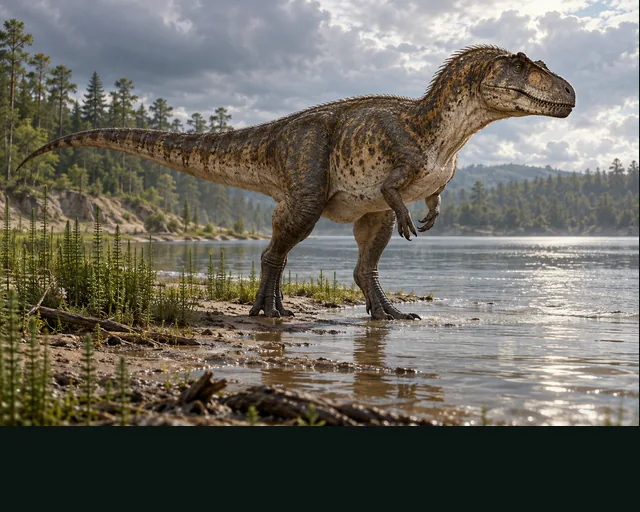
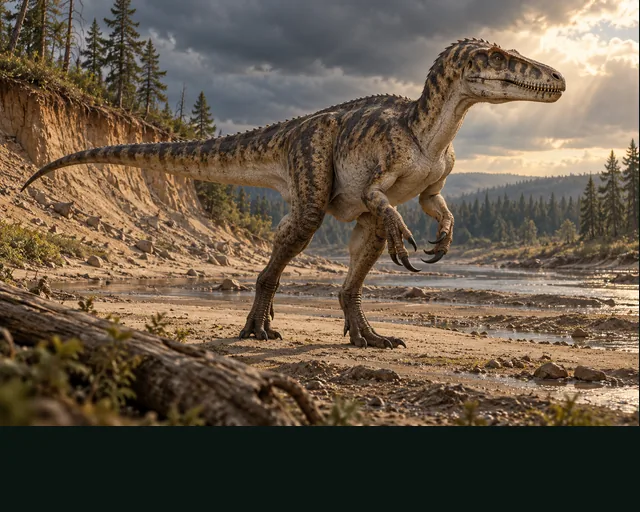
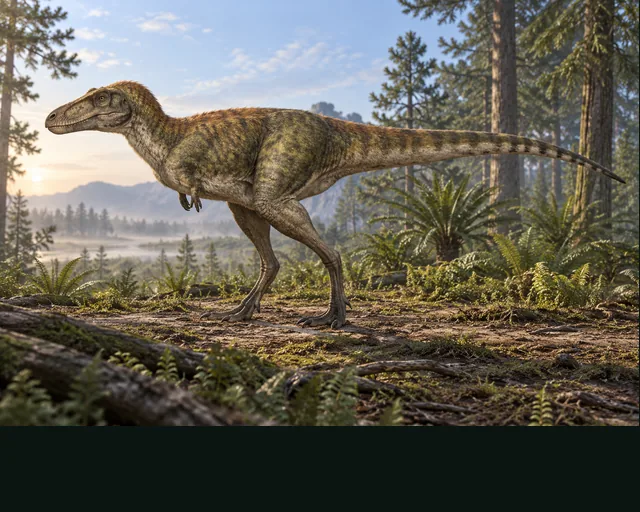
Dilong was a small Early Cretaceous Chinese tyrannosauroid with directly preserved feather-like covering.
Distinctive features and evidence
Its Yixian fossils supplied important evidence about integument early in tyrannosaur evolution. They do not establish the exact feather coverage of every later giant tyrannosaur.
Genus overview and research references.
Dilong fossil discoveries
The type specimen of Dilong paradoxus, catalogued IVPP 14243 at the Institute of Vertebrate Paleontology and Paleoanthropology in Beijing, is a nearly complete skeleton with a skull, preserved in a semi-articulated state. It came from the Lujiatun Unit of the Yixian Formation near Beipiao in western Liaoning Province, China. Xu Xing and colleagues described it in 2004.
A few more skulls and partial skulls have been assigned to the genus. One of these, IVPP V11579, may belong to Dilong or to a close relative.
Did Dilong have feathers?
Yes, in a simple form. Skin impressions near the jaw and the tail show a covering of simple feathers, sometimes called protofeathers. They lacked the central shaft of modern bird feathers and could not have allowed flight, and scientists think they were most likely used for warmth. The find was described as the first direct evidence of feathers in a tyrannosaur.
This does not mean that all tyrannosaurs were fully feathered. Adult tyrannosaurs from Alberta and Mongolia have skin impressions that appear to show pebbly scales. Xu and colleagues suggested that different body parts may have carried different coverings, and that feathers might have become less common as animals grew bigger, but this is a hypothesis and not a proven pattern.
How big was Dilong?
Dilong was small. The type specimen was about 1.6 metres long, but it is thought to be a young animal, and a full-grown one may have exceeded 2 metres. The palaeontologist Gregory Paul estimated that an individual about 1.3 metres long would have weighed around 6 kilograms. These are single published estimates from a small number of specimens, so treat them as rough.
This size is tiny next to Tyrannosaurus, but the name makes the connection: the “emperor” in Dilong refers to its relationship with the “king” of the tyrannosaurids.
Is Dilong a tyrannosaur?
When it was first described, Dilong was seen as one of the oldest and least advanced tyrannosauroids, the wider group that later included giants such as the tyrannosaurids. Not all studies agree. One 2007 analysis found it was not a tyrannosauroid at all and placed it among more distant coelurosaurs, and a 2014 study grouped it with the proceratosaurids such as Guanlong. Later analyses, including one in 2016, kept it as a slightly more advanced tyrannosauroid outside that family, while the team that described Alpkarakush in 2024 placed Dilong and the proceratosaurids outside Tyrannosauroidea.
In short, Dilong is usually treated as an early tyrannosauroid, but its exact place on the family tree is still debated.
What do scans reveal about Dilong?
Braincase scans show an S-shaped brain with thin protective membranes, unlike the straighter brain of Tyrannosaurus, which is probably linked to body size. A large flocculus, a brain region tied to balance, suggests it was agile, and small olfactory tracts suggest a less refined sense of smell than in more advanced tyrannosauroids.
A 2023 study estimated its bite force at about 337 newtons, in a study that compared early tyrannosauroids with their later, more advanced relatives.
Classification and fossil record
The Paleobiology Database taxonomic record catalogues Dilong under Tyrannosauroidea. This is the immediate parent in that catalogue, rather than a complete list of evolutionary relationships.
The corroborated occurrence sample includes China; those are modern discovery locations, not a complete ancient geographic range.
Research starting point
The catalogue links Dilong to Xu and Norell, 2004, published in Nature. This identifies a research starting point; the catalogue’s citation alone does not verify every later reconstruction or species assignment.
For the meaning of taxonomic terms and how evidence is checked, see the glossary and editorial policy.
Quick answers
- Is Dilong a dinosaur?
- Yes. Dilong was a small theropod dinosaur, usually classed as an early tyrannosauroid, from the Early Cretaceous Yixian Formation of China.
- Did Dilong have feathers?
- Yes. Skin impressions near the jaw and tail show simple, protofeather-like filaments, which were probably used for warmth rather than flight.
- How big was Dilong?
- The type specimen was about 1.6 metres long and probably still young, so an adult may have been over 2 metres. One estimate gives about 6 kilograms for a 1.3-metre animal.
- Is Dilong a tyrannosaur?
- Most studies place Dilong as an early member of the tyrannosaur superfamily Tyrannosauroidea, but some analyses put it outside that group, so its exact position is debated.
- Where was Dilong found?
- The type skeleton came from the Lujiatun Unit of the Yixian Formation, close to Beipiao in western Liaoning Province, in northeastern China.