Jurassic Dinos editorial · Updated · Source-based review
What is Dryptosaurus?
Dryptosaurus was a Late Cretaceous eastern North American theropod known from fragmentary New Jersey remains.
Distinctive features and evidence
The original name Laelaps was replaced because it was already used for a mite. Its partial skeleton documents a predator in the eastern landmass, but does not justify a complete, precisely sized adult reconstruction.
Genus overview and research references.
Dryptosaurus fossil discoveries
Until 1866, large meat-eating dinosaurs in the United States were known only from isolated teeth. That summer, workers digging marl, a lime-rich clay used as fertiliser, for the West Jersey Marl Company near Barnsboro, New Jersey, found an associated skeleton. Edward Drinker Cope visited the pit in August and called it the finest discovery he had made so far.
The skeleton is held by the Academy of Natural Sciences in Philadelphia. It is incomplete: pieces of the skull and lower jaw, teeth, tail vertebrae, both upper arm bones, part of a hand, part of the pelvis and a nearly complete left hind leg. Several bones that Cope mentioned, including a shoulder blade and breastbone, have since been lost, and some vertebrae he assigned to it belong to a sea turtle. The surviving fossils have been damaged by pyrite disease, a chemical decay. Old plaster casts in London’s Natural History Museum preserve some detail that the originals no longer show.
Why was Dryptosaurus once called Laelaps?
Cope named the animal Laelaps aquilunguis in 1866, taking Laelaps from the Greek name for a mythical dog that always caught what it chased. In 1877 his rival Othniel Charles Marsh pointed out that Laelaps was already in use for a mite, so it could not be used again for a dinosaur. Marsh replaced it with Dryptosaurus, ‘tearing lizard’. Cope never accepted the change and went on using his own name.
In the late 1800s the genus also became a catch-all name, a ‘wastebasket’, for isolated theropod teeth and bones from across North America. Many of those were later reassigned or are now considered doubtful, which is why Dryptosaurus is now judged mainly by the one skeleton from New Jersey.
How big was Dryptosaurus?
Dryptosaurus is known from partial remains of one adult, so size is an estimate. One published account gives about 7.5 metres in length and 756 to 1,500 kilograms, while the Natural History Museum lists about 6.4 metres. The sources do not agree and neither is a measurement.
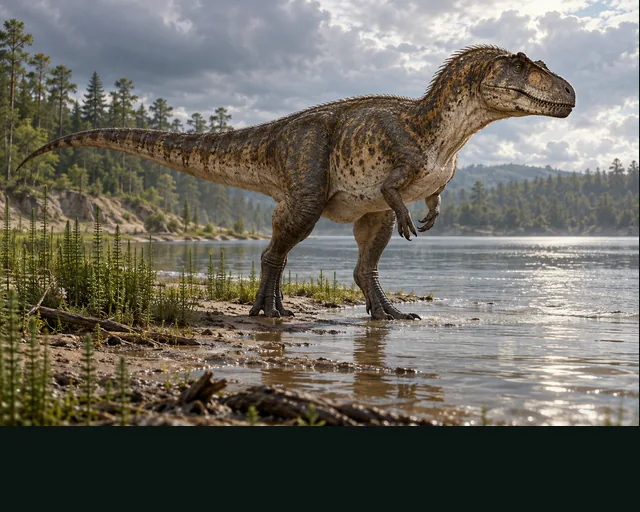
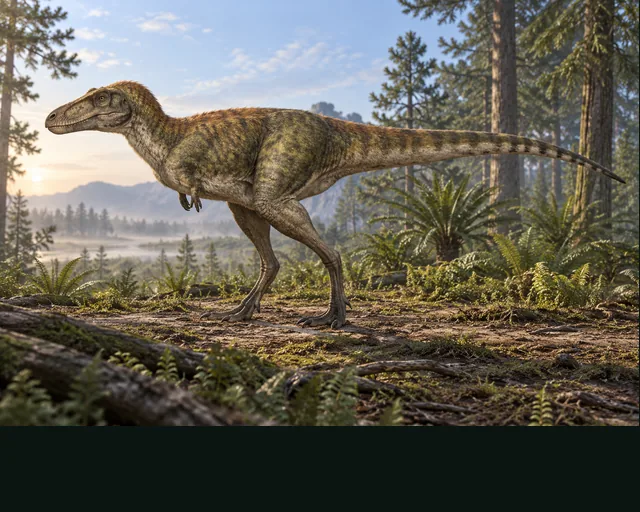
The skeleton shows a slender, long-legged tyrannosaur with a lightly built skull and sharp, blade-like, serrated teeth. Its most unusual feature is its arms. They were long compared with those of Tyrannosaurus, and the hand ended in big claws, the longest recovered bone from a claw being 176 millimetres. Scientists once thought that the hand had three fingers, but a 2011 study by Stephen Brusatte and colleagues suggested that only two may have been functional. Arm reduction in the tyrannosaur family may therefore not have happened evenly, and these arms might have been useful when catching or handling prey, although that is an interpretation.
Is Dryptosaurus a tyrannosaur?
Yes, in the broad sense. Dryptosaurus is a tyrannosauroid, a member of the larger group of tyrannosaur relatives. For a century its classification was uncertain, and it was placed with megalosaurids and other groups. The description of Appalachiosaurus in 2005, a better-known relative from the same part of North America, helped show that Dryptosaurus was an early tyrannosauroid, in a middle position between small early forms like Dilong and the giant tyrannosaurids such as Tyrannosaurus.
Details are still disputed. Many analyses place it near the base of the group called Eutyrannosauria, while some studies treat it as its own family, Dryptosauridae, or put it in Nanotyrannidae. Different analyses give different answers, and scientists say that more fossils are needed.
Where and when Dryptosaurus lived
The type skeleton comes from the New Egypt Formation, dated to the late Maastrichtian, about 67 to 66 million years ago. The Natural History Museum gives a wider range of 84 to 66 million years ago, although the museum does not explain the wider span, and the type material itself is the best-dated.
In the Late Cretaceous, North America was split by a seaway into a western landmass, Laramidia, and an eastern one, Appalachia. Dryptosaurus lived in the east, where dinosaur fossils are scarce. The New Egypt Formation was laid down in the sea, so the skeleton probably floated out from land before sinking. Most fossils there belong to marine animals such as mosasaurs, sharks and fish. Other dinosaurs recorded include a doubtful hadrosaurid and a possible lambeosaurine.
Cope thought that Dryptosaurus hunted hadrosaurs such as Hadrosaurus, but the two come from different rock units, so this was an idea rather than evidence. Its fame also comes from a 1897 painting by Charles R. Knight, Leaping Laelaps, which may be the earliest picture to show theropods as active, agile animals.
Classification and fossil record
The Paleobiology Database taxonomic record catalogues Dryptosaurus under Tyrannosauroidea. This is the immediate parent in that catalogue, rather than a complete list of evolutionary relationships.
The corroborated occurrence sample includes United States; those are modern discovery locations, not a complete ancient geographic range.
Research starting point
The catalogue links Dryptosaurus to Marsh, 1877, published in American Journal of Science and Arts. This identifies a research starting point; the catalogue’s citation alone does not verify every later reconstruction or species assignment.
For the meaning of taxonomic terms and how evidence is checked, see the glossary and editorial policy.
Quick answers
- Is Dryptosaurus a dinosaur?
- Yes. Dryptosaurus was a meat-eating theropod dinosaur, an early member of the tyrannosaur line, known from a fragmentary skeleton found in New Jersey.
- When did Dryptosaurus live?
- The type skeleton is from the late Maastrichtian, about 67 to 66 million years ago. The Natural History Museum gives a wider range of 84 to 66 million years ago.
- How big was Dryptosaurus?
- Estimates differ: about 7.5 metres long in one account and 6.4 metres in the Natural History Museum directory. Both come from partial remains of one individual.
- Is Dryptosaurus a tyrannosaur?
- It is a tyrannosauroid, an early relative of the giant tyrannosaurids. Its exact place is debated, and some studies give it a family of its own.
- Where was Dryptosaurus found?
- The skeleton was found in 1866 in a marl pit near Barnsboro, New Jersey, in the New Egypt Formation, and described by Edward Drinker Cope.