Jurassic Dinos editorial · Updated · Source-based review
What is Moros?
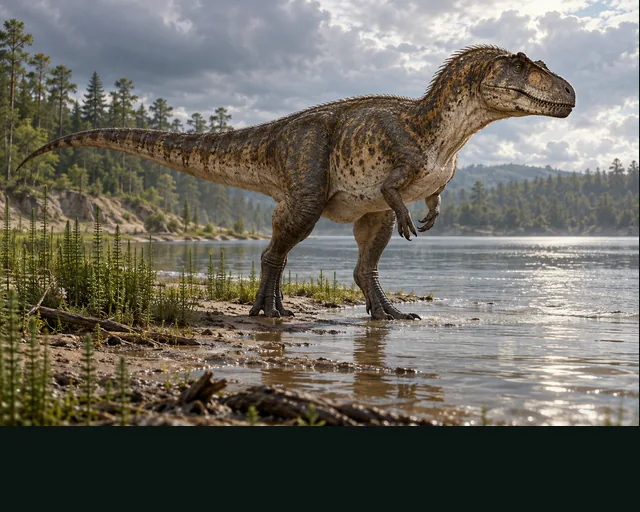
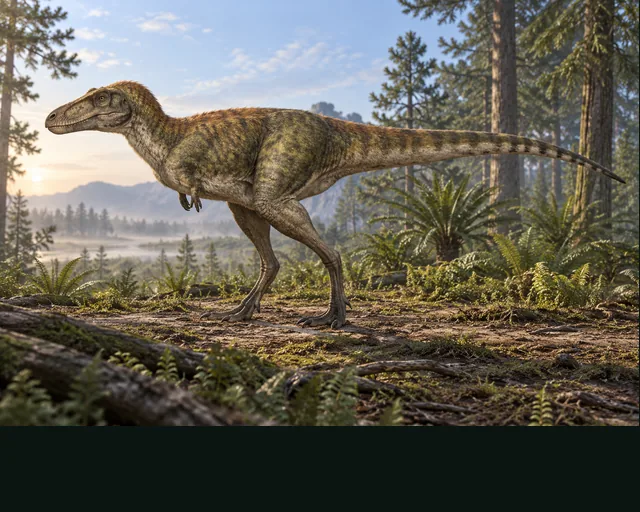
Moros was a small Late Cretaceous tyrannosauroid from Utah.
Distinctive features and evidence
Its material documents an earlier North American stage of tyrannosauroid diversity. A small member of the lineage is informative about evolution, but fragmentary remains cannot establish a precise running speed or full ecological routine.
Genus overview and research references.
Moros fossil discoveries
Moros is known from one partial leg. Researchers working in Emery County, Utah, had studied the area for about ten years when, in 2013, limb bones were noticed sticking out of a hillside at a site the team nicknamed “Stormy Theropod”. The bones belong to the right hind limb of a single animal and include parts of the thigh bone (femur), shin bone (tibia), two of the long foot bones (metatarsals) and some toe bones.
Lindsay Zanno, Ryan Tucker and colleagues named Moros intrepidus in a 2019 paper in the journal Communications Biology. The genus name comes from the Greek word for the personification of doom, chosen because the animal marks the arrival of a lineage that would later dominate North America. The species name, Latin for “intrepid”, refers to the idea that tyrannosauroids spread across the continent. Two isolated front teeth from nearby sites were identified as tyrannosauroid too, but the authors left them out of their evolutionary analysis of Moros itself.
How big was Moros?
Moros was small. The team estimated a limb about 1.2 metres long, a skull roughly 30 to 40 centimetres long and a body mass of about 78 kilograms, with a possible range of 53 to 85 kilograms. These are estimates scaled from the leg bones, because no skull or body bones were found.
Thin slices of the thigh bone show seven growth cycles, marked by lines where growth paused. The team concluded that the animal was about six to seven years old and nearly full grown, with a slow to moderate growth rate, so Moros would have stayed small as an adult. That makes it one of the smallest Cretaceous tyrannosauroids described, and a very different animal from the colossal later tyrannosaurs such as Tyrannosaurus.
Why is Moros called fleet-footed?
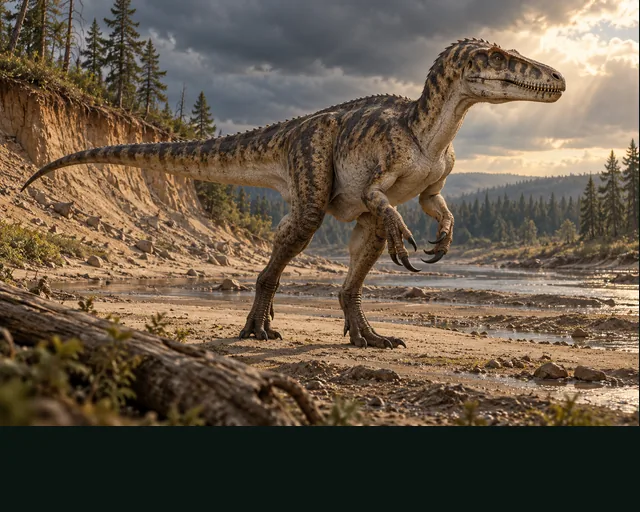
The leg is unusually slim. The tibia is longer than the femur, and the foot has a pinched, narrow shape called an arctometatarsalian foot, in which the middle foot bone is squeezed between its neighbours. The foot was most similar to that of the small tyrannosauroid Alectrosaurus and more slender than the feet of young individuals of larger relatives, closer to the proportions of ostrich-like ornithomimid dinosaurs. The authors read these features as adaptations for running. That describes leg proportions, not a measured speed.
Is Moros a tyrannosaur?
Moros is a tyrannosauroid, a member of the wider group that includes the true tyrannosaurs. In the 2019 analyses it sits after Dilong, a small early tyrannosauroid from China, and before the big Late Cretaceous North American species. It was recovered close to mid-Cretaceous Asian forms such as Xiongguanlong and Timurlengia, and in some analyses close to the eastern North American genera Appalachiosaurus and Dryptosaurus. The exact branching order changed depending on which data set was used.
The discovery matters because the North American record of tyrannosauroid skeletons had a gap of about 70 million years. Moros extends the definite record of the group on the continent back by around 15 million years, and its Asian relatives support the idea of animals crossing between the continents.
Where and when Moros lived
The leg came from the lower part of the Mussentuchit Member, a unit within the Cedar Mountain Formation of Utah. Tiny zircon crystals in the rock indicate that the layer is no older than about 96.4 million years, which falls in the Cenomanian stage, early in the Late Cretaceous. The sediments were laid down on a coastal mudflat with small channels and lakes. The same rock unit has produced the large meat-eating dinosaur Siats, and the authors argue that big allosaur-group predators still held the top-predator role while tyrannosauroids such as Moros hunted beneath them.
Classification and fossil record
The Paleobiology Database taxonomic record catalogues Moros under Tyrannosauroidea. This is the immediate parent in that catalogue, rather than a complete list of evolutionary relationships.
The corroborated occurrence sample includes United States; those are modern discovery locations, not a complete ancient geographic range.
Research starting point
The catalogue links Moros to Zanno and Tucker, 2019, published in Communications Biology. This identifies a research starting point; the catalogue’s citation alone does not verify every later reconstruction or species assignment.
For the meaning of taxonomic terms and how evidence is checked, see the glossary and editorial policy.
Quick answers
- Is Moros a dinosaur?
- Yes. Moros was a small theropod dinosaur belonging to Tyrannosauroidea, the group that later produced giants such as Tyrannosaurus.
- When did Moros live?
- Moros lived in the Cenomanian, early in the Late Cretaceous. The rock that held its leg bones is no older than about 96.4 million years.
- How big was Moros?
- The describing team estimated a body mass of about 78 kilograms and a leg about 1.2 metres long. These are estimates from one leg, and the individual was nearly full grown.
- Is Moros a tyrannosaur?
- Moros is a tyrannosauroid, an early relative of the true tyrannosaurs, but a far smaller and more lightly built one. Its exact position among early tyrannosauroids varies between analyses.
- What was found of Moros?
- A partial right hind limb from Utah: parts of the thigh bone, shin bone, two foot bones and toe bones. No skull has been found.