Jurassic Dinos editorial · Updated · Source-based review
What was Alectrosaurus?
Alectrosaurus was an Asian Cretaceous tyrannosauroid, a member of the wider lineage that includes Tyrannosaurus. Its original material is especially informative about the hindlimbs. It is also a case study in the problems caused when bones found near one another are assumed to belong together.
What makes the fossil distinctive?
The long-legged proportions differ from the most heavily built adult tyrannosaurids. They suggest a relatively lightly built animal, although an exact running speed cannot be read directly from a leg bone. Full-body and skull reconstructions depend more heavily on relatives than the preserved hindlimb does.
Where was it found and how was it named?
The principal specimens were collected during American Museum of Natural History expeditions in 1923 from the Iren Dabasu Formation of what is now Inner Mongolia, China. Charles Gilmore named Alectrosaurus olseni in 1933, honouring collector George Olsen. Some material originally associated with the genus was later reconsidered, illustrating why locality and association must be documented carefully.
What can we infer, and what remains uncertain?
The lesson is not that incomplete fossils are useless. Distinctive ankle, foot and leg features can still identify a meaningful taxon. However, combining unrelated bones can produce a misleading animal. Its exact relationships and the geological age of its deposits require attention to the particular study being used. Compare its evidence with the far more extensive skeletons available for some later tyrannosaurids.
Does “alone lizard” mean it hunted alone?
No. The scientific name is not behavioural evidence. Social behaviour would require independent observations, such as well-interpreted trackways or fossil associations.
How can you check the evidence?
The Paleobiology Database record catalogues Alectrosaurus under Tyrannosauroidea. Its linked bibliography identifies this research starting point: C. W. Gilmore. 1933. On the dinosaurian fauna of the Iren Dabasu Formation. Bulletin of the American Museum of Natural History 68(2-3):23-78. Open the bibliographic record. A catalogue entry establishes the source trail; it does not independently verify every later illustration or behavioural claim.
Use the dated genus overview to follow the references behind the discovery and anatomy discussed above. When sources disagree, compare which specimen and rock layer each author studied. A reconstructed whole animal can combine original bones with comparisons to relatives; those two kinds of evidence should not be confused. The account above explains the particular limits that matter for Alectrosaurus, rather than supplying unsupported size, speed or lifespan figures.
Read the image and keep exploring
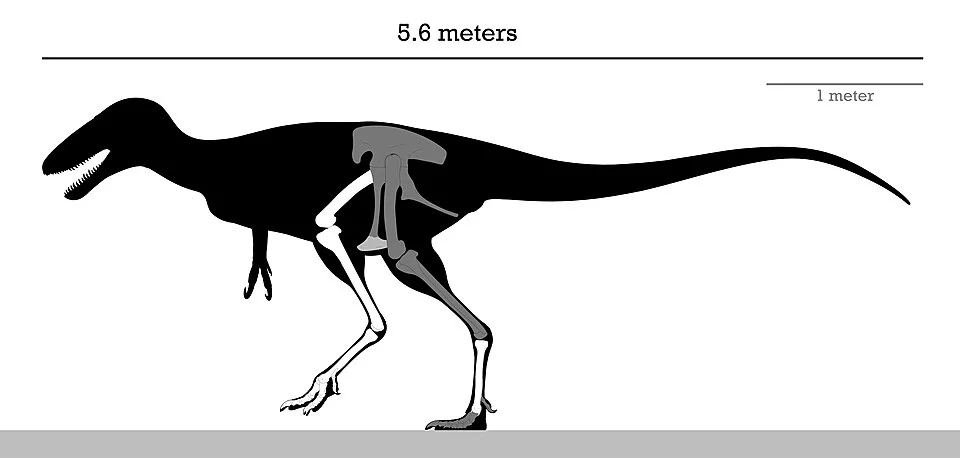
The Alectrosaurus diagram places known limb material within an estimated silhouette. The full outline and displayed length remain reconstruction choices. This diagram explains the stated evidence; schematic elements are not additional fossil observations.
Compare Alioramus, Tarbosaurus, Tyrannosaurus. Find more names in the A index and explore theropod field notes. The glossary explains unfamiliar fossil terms.
Quick answers
- Where have Alectrosaurus fossils been found?
- The discoveries discussed here come from China. Modern place names describe discovery locations, not a complete ancient geographic range.
- When did Alectrosaurus live?
- It is placed in the Cretaceous period. See the discovery discussion for qualifications about the particular rock layers and dating.
- Where can I compare Alectrosaurus with related dinosaurs?
- Follow the related field notes below. Comparisons explain shared anatomy; they do not imply that all the animals lived together.