Jurassic Dinos editorial · Updated · Source-based review
What is Alioramus?
Alioramus was a Late Cretaceous Mongolian tyrannosaurid represented by species from the Nemegt Formation.
Distinctive features and evidence
Its skull and more complete remains of Alioramus altai help document diversity within tyrannosaurs. Compare it with Qianzhousaurus to explore the long-snouted branch called Alioramini, rather than treating every tyrannosaur as a scaled-down T. rex.
Genus overview and research references.
Alioramus fossil discoveries
Two species are known, both from Mongolia’s Nemegt Formation. The type species, Alioramus remotus, is based on a partial skull about 45 centimetres long plus three foot bones, found in the early 1970s by a Soviet-Mongolian expedition at Nogon-Tsav and described by Sergei Kurzanov in 1976. The skull’s low shape and crests looked so unlike other tyrannosaurids that he thought its owner belonged to a distant branch, which is the origin of the name.
The second species, A. altai, was found in 2001 at Tsagan Khushu and named in 2009 by Stephen Brusatte and colleagues. It comes from a much more complete skeleton, including a very complete skull, hips and hindlimbs, and has told us most of what we know about the genus.
What did Alioramus look like?
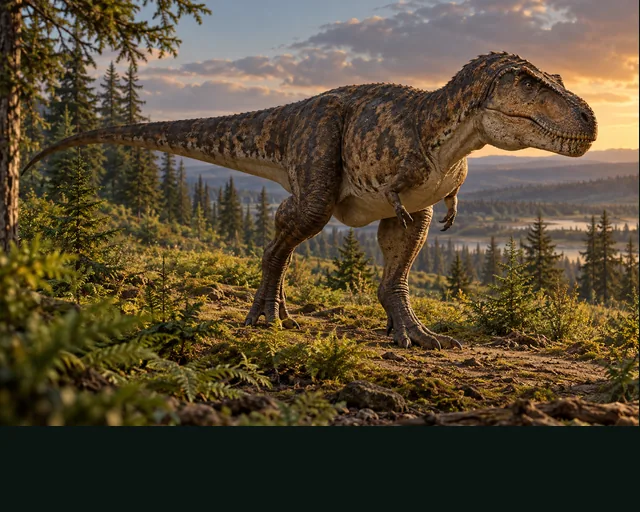
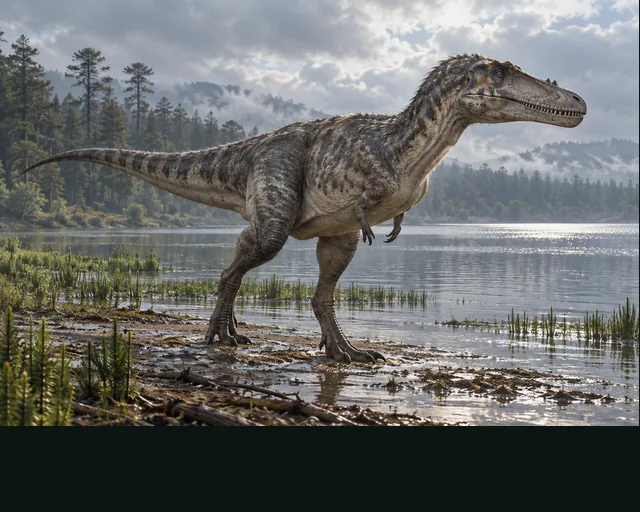
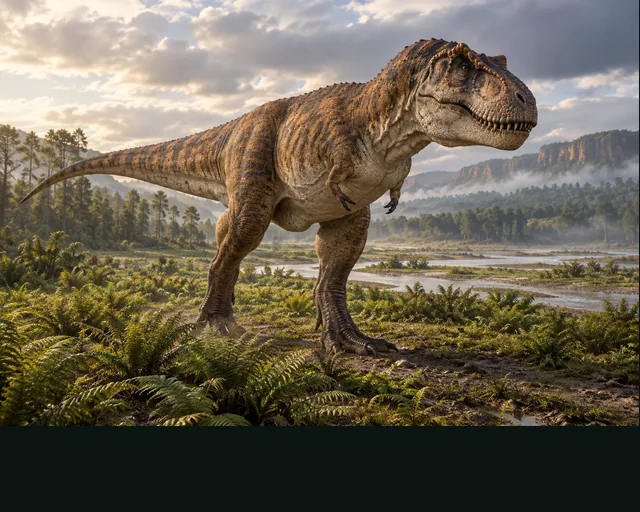
Alioramus had a long, low, slender skull. A row of five bony crests ran along the top of the snout, each more than a centimetre tall. It also had 76 or 78 teeth in total, more than any other tyrannosaurid described, and a locking joint in the lower jaw like that of Tarbosaurus.
Estimates of its length are about 5 to 6 metres, with weights of roughly 385 to 500 kilograms in one 2016 estimate. The bones of both species come from young or half-grown animals, so adults may have been larger. Brusatte’s team argued that the crests and slender skull were not simply juvenile traits.
Is Alioramus related to Tyrannosaurus?
Yes. Alioramus is a tyrannosaur, a member of the superfamily Tyrannosauroidea, and probably of the family Tyrannosauridae. For years it was grouped with Tyrannosaurus, Tarbosaurus and Daspletosaurus. After Qianzhousaurus was described in 2014, scientists recognised a tribe called Alioramini, with the long-snouted Qianzhousaurus and the two Alioramus species.
The tribe’s exact position still varies: one analysis put it with the tyrannosaurines, closer to Tyrannosaurus than to Albertosaurus, while another placed it outside the main tyrannosaurid groups. It was once also suspected that the skull might belong to a young Tarbosaurus, but the higher tooth count and crests argue against it.
What did Alioramus eat?
No stomach contents are known, so this is inferred. Brusatte and colleagues noted that Alioramus lacked the deep jaws and heavy teeth that large tyrannosaurids used to bite into big prey, and suggested it may have targeted small animals. A 2022 study of alioramins proposed that they hunted small, quick prey, which would have reduced competition with larger tyrannosaurs living nearby. These are hypotheses about feeding style, not records of what it ate.
When and where did Alioramus live?
The Nemegt Formation has never been dated radiometrically, but its fossils point to the Maastrichtian stage at the end of the Cretaceous. Its sediments record floodplains and big river channels in a wetter climate than the older formations beneath, though occasional droughts occurred. Other animals at the same sites include Tarbosaurus, ostrich-like dinosaurs, therizinosaurs, and probably duck-billed dinosaurs and titanosaurs.
Classification and fossil record
The Paleobiology Database taxonomic record catalogues Alioramus under Alioramini. This is the immediate parent in that catalogue, rather than a complete list of evolutionary relationships.
Discovery and naming history
Sergei Kurzanov described the original material in 1976. A later, more complete species expanded the anatomical evidence, so the genus should not be reconstructed solely from its first fragmentary find. Historical overview.
The corroborated occurrence sample includes Mongolia, China; those are modern discovery locations, not a complete ancient geographic range.
The sourced length estimate for Alioramus is 5–6 metres. This is an estimate for the reconstructed animal, not a measurement shared by every individual. See the body-size discussion and linked evidence for context.
Research starting point
The catalogue links Alioramus to Kurzanov, 1976, published in Paleontology and Biostratigraphy of Mongolia. The Joint Soviet-Mongolian Paleontological Expedition, Transactions. This identifies a research starting point; the catalogue’s citation alone does not verify every later reconstruction or species assignment.
For the meaning of taxonomic terms and how evidence is checked, see the glossary and editorial policy.
Quick answers
- Is Alioramus a dinosaur?
- Yes. Alioramus was a meat-eating tyrannosaur, a theropod dinosaur from the Late Cretaceous of Mongolia, with a long, low skull and a row of crests on the snout.
- How big was Alioramus?
- Estimates are about 5 to 6 metres long. Both species are known from young individuals, so fully grown adults may have been somewhat larger.
- When did Alioramus live?
- Probably in the Maastrichtian stage, at the very end of the Cretaceous. Its rock unit, the Nemegt Formation, has not been dated radiometrically.
- Is Alioramus a tyrannosaur?
- Yes. It belongs to Tyrannosauroidea and probably to Tyrannosauridae, in a tribe called Alioramini with Qianzhousaurus, though its exact place in the family tree varies.
- Where was Alioramus found?
- Both species come from the Nemegt Formation in Mongolia's Gobi region, at Nogon-Tsav for A. remotus and Tsagan Khushu for A. altai.