Jurassic Dinos editorial · Updated · Source-based review
What is Qianzhousaurus?
Qianzhousaurus was a latest Cretaceous Asian tyrannosaurid belonging to the long-snouted Alioramini branch.
Distinctive features and evidence
The species Qianzhousaurus sinensis offers a direct comparison with Alioramus. Its skull form broadens the tyrannosaurid picture beyond the deep-headed build familiar from Tyrannosaurus.
Genus overview and research references.
Qianzhousaurus fossil discoveries
Workmen found the bones of Qianzhousaurus in the summer of 2010 while building an industrial park near the city of Ganzhou in southern China. They handed the fossil to a local museum, and a team led by Lü Junchang described it in 2014 in the journal Nature Communications. The rock is part of the Nanxiong Formation.
The single specimen is a partial skeleton of what appears to be a sub-adult. It includes a nearly complete skull, though the lower jaws are missing and the teeth were lost during fossilisation. Also preserved are neck, back and tail vertebrae, both shoulder girdles, parts of the hips and most of the left leg. That is enough for a firm identification, but nothing is known yet of the arms, the ribs or the front of the trunk.
How big was Qianzhousaurus?
Qianzhousaurus was a medium-sized tyrannosaurid. One published estimate puts the specimen at about 6.3 metres long, around 2 metres tall at the hip and roughly 750 kilograms in weight, while higher estimates suggest it could have grown to between 7.5 and 9 metres. Because the animal was still a sub-adult, with some vertebrae not yet fully fused, a fully grown individual might have been larger, though that is not known.
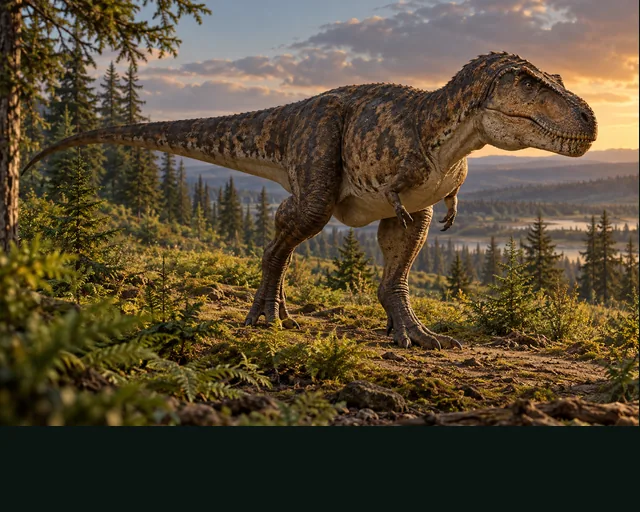
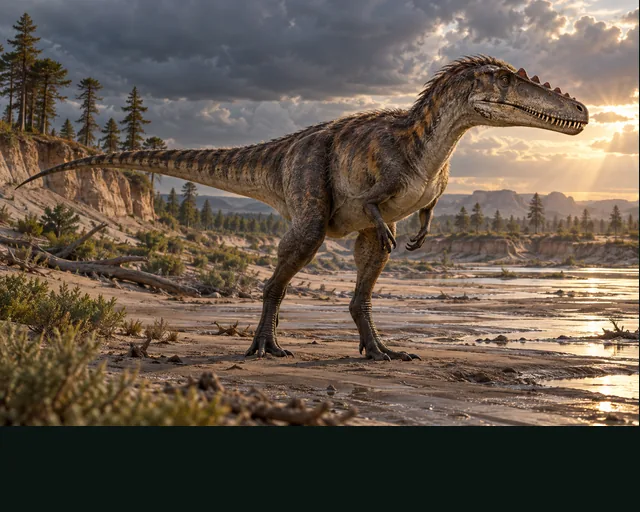
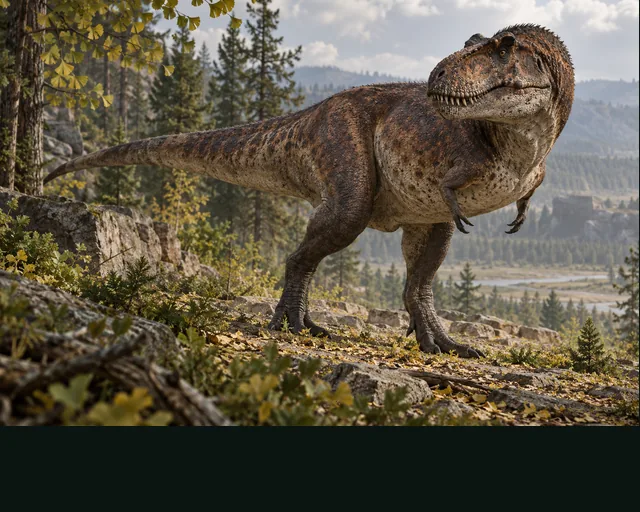
The skull is what makes it stand out. Instead of the deep jaws and thick teeth of Tyrannosaurus, it had a long, narrow snout with slim teeth. It also had long legs, with a thigh bone about 70 centimetres long and a shin bone of about 76 centimetres.
Is Qianzhousaurus a tyrannosaurid?
Yes. Qianzhousaurus belongs to the family Tyrannosauridae, in a small branch called Alioramini. Its closest known relative is Alioramus from Mongolia, so these long-snouted tyrannosaurids are known from more than one part of Asia. Before this find, scientists had suspected such animals existed, but short-snouted juveniles could have explained the earlier clues.
The 2014 analysis was not certain where Alioramini sits within the family. One run placed them closer to Tyrannosaurus than to Albertosaurus, while another put them outside the main tyrannosaurid branches. A 2017 study treated Qianzhousaurus as part of Alioramus, but a detailed redescription of the skull in 2022 found features unique to Qianzhousaurus and supported keeping the two genera separate.
What did Qianzhousaurus eat and where did it live?
No stomach contents are known, so diet is inferred from the skull. A 2022 study suggested that slender alioramins may have hunted small, quick prey, which could have kept them from competing with bulkier tyrannosaurs. Their jaws also appear weaker than those of larger relatives, and a 2024 study found lower stresses during biting, suggesting they did not use the puncture-and-pull style proposed for other tyrannosaurids. These are interpretations, not direct observations.
The Nanxiong Formation dates to about 66.7 million years ago, in the last part of the Cretaceous. It records a warm, humid, subtropical floodplain, rich in oviraptorosaur fossils and nests. Qianzhousaurus may have been the top predator there, alongside a smaller tyrannosaurine called Asiatyrannus.
Classification and fossil record
The Paleobiology Database taxonomic record catalogues Qianzhousaurus under Alioramini. This is the immediate parent in that catalogue, rather than a complete list of evolutionary relationships.
Research starting point
The catalogue links Qianzhousaurus to Lü and Yi, 2014, published in Nature Communications. This identifies a research starting point; the catalogue’s citation alone does not verify every later reconstruction or species assignment.
For the meaning of taxonomic terms and how evidence is checked, see the glossary and editorial policy.
Quick answers
- Is Qianzhousaurus a dinosaur?
- Yes. Qianzhousaurus was a theropod dinosaur, a medium-sized member of the tyrannosaurid family with an unusually long, narrow snout.
- When did Qianzhousaurus live?
- It lived in the latest Cretaceous, in the Maastrichtian age. The rock that held its bones, the Nanxiong Formation, has been dated to about 66.7 million years ago.
- How big was Qianzhousaurus?
- One estimate gives about 6.3 metres in length and 750 kilograms, with higher estimates of 7.5 to 9 metres. The only known skeleton is a sub-adult, so these are estimates.
- Is Qianzhousaurus a tyrannosaurid?
- Yes. It is a tyrannosaurid placed in the Alioramini, with Alioramus as its closest known relative, though the exact position of this branch within the family has been debated.
- Where was Qianzhousaurus found?
- It was found near Ganzhou in southern China in 2010, in the Nanxiong Formation, by workmen building an industrial park.