Jurassic Dinos editorial · Updated · Source-based review
What is Daspletosaurus?
Daspletosaurus was a Late Cretaceous tyrannosaurid known from Alberta and Montana.
Distinctive features and evidence
Several named species have been discussed as a sequence through time. Proposed ancestor-descendant relationships require testing and should not be inferred simply because differently aged fossils look similar.
Genus overview and research references.
Daspletosaurus fossil discoveries
Charles Mortram Sternberg found the first specimen near Steveville, Alberta, in 1921 and took it for a new kind of Gorgosaurus. It is a partial skeleton with a skull, and it was not fully described until 1970, when Dale Russell used it as the type of the new genus Daspletosaurus. It came from the Oldman Formation.
A famous mounted skeleton in Chicago has its own story. It was collected by Barnum Brown in 1914 and labelled Albertosaurus for many years, until researchers found that several skull features, including most of the teeth, had been modelled in plaster. In 1999 Thomas Carr reassigned it to Daspletosaurus torosus. Fossils of the genus are not as common as those of some other tyrannosaurids.
How many species of Daspletosaurus are there?
Three species have been named, and scientists still argue over how they relate. Daspletosaurus torosus is the type species. D. horneri was named in 2017 from Montana, and D. wilsoni was described in 2022 from the Judith River Formation of Montana as a form that lived between the other two in time.
Some researchers think the three evolved in a single line, one species gradually turning into the next, a process called anagenesis. Others have argued that D. wilsoni may just be D. torosus under another name, and a 2024 study disagreed that the evidence supports anagenesis. There are also specimens that may be further new species but have not been formally named. A New Mexico skeleton once placed in the genus was later moved to a more primitive tyrannosauroid, Bistahieversor.
How big was Daspletosaurus?
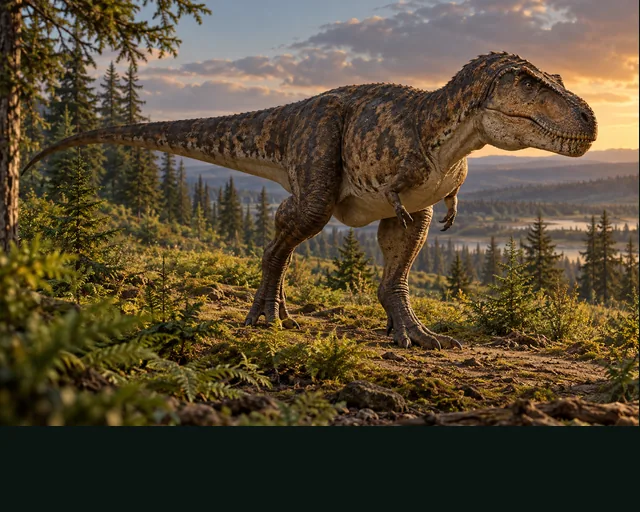
Adult Daspletosaurus averaged about 8.5 to 9 metres in length, with a hip height near 2.2 metres and a body mass of roughly 2 to 3 tonnes, so it was big but smaller than Tyrannosaurus. One unusually large specimen, nicknamed Pete III, suggests that the genus could exceed 9 metres and perhaps reach about 11 metres and 4 to 5 tonnes, though that is an estimate.
The skull could be more than a metre long, with fused nasal bones for strength and about six dozen teeth. Its forelimbs were tiny, with two fingers, but proportionally the longest of any tyrannosaurid.
What did Daspletosaurus eat?
A specimen from the Two Medicine Formation preserves what appear to be the digested remains of a young hadrosaur in the gut region, which suggests that these animals ate duck-billed dinosaurs. In a Montana bonebed, hadrosaur bones also carry many tyrannosaur tooth marks.
That same bonebed holds three Daspletosaurus of different sizes together with at least five hadrosaurs. Philip Currie speculated that they formed a pack, but he stated that this cannot be certain, and other scientists doubt that large theropods lived in social groups. Bite marks on the face of one adult skull show that tyrannosaurs sometimes bit each other, but why is still debated.
Where and when Daspletosaurus lived
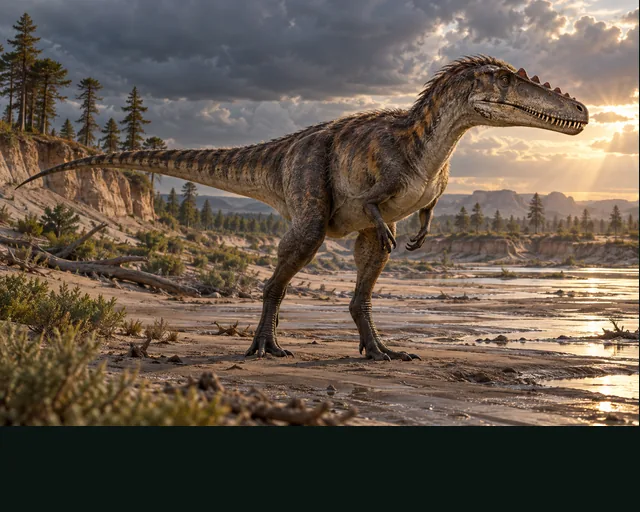
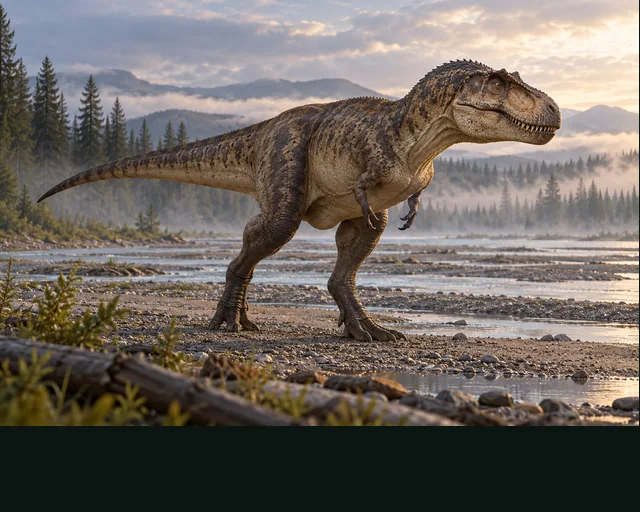
Daspletosaurus fossils are known from rocks of the Campanian stage, in the later part of the Late Cretaceous, between about 78 and 74.4 million years ago, in Alberta and Montana. Back then this region lay on the western shore of the Western Interior Seaway, a broad floodplain crossed by rivers, with periodic droughts. In places Daspletosaurus lived alongside another tyrannosaurid, Gorgosaurus, and researchers have discussed how the two may have avoided competing directly.
Classification and fossil record
The Paleobiology Database taxonomic record catalogues Daspletosaurus under Daspletosaurini. This is the immediate parent in that catalogue, rather than a complete list of evolutionary relationships.
The sourced length estimate for Daspletosaurus is 8.5–9 metres. This is an estimate for the reconstructed animal, not a measurement shared by every individual. See the body-size discussion and linked evidence for context.
Research starting point
The catalogue links Daspletosaurus to Russell, 1970, published in National Museum of Natural Sciences, Publications in Paleontology. This identifies a research starting point; the catalogue’s citation alone does not verify every later reconstruction or species assignment.
For the meaning of taxonomic terms and how evidence is checked, see the glossary and editorial policy.
Quick answers
- Is Daspletosaurus a dinosaur?
- Yes. Daspletosaurus was a large meat-eating theropod in the tyrannosaurid family, a relative of Tyrannosaurus, that lived in western North America in the Late Cretaceous.
- When did Daspletosaurus live?
- Daspletosaurus lived during the Campanian stage, late in the Cretaceous, roughly 78 to 74.4 million years ago, according to published dating of the formations that contain it.
- How big was Daspletosaurus?
- Adults averaged about 8.5 to 9 metres long and 2 to 3 tonnes, although one very large specimen suggests the genus may have reached roughly 11 metres.
- What did Daspletosaurus eat?
- It was a predator. A specimen with young hadrosaur remains in its gut region and tooth-marked hadrosaur bones in a bonebed show that duck-billed dinosaurs were part of its diet.
- Where was Daspletosaurus found?
- Fossils come from the Canadian province of Alberta and the US state of Montana, in rocks such as the Oldman, Dinosaur Park, Judith River and Two Medicine formations.