Jurassic Dinos editorial · Updated · Source-based review
What is Albertosaurus?
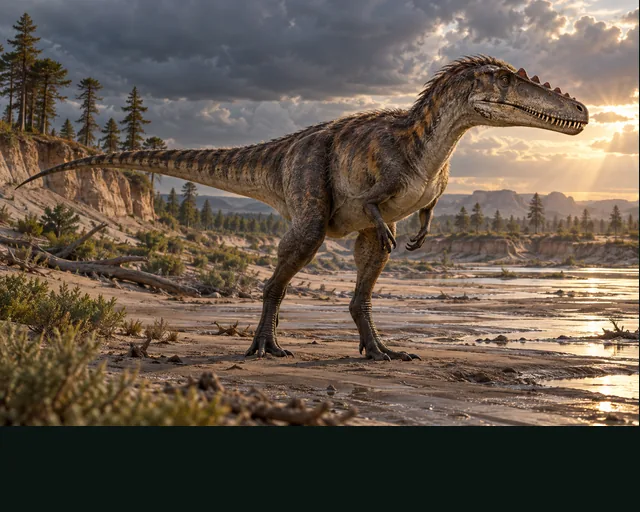
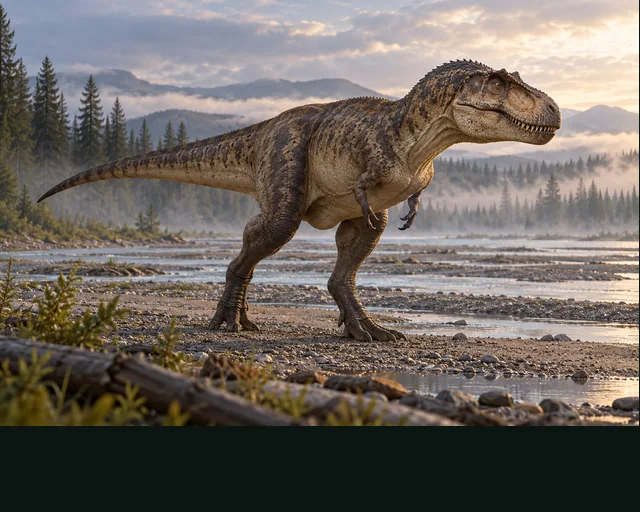
Albertosaurus was a Late Cretaceous tyrannosaurid named for Alberta, with a large head and short, two-fingered forelimbs.
Distinctive features and evidence
Albertosaurus sarcophagus is the best-known species. Comparisons with Gorgosaurus depend on whether an author treats the two as distinct genera, so a historical label should be checked before combining their fossil records.
Genus overview and research references.
Albertosaurus fossil discoveries
The first Albertosaurus bones were collected in 1884 along the Red Deer River in Alberta by a Geological Survey of Canada expedition led by Joseph Tyrrell. The partial skull became the type specimen, and Henry Fairfield Osborn gave the genus its name in 1905. Because the skull was damaged, some researchers once wondered whether the name could be used for anything else, but in 2010 Thomas Carr identified a feature in the palate that is shared by the type and later finds, which supports the genus as valid.
More than 30 individuals are now known, which gives scientists a more detailed view of its anatomy than they have for most tyrannosaurids. The best-known site, the Dry Island bonebed, was found by Barnum Brown in 1910 and reopened by Philip Currie in 1997. Counting bones that appear in mirrored pairs gives a total of 26 individuals.
How big was Albertosaurus?
Adults reached about 8 to 9 metres in length, with a skull up to about a metre long. Estimates for weight vary between sources, from about 1.5 tonnes to 3 tonnes. The largest specimen, from the Dry Island site, is estimated at over 10 metres and was about 28 years old. A two-year-old from the same site was about 2 metres long.
It looked like other tyrannosaurids, with a big head, two-fingered hands and long legs, but it was slimmer than the heavyweight tyrannosaurines such as Tyrannosaurus. Two small skin impressions show pebbly scales.
Is Albertosaurus the same as Gorgosaurus?
No, though they are close relatives. Gorgosaurus was named in 1914 for fossils from Alberta and Montana. In 1970 Dale Russell combined the two genera, and for a time Gorgosaurus was called Albertosaurus libratus. In 2003, Philip Currie compared many skulls and recommended keeping them separate, and most authors have followed him, although some have not.
Both belong to Albertosaurinae, the slender-built branch of the family, while Tyrannosaurinae includes Tyrannosaurus, Tarbosaurus and Daspletosaurus. Only these two albertosaurines have been described.
Did Albertosaurus hunt in packs?
This is an open question. The Dry Island bonebed holds at least a dozen individuals of mixed ages, with very few bones of plant-eaters. Philip Currie took this as a sign that they died together and perhaps hunted as a group, with younger, faster animals helping to drive prey. Other scientists note that drought or flooding could have gathered them in one place. Currie himself later accepted that a flood might explain the site.
A 2024 study reported tooth marks from another albertosaurine on a pubic bone, which suggests scavenging, possibly of a dead member of its own species. None of these ideas can be tested directly.
When and where did Albertosaurus live?
Most fossils come from the upper Horseshoe Canyon Formation, dated to about 70 to 68 million years ago, in the early Maastrichtian. At that time the region was a lowland of river deltas, floodplains, swamps and coasts beside a retreating inland sea. Its neighbours included the duck-billed dinosaur Edmontosaurus, horned dinosaurs and ostrich-like dinosaurs. A single published age is not enough to define the genus, since the related Gorgosaurus lived a few million years earlier.
Classification and fossil record
The Paleobiology Database taxonomic record catalogues Albertosaurus under Albertosaurinae. This is the immediate parent in that catalogue, rather than a complete list of evolutionary relationships.
The corroborated occurrence sample includes Canada, United States, Mexico; those are modern discovery locations, not a complete ancient geographic range.
The sourced length estimate for Albertosaurus is 8–9 metres. This is an estimate for the reconstructed animal, not a measurement shared by every individual. See the body-size discussion and linked evidence for context.
Research starting point
The catalogue links Albertosaurus to Osborn, 1905, published in Bulletin of the American Museum of Natural History. This identifies a research starting point; the catalogue’s citation alone does not verify every later reconstruction or species assignment.
For the meaning of taxonomic terms and how evidence is checked, see the glossary and editorial policy.
Quick answers
- Is Albertosaurus a dinosaur?
- Yes. Albertosaurus was a large meat-eating tyrannosaurid theropod dinosaur that lived in western North America in the Late Cretaceous.
- How big was Albertosaurus?
- Adults were about 8 to 9 metres long, smaller than Tyrannosaurus. Weight estimates differ between sources, from about 1.5 to 3 tonnes.
- When did Albertosaurus live?
- Most fossils come from rocks about 70 to 68 million years old, in the early Maastrichtian stage of the Late Cretaceous.
- Is Albertosaurus a tyrannosaur?
- Yes. It is a tyrannosaurid in the subfamily Albertosaurinae, a slimmer branch than Tyrannosaurus. Its closest relative is Gorgosaurus.
- Did Albertosaurus live in groups?
- Possibly, but it is debated. A bonebed in Alberta holds many individuals, yet floods or drought could also have gathered them, so pack behaviour is not proven.