Jurassic Dinos editorial · Updated · Source-based review
What is Appalachiosaurus?
Appalachiosaurus was a tyrannosauroid from Late Cretaceous eastern North America, initially described from a juvenile skeleton in Alabama.
Distinctive features and evidence
The known juvenile cannot provide a directly measured adult maximum. Its eastern record is also useful because North America was divided by an interior seaway, separating it geographically from many better-known western tyrannosaurs.
Genus overview and research references.
Appalachiosaurus fossil discoveries
The type specimen was found in July 1982 by David King, a geologist at Auburn University, in central Alabama, and Thomas Carr and Thomas Williamson named it in 2005. It is a partial skeleton: it includes parts of the skull and lower jaw, some backbone and hip bones, and nearly all of both legs. It is kept at the McWane Science Center in Birmingham, Alabama. Many of the bones are crushed, but they still show enough detail to identify the animal.
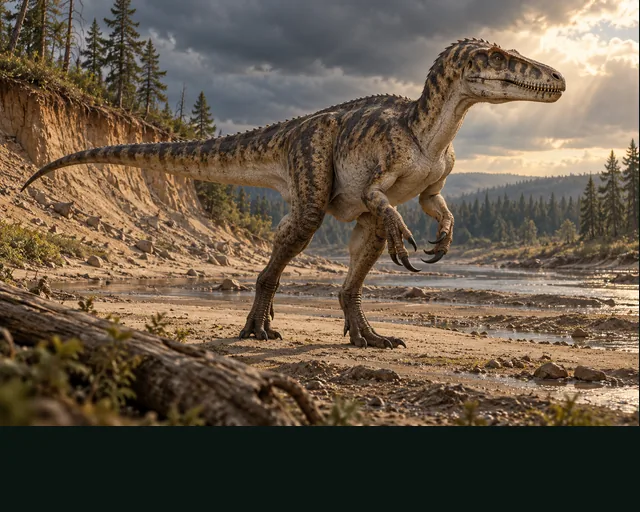
The arms are not known. Older reconstructions drew it with long, three-fingered arms. Scientists now expect short, two-fingered ones, as in other tyrannosauroids, and museum mounts have been corrected to match. More fossils attributed to the genus have been reported from the Carolinas and Georgia.
How big was Appalachiosaurus?
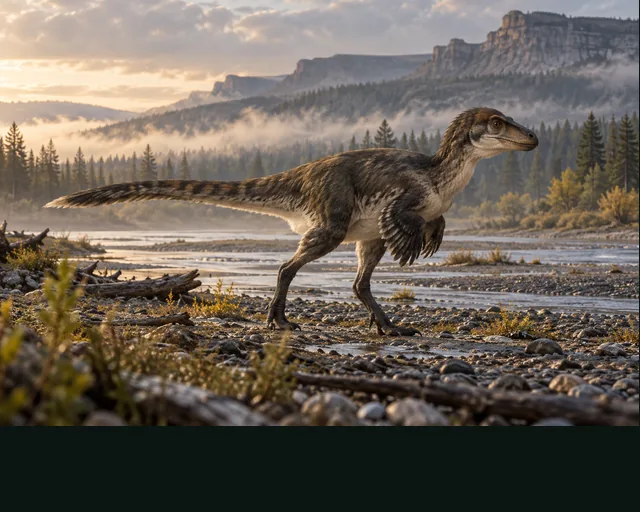
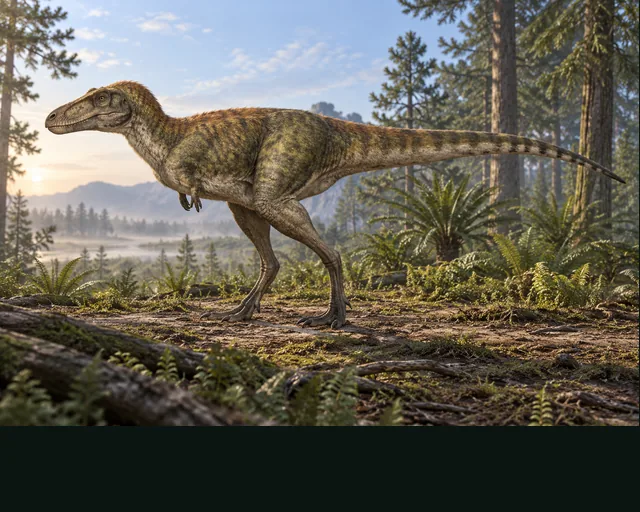
The one skeleton belongs to a young animal. Open seams between several skull bones show that it had not finished growing. It has been estimated at about 6.5 metres long and 623 kilograms, so a fully grown Appalachiosaurus would probably have been considerably bigger, although no adult has been found and its true adult size is unknown.
Small details help to identify it. A row of six low crests runs along the top of the snout, which is similar to the crests of the Asian Alioramus, and one of its foot claws has an odd bump at the end nearest the foot.
Is Appalachiosaurus a tyrannosaur?
It is a tyrannosauroid, a member of the wider tyrannosaur line, but its exact place is debated. Only one specimen exists, but it is complete enough to be used in family-tree analyses. An analysis made before it was named placed it with the albertosaurine tyrannosaurids, whereas the original description found it outside the true tyrannosaurid family. A 2013 study placed it close to the group Eutyrannosauria, the one that includes Tyrannosaurus.
In 2025, Zanno and Napoli ran two different analyses that disagreed. One put Appalachiosaurus outside Eutyrannosauria, next to Alectrosaurus and Khankhuuluu from Mongolia. The other placed it and Dryptosaurus, another eastern North American tyrannosauroid, among the earliest branches of the Nanotyrannidae. The authors said more data would be needed to choose between them. It is clearly different from Dryptosaurus and more advanced than that animal.
Where and when Appalachiosaurus lived
The Demopolis Chalk of Alabama dates to the middle Campanian stage of the Late Cretaceous, roughly 77 million years old. At that time eastern North America was an island landmass known as Appalachia, separated from the west by a seaway, so its tyrannosauroids were cut off from many of the better-known western species. Material attributed to the genus also comes from the Donoho Creek and Tar Heel/Coachman rocks of the Carolinas and the Ripley Formation of Georgia, and the Paleobiology Database lists a wider range of dates for them, from the Santonian to the Maastrichtian.
Classification and fossil record
The Paleobiology Database taxonomic record catalogues Appalachiosaurus under Tyrannosauroidea. This is the immediate parent in that catalogue, rather than a complete list of evolutionary relationships.
The corroborated occurrence sample includes United States; those are modern discovery locations, not a complete ancient geographic range.
Research starting point
The catalogue links Appalachiosaurus to Carr and Williamson, 2005, published in Journal of Vertebrate Paleontology. This identifies a research starting point; the catalogue’s citation alone does not verify every later reconstruction or species assignment.
For the meaning of taxonomic terms and how evidence is checked, see the glossary and editorial policy.
Quick answers
- Is Appalachiosaurus a dinosaur?
- Yes. Appalachiosaurus was a predatory theropod dinosaur and a tyrannosauroid, from the Late Cretaceous of eastern North America.
- How big was Appalachiosaurus?
- The one known skeleton is a juvenile estimated at about 6.5 metres long, so an adult was probably larger. Its true adult size has not been measured.
- Is Appalachiosaurus a tyrannosaur?
- It is a tyrannosauroid, a relative of tyrannosaurs, but studies disagree on whether it was close to the Tyrannosaurus line or an earlier branch.
- Where was Appalachiosaurus found?
- The type specimen came from the Demopolis Chalk Formation in central Alabama, United States. Related fossils are reported from the Carolinas and Georgia.
- When did Appalachiosaurus live?
- The type specimen dates to the middle Campanian stage of the Late Cretaceous, roughly 77 million years ago.