Jurassic Dinos editorial · Updated · Source-based review
What is Hadrosaurus?
Hadrosaurus was a Late Cretaceous duck-billed dinosaur first known from New Jersey’s Woodbury Formation.
Distinctive features and evidence
The name-bearing animal was buried in marine-influenced sediments after transport. Burial setting should not be mistaken for an aquatic lifestyle, an important distinction when using fossil geology to reconstruct habitat.
Genus overview and research references.
Hadrosaurus fossil discoveries
The story starts in 1838, when John Estaugh Hopkins uncovered large bones while digging in a marl pit, a small clay-and-lime quarry, in Haddonfield, New Jersey. He displayed them at home. In 1858 a visitor, William Parker Foulke, was intrigued by them and dug out the remaining bones. Together with the Philadelphia scientist Joseph Leidy he recovered teeth, jaw fragments, vertebrae from the back and tail, parts of the shoulder, arm, hip and a left hind leg.
Leidy named the animal Hadrosaurus foulkii in 1858, in honour of Foulke. He recognised that the bones resembled those of Iguanodon, found in England some decades earlier. Few dinosaur skeletons known then were as complete, and it was the first North American dinosaur species known from more than isolated teeth. The pit is now a National Historic Landmark.
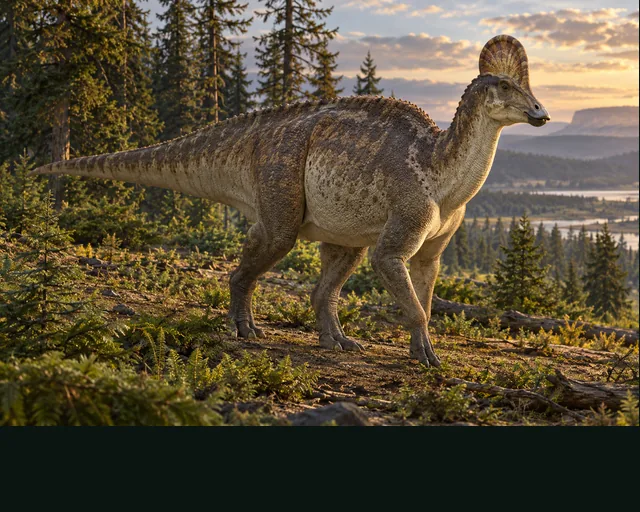
In 1868 a team including the English sculptor Benjamin Waterhouse Hawkins mounted the skeleton in Philadelphia. It was the first dinosaur skeleton ever assembled for display. Leidy had reconstructed it as a biped, at a time when many scientists expected such dinosaurs to be four-legged. Because no skull was found, the head on that first mount was a plaster model, and many later artists have borrowed skulls from other hadrosaurs. Hadrosaurus became the state dinosaur of New Jersey in 1991.
How big was Hadrosaurus?
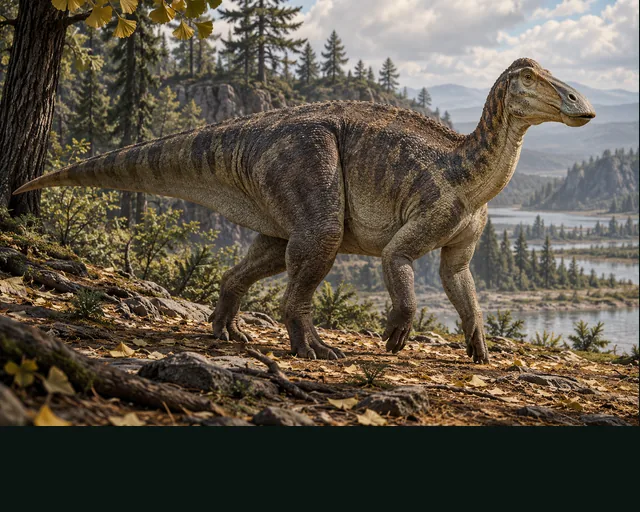
Hadrosaurus was a large, heavily built plant-eater. One published summary gives a length of 7 to 8 metres and a weight of 2 to 4 tonnes, while the Natural History Museum lists about 9 metres. These are estimates from a single partial skeleton, so they are approximate and the sources do not agree exactly. The thigh bone of the type specimen is 1.05 metres long.
Most of the preserved bones are unusually stout for a hadrosaur, and the fibula, a slender bone of the lower leg, is among the sturdiest known in the group. As in most hadrosaurs, the arms were lighter than the legs but long enough to have been used when standing or moving.
Is Hadrosaurus a hadrosaur?
Yes, and the family is named after it: Hadrosauridae takes its name from Hadrosaurus, the type genus. This makes the genus important even though its skeleton has no skull. For a long time most scientists considered the name dubious because the skeleton seemed too incomplete to compare reliably. In 2011 a re-examination of the bones found several distinctive features that allow Hadrosaurus foulkii to remain a valid species.
Its closest relatives have also been revised. Hadrosaurus was traditionally the basis for the subfamily Hadrosaurinae, a group of mostly crestless duck-billed dinosaurs. A 2008 study found it to be more primitive than either the crested lambeosaurines, such as Corythosaurus and Lambeosaurus, or classic crestless forms like Edmontosaurus. Because of this, the name Hadrosaurinae now applies to Hadrosaurus by itself, and the traditional crestless group was renamed Saurolophinae. Maiasaura is a better-known hadrosaurid for comparison.
What did Hadrosaurus eat?
Hadrosaurus was a plant-eater. The jaws ended in a horny beak suited to cropping foliage, behind which were teeth arranged for processing food. The fossil teeth and dental battery fragments back this up, but no stomach contents have been found, so what it actually ate is not known.
The Natural History Museum notes that large tyrannosaurs may have hunted it, and that giant crocodiles were a danger in Cretaceous North America. These are possibilities rather than direct evidence from this animal.
One unusual study checked more than 10,000 fossils for signs of tumours. Rothschild and colleagues reported in 2003 that tumours of several kinds showed up on tail vertebrae of Hadrosaurus and some other hadrosaurs, and they suggested that environment or inheritance could have been responsible.
Where and when Hadrosaurus lived
All Hadrosaurus remains come from the Woodbury Formation of New Jersey, and some fossils have been mentioned from the Tar Heel and Coachman formations. The age is Campanian, in the Late Cretaceous. Dating of bivalve shells in the formation gave a range of 80.5 to 78.5 million years, while a wider estimate runs from 83.6 to about 77.9 million years ago. The museum gives 78 to 74 million years ago, so published dates differ by a few million years.
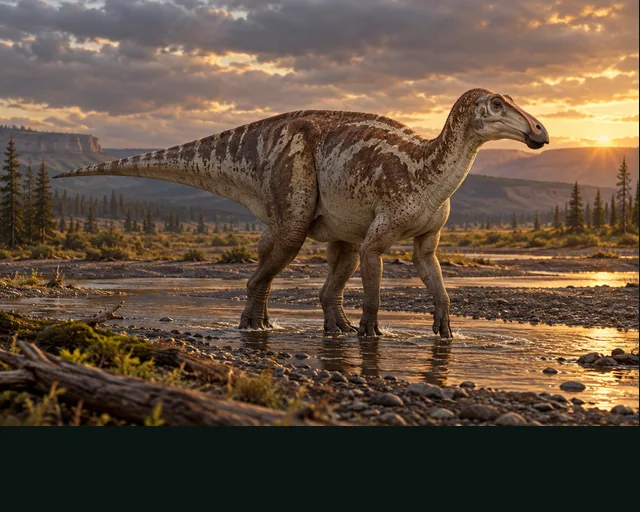
The type specimen was buried in marine sediment, which suggests that a river carried the carcass out to sea after death. This tells us how it was preserved, not that it lived in the water.
Classification and fossil record
The Paleobiology Database taxonomic record catalogues Hadrosaurus under Brachylophosaurini. This is the immediate parent in that catalogue, rather than a complete list of evolutionary relationships.
The corroborated occurrence sample includes United States, Canada; those are modern discovery locations, not a complete ancient geographic range.
Research starting point
The catalogue links Hadrosaurus to Leidy, 1858, published in Proceedings of the Academy of Natural Sciences of Philadelphia. This identifies a research starting point; the catalogue’s citation alone does not verify every later reconstruction or species assignment.
For the meaning of taxonomic terms and how evidence is checked, see the glossary and editorial policy.
Quick answers
- Is Hadrosaurus a dinosaur?
- Yes. Hadrosaurus was a large, plant-eating hadrosaurid dinosaur, known from a partial skeleton found in New Jersey, USA.
- When did Hadrosaurus live?
- It lived in the Late Cretaceous, in the Campanian stage. Sources give dates between about 83.6 and 74 million years ago, so the exact figure varies.
- How big was Hadrosaurus?
- One summary gives 7 to 8 metres long and 2 to 4 tonnes, while the Natural History Museum says about 9 metres. The estimates come from one partial skeleton.
- Is Hadrosaurus a hadrosaur?
- Yes. It is the type genus of the family Hadrosauridae. Its skeleton lacks a skull, so its place within the family has been debated.
- Where was Hadrosaurus found?
- The type skeleton was found in a marl pit at Haddonfield, New Jersey, in the Woodbury Formation, and first described by Joseph Leidy in 1858.