Jurassic Dinos editorial · Updated · Source-based review
What is Corythosaurus?
Corythosaurus was a Late Cretaceous North American duck-billed dinosaur with a helmet-shaped skull crest.
Distinctive features and evidence
Numerous relatively complete specimens provide a strong anatomical record. Its crest is a useful contrast with the long tube of Parasaurolophus; a reconstructed crest shape does not by itself establish a particular sound or social behavior.
Genus overview and research references.
Corythosaurus fossil discoveries
Barnum Brown found the first specimen, catalogued AMNH 5240, in 1911 along the Red Deer River in Alberta and recovered it in 1912. It is an almost complete skeleton that lacks only the last stretch of the tail and most of the forelimbs. Much of the body is covered by impressions of skin, which makes the find unusually informative. A second specimen found in 1914 was used with it in Brown’s fuller description of 1916, and both are held at the American Museum of Natural History.
Not every discovery survived. The two best-preserved specimens collected by Charles H. Sternberg in 1912 were lost in December 1916, when the ship carrying them across the Atlantic to the British Museum was sunk by a German raider in World War I.
How big was Corythosaurus?
Estimates differ. One estimate puts the average length at about 9 metres, while the Natural History Museum lists about 10 metres and another published estimate for the holotype is about 8.1 metres. Weight estimates range from about 2.5 to 3.8 tonnes, depending on the method and the species. The tallest part of the skull, including the crest, stands about 70 centimetres in the type specimen.
So a fair summary is a hadrosaur of roughly 8 to 10 metres long, with the exact figure depending on the specimen and the person doing the measuring.
What was the Corythosaurus crest for?
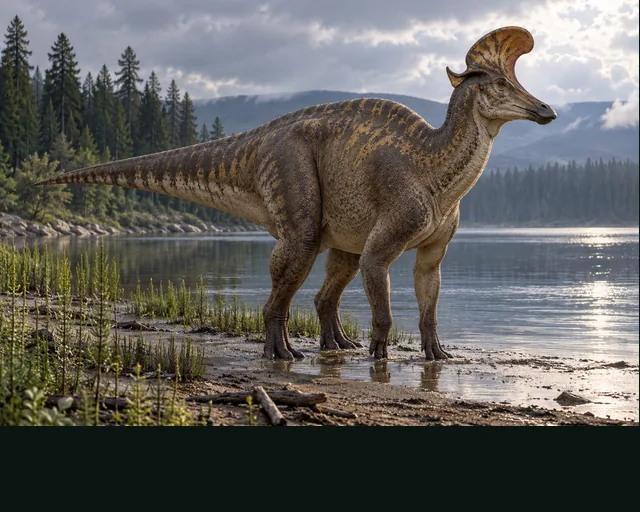
The crest is a hollow structure made from several skull bones, and the breathing passages ran up into it and back down. It rises into a high, rounded shape above the eyes, which is why people compare it with a Corinthian helmet and with the casque of a cassowary.
The most likely function, according to current thinking, is making sound. Air passing through the chambers would have produced low, loud calls, a little like a brass instrument, but this is a reconstruction from anatomy, not a recording. Early researchers had imagined that crested hadrosaurs lived in water and stored air in the crest, an idea that was later rejected because the crest has no opening at the top and the water pressure would have stopped the lungs from inflating. The supposed webbed hands turned out to be collapsed padding.
What did Corythosaurus eat?
Corythosaurus was a plant eater. One specimen has fossilised stomach contents in the chest cavity: conifer needles, seeds, twigs and fruit, which suggests a browser rather than a grazer on low plants. The beak is narrow and fairly delicate, and researchers have inferred that it was used on soft vegetation, possibly picking out the more nutritious leaves and fruit. These last two points are interpretations rather than direct observation.
Where and when Corythosaurus lived
Fossils come from the Oldman and Dinosaur Park formations of southern Alberta, in the Campanian stage of the Late Cretaceous. One summary dates the genus to about 77 to 75.7 million years ago. It has not been found outside southern Alberta even though it is common there.
Its neighbours included the tyrannosaurid Gorgosaurus, the horned dinosaur Centrosaurus and the crested Parasaurolophus. Corythosaurus is classed as a lambeosaurine hadrosaurid, related to Lambeosaurus, Hypacrosaurus and Olorotitan. Juvenile crests are small, which made young animals hard to name and led to several species names being reconsidered. C. casuarius anchors the genus, while the status of C. intermedius varies between studies. In 2026, Sharpe and Brown proposed transferring the species stebingeri from Hypacrosaurus to Corythosaurus. This is a published revision of the boundary between the two genera, rather than proof that every specialist or museum has adopted the same arrangement. Our Hypacrosaurus account focuses on H. altispinus and explains the proposal.
Classification and fossil record
The Paleobiology Database taxonomic record catalogues Corythosaurus under Corythosaurini. This is the immediate parent in that catalogue, rather than a complete list of evolutionary relationships.
Discovery and naming history
Barnum Brown named Corythosaurus in 1914, following discovery of the holotype in 1911. That skeleton preserves much of the body and skin impressions, adding evidence beyond the conspicuous head crest. Historical overview.
The corroborated occurrence sample includes Canada, United States; those are modern discovery locations, not a complete ancient geographic range.
Research starting point
The catalogue links Corythosaurus to Brown, 1914, published in the linked reference. This identifies a research starting point; the catalogue’s citation alone does not verify every later reconstruction or species assignment.
For the meaning of taxonomic terms and how evidence is checked, see the glossary and editorial policy.
Quick answers
- Is Corythosaurus a dinosaur?
- Yes. Corythosaurus was a duck-billed dinosaur, a lambeosaurine hadrosaurid, that lived in what is now western Canada during the Late Cretaceous.
- When did Corythosaurus live?
- Corythosaurus lived in the Campanian stage of the Late Cretaceous, about 77 to 75.7 million years ago according to one published dating.
- How big was Corythosaurus?
- Published estimates run from about 8 to 10 metres in length, with weights of roughly 2.5 to 3.8 tonnes, depending on the specimen and method.
- What was the crest of Corythosaurus for?
- Scientists think the hollow crest helped make loud, low calls, because air passed through chambers inside it. This is an interpretation of the anatomy, not a recorded sound.
- What did Corythosaurus eat?
- It ate plants. A specimen with preserved stomach contents held conifer needles, seeds, twigs and fruit, which suggests it browsed on vegetation.