Jurassic Dinos editorial · Updated · Source-based review
What is Parasaurolophus?
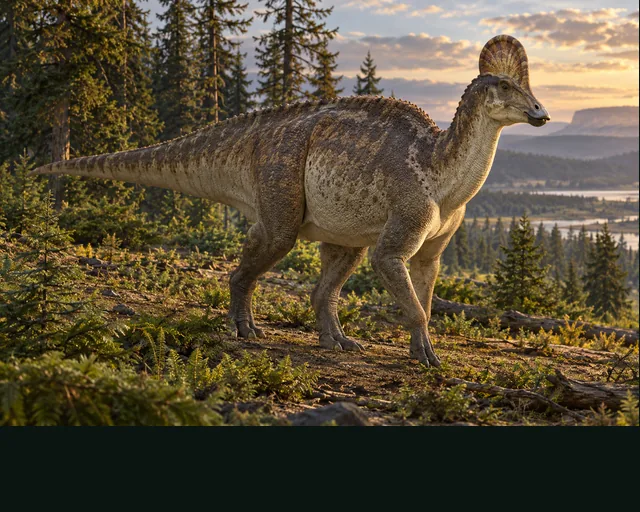
Parasaurolophus was a Late Cretaceous duck-billed dinosaur with a long, hollow skull crest.
Distinctive features and evidence
The recognized species include long- and short-crested forms. Proposed acoustic functions depend on anatomy and modeling, while a disputed Asian species assignment should not automatically extend the genus’s established North American distribution.
Genus overview and research references.
Parasaurolophus fossil discoveries
Parasaurolophus is a rare dinosaur in the fossil record. Only a handful of good skulls are known, and most of the skeleton of any one individual is missing.
The first specimen, catalogued ROM 768, was found in 1920 by a University of Toronto field party near the Red Deer River in Alberta, in rocks now called the Dinosaur Park Formation. It includes a skull and part of a skeleton, but most of the tail and the lower hind legs are missing. William Parks described it in 1922 and named the species Parasaurolophus walkeri, honouring Sir Byron Edmund Walker of the Royal Ontario Museum.
Two more species came from the American south-west. Parasaurolophus tubicen, named by Carl Wiman in 1931, comes from the Kirtland Formation of New Mexico, and its species name means “trumpeter”. A near-complete skull of this species found in 1995 was scanned by CT in a 1999 study by Robert Sullivan and Thomas Williamson. John Ostrom named P. cyrtocristatus in 1961, from New Mexico, and similar specimens have since turned up in Utah. A one-year-old juvenile nicknamed Joe, described in 2013 from the Kaiparowits Formation in Utah, is the youngest Parasaurolophus known, at about 2.5 metres long.
How big was Parasaurolophus?
The type specimen of P. walkeri is estimated at about 9.45 metres long, and the Natural History Museum lists about 9 metres. A figure for body mass often quoted is over 5 tonnes, which is based on scaling from the size of the bones. Gregory Paul gave smaller figures for an average adult of the type species, around 7.5 metres and 2.6 tonnes, so published sizes do not agree.
The skull of the type specimen is about 1.6 metres long including the crest. Parasaurolophus could walk on two legs or four. It probably fed on all fours but ran on two. Its arms were short for a hadrosaur and its thigh bone was sturdy. The spines on its back vertebrae were tall, making the back higher over the hips. Skin impressions show a covering of small, uniform, pebble-like scales with no larger structures.
What was the Parasaurolophus crest for?
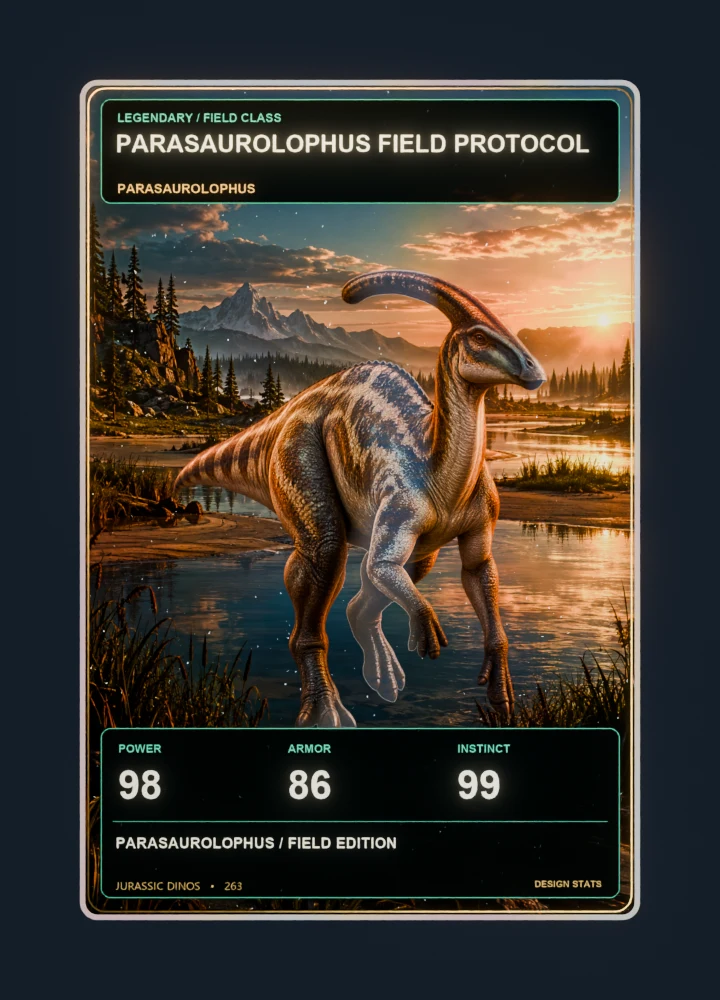
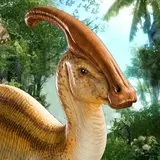
The long, curved crest is the reason most people recognise Parasaurolophus. It was made by the premaxilla and nasal bones and was hollow: a tube led from each nostril up to the tip of the crest, turned back and ran down again to the skull. Their layout was simplest in P. walkeri and more complex in P. tubicen, while P. cyrtocristatus had a short, curved crest.
Several ideas about its purpose have been rejected. Older suggestions that it was a snorkel, an air reservoir for diving, a weapon, or a support for neck ligaments fail for reasons such as having no hole at the tip and not matching the anatomy. The present view is that it served more than one role: a visual signal to tell species and perhaps sexes apart, a resonating chamber for sound, and possibly temperature control.
For sound, computer modelling of a well-preserved P. tubicen skull indicated that its main air path would resonate at around 30 hertz, a deep tone, with extra peaks and dips from the complicated passages. Hadrosaur ear anatomy suggests good hearing, so calls might have worked for communication, for example between parents and young. The Natural History Museum describes the reconstructed sound as a deep bellow, but stresses that no one knows if the real animal sounded like this. These are models from bone, not recordings.
Is the short-crested Parasaurolophus a different species?
P. cyrtocristatus has the smallest body and the most curved crest, so it has often been suggested to be a female or a younger individual of one of the longer-crested species. James Hopson proposed female, and Thomas Williamson proposed juvenile. Neither idea has been widely accepted, partly because the specimens differ in age and place and in the inner structure of the crest. The question is open because very few skulls exist.
The Chinese hadrosaur Charonosaurus is also part of the debate. It has a very similar skull, and a 2014 study placed it deep inside Parasaurolophus, which would make the genus a two-continent one. Most accounts still keep it in a separate genus, and the Natural History Museum notes that a few scientists consider the two to be one animal.
Where and when Parasaurolophus lived
Parasaurolophus lived in western North America in the Campanian, around 77 to 73 million years ago. That puts it in the Late Cretaceous, when an inland sea split North America and the western landmass had river plains and swamps near the shoreline.
In Alberta it shared the Dinosaur Park environment with horned dinosaurs such as Centrosaurus, other duckbills, and tyrannosaurids such as Gorgosaurus and Daspletosaurus. It was a rare member of that community, which may mean that these individuals were passing through or that it preferred other habitats. Its relatives include Corythosaurus and Lambeosaurus, which belong to the same subfamily of crested hadrosaurs, the lambeosaurines. Parasaurolophus is usually thought to sit on its own branch of that group, rather than with the helmet-crested forms. It was initially compared to the unrelated, hadrosaurine Saurolophus, because of the crest.
Its food was leaves, twigs and pine needles, cropped with the beak and ground by hundreds of small teeth, of which only a few worked at a time. Vegetation up to around 4 metres high was within reach.
Parasaurolophus in the game
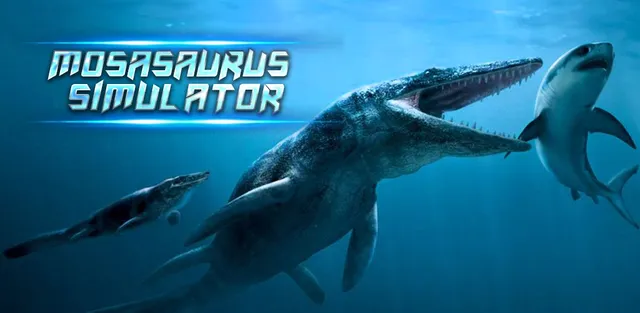
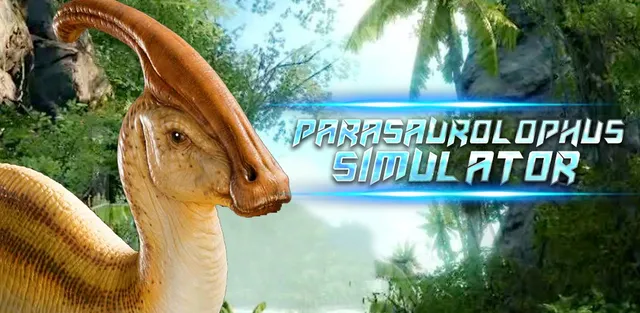
Parasaurolophus Simulator lets you play as the crested dinosaur. Its store listing describes surviving by foraging and drinking, exploring an open world with weather and a day-night cycle, levelling up and battling other dinosaurs, and customising your character.
The game is entertainment. Its fights, skills and mix of animals from different times do not show how Parasaurolophus really lived, and the evidence for its behaviour is far more cautious than the game suggests.
Classification and fossil record
The Paleobiology Database taxonomic record catalogues Parasaurolophus under Parasaurolophini. This is the immediate parent in that catalogue, rather than a complete list of evolutionary relationships.
Discovery and naming history
William Parks described Parasaurolophus in 1922 from an Alberta skull and partial skeleton. Subsequent material expanded the anatomical account, while reconstructed calls remain models derived from the crest’s internal structure. Historical overview.
The corroborated occurrence sample includes Canada, United States; those are modern discovery locations, not a complete ancient geographic range.
The sourced length estimate for Parasaurolophus is 9–9.5 metres. This is an estimate for the reconstructed animal, not a measurement shared by every individual. See the body-size discussion and linked evidence for context.
Research starting point
The catalogue links Parasaurolophus to Parks, 1922, published in University of Toronto Studies, Geology Series. This identifies a research starting point; the catalogue’s citation alone does not verify every later reconstruction or species assignment.
For the meaning of taxonomic terms and how evidence is checked, see the glossary and editorial policy.
Quick answers
- Is Parasaurolophus a dinosaur?
- Yes. Parasaurolophus was a plant-eating duck-billed dinosaur, a lambeosaurine hadrosaurid, known for the long hollow crest that curved back from its skull.
- When did Parasaurolophus live?
- It lived in the Campanian age of the Late Cretaceous, roughly 77 to 73 million years ago, in western North America.
- How big was Parasaurolophus?
- The type specimen is estimated at about 9 to 9.5 metres long. Mass estimates vary a lot, from around 2.6 tonnes to over 5 tonnes, depending on the method.
- What was the Parasaurolophus crest for?
- Scientists think it had several uses: visual display, amplifying calls, and possibly cooling. The hollow tubes could have worked as a resonator, though the exact sound is a model.
- What did Parasaurolophus eat?
- Plants. It cropped leaves, twigs and pine needles with its beak and ground them with batteries of small teeth, browsing from the ground up to about 4 metres.
- Where was Parasaurolophus found?
- Fossils come from Alberta in Canada and from New Mexico and Utah in the United States. A possible Asian relative, Charonosaurus, is debated.