Jurassic Dinos editorial · Updated · Source-based review
What is Lambeosaurus?
Lambeosaurus was a crested Late Cretaceous North American hadrosaur with a complicated naming history.
Distinctive features and evidence
Skull material once used under Stephanosaurus contributed to the recognition of Lambeosaurus. The reassignment of Lambeosaurus laticaudus to Magnapaulia illustrates why older species lists should be checked before merging their anatomy and geographic ranges.
Genus overview and research references.
Lambeosaurus fossil discoveries on the Red Deer River
Lambeosaurus was found in the badlands of Alberta, Canada, along the Red Deer River. Lawrence Lambe led expeditions there in 1897, 1898 and 1901, and later teams, including collectors from the Sternberg family, uncovered skulls, skeletons and skin impressions. Lambe first used a skull for a genus he called Stephanosaurus, but the skull did not belong to the original type material of that name. In 1923 William Parks named Lambeosaurus lambei for two good skulls instead, choosing the name to give Lambe, who had died in 1919, credit for recognising the new kind of hadrosaur.
Three species are now recognised, L. lambei, L. clavinitialis and L. magnicristatus, all from the Dinosaur Park Formation. A fourth, from Baja California, was moved to its own genus, Magnapaulia, in 2012, after being found to be different enough.
How big was Lambeosaurus?
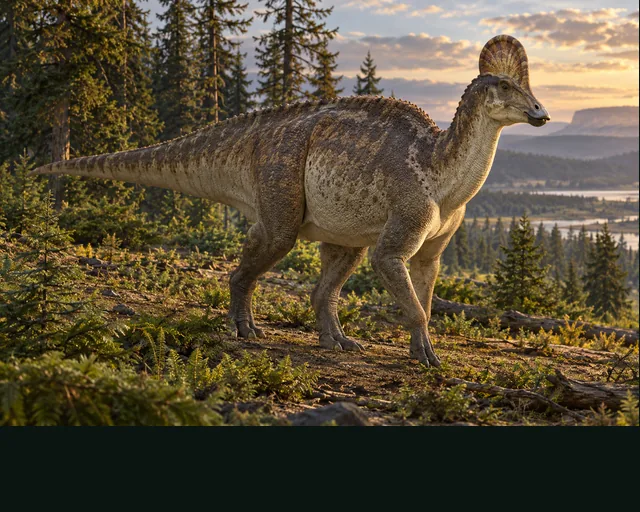
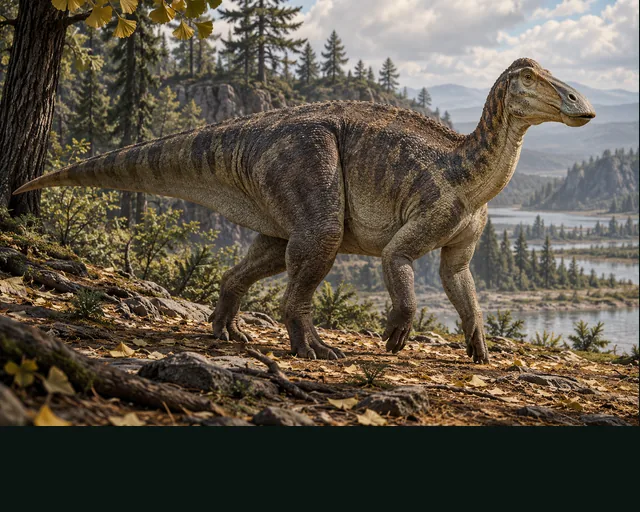
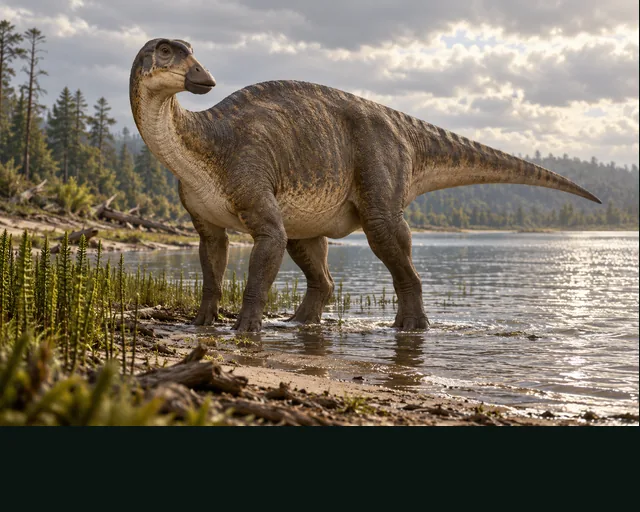
One recent summary gives adult lengths of about 7 to 7.7 metres and weights of 2.6 to 3.4 tonnes for the three species. The Natural History Museum lists a larger 9 metres, so sources disagree and the figures are estimates. Lambeosaurus could move on two or four legs, had a long tail stiffened by bony tendons, and had skin covered in small scales without large decorations, as shown by impressions from three specimens.
What was the Lambeosaurus crest for?
The head carried a tall, hollow crest, mostly built from the premaxillae, the bones at the front of the snout. Inside it ran looping air passages that linked the outer nostrils with the inner ones. For decades scientists have debated its purpose. Ideas have included a better sense of smell, help with feeding underwater, and heat control, but a 2006 braincase study found no sign that smell nerves ran into the crest. Many researchers now favour sound: the crest may have worked as a resonating chamber for calls, with visual display and recognising species or sex as secondary uses. This is a hypothesis built from anatomy and models, since we cannot hear the animals.
Were small crested hadrosaurs young Lambeosaurus?
Some of them were. Small crested hadrosaurs from Alberta were once given names such as Procheneosaurus and Tetragonosaurus. In 1975 Peter Dodson argued that many were juveniles of larger genera, and later studies agreed that several belong to Lambeosaurus. The crest only grew large late in life, so young Lambeosaurus look much like young Corythosaurus, and experts rely on small differences in the snout bones to tell them apart. Crest shape also differed with age and possibly sex, so it is a poor guide to species on its own.
What did Lambeosaurus eat?
Like other hadrosaurs, Lambeosaurus chewed plants with batteries of tightly packed teeth. Hadrosaur gut contents and possible droppings include conifer wood, seeds, fruits and leaves, which fits a generalist browser. Tooth-wear marks differ from those of the coexisting Prosaurolophus, which suggests the two fed on different plants or at different heights, with Lambeosaurus perhaps preferring more closed, wooded habitats.
Where and when Lambeosaurus lived
Lambeosaurus is known only from the Dinosaur Park Formation of Alberta, which dates to roughly 76.5 to 74.4 million years ago, in the middle of the Campanian stage. Species appear in sequence: L. clavinitialis is the oldest, followed by L. lambei, and L. magnicristatus appears later. The landscape was a coastal plain crossed by rivers, with conifers, ferns and flowering shrubs, and the nearby Western Interior Seaway was spreading west. Its neighbours included Parasaurolophus and Corythosaurus, as well as the tyrannosaurids Gorgosaurus and Daspletosaurus.
Classification and fossil record
The Paleobiology Database taxonomic record catalogues Lambeosaurus under Corythosaurini. This is the immediate parent in that catalogue, rather than a complete list of evolutionary relationships.
The corroborated occurrence sample includes Canada; those are modern discovery locations, not a complete ancient geographic range.
Research starting point
The catalogue links Lambeosaurus to Parks, 1923, published in University of Toronto Studies, Geology Series. This identifies a research starting point; the catalogue’s citation alone does not verify every later reconstruction or species assignment.
For the meaning of taxonomic terms and how evidence is checked, see the glossary and editorial policy.
Quick answers
- Is Lambeosaurus a dinosaur?
- Yes. Lambeosaurus was a crested, duck-billed hadrosaur, a plant-eating ornithischian dinosaur from the Late Cretaceous of western North America.
- When did Lambeosaurus live?
- Lambeosaurus lived in the Campanian stage of the Late Cretaceous, roughly 76.5 to 74.4 million years ago, based on the dating of the Dinosaur Park Formation.
- How big was Lambeosaurus?
- Estimates are around 7 to 7.7 metres long and 2.6 to 3.4 tonnes, though the Natural History Museum lists about 9 metres, so sources differ.
- What was the crest of Lambeosaurus for?
- It is uncertain, but many researchers think the hollow crest acted as a resonating chamber for calls, and also helped animals recognise each other.
- Where was Lambeosaurus found?
- Lambeosaurus fossils come from the Dinosaur Park Formation in Alberta, Canada, mainly along the Red Deer River and in Dinosaur Provincial Park.