Jurassic Dinos editorial · Updated · Source-based review
What is Edmontosaurus?
Edmontosaurus was a large North American duck-billed dinosaur with species from different parts of the Late Cretaceous.
Distinctive features and evidence
Edmontosaurus regalis and Edmontosaurus annectens should be distinguished when discussing age and anatomy. Only the latest populations belong to the end-Cretaceous communities familiar from comparisons with Tyrannosaurus and Triceratops.
Genus overview and research references.
Edmontosaurus fossil discoveries
Edmontosaurus is known from many specimens, including several with skin impressions. The older of the two species to be named, E. annectens, was described by Othniel Charles Marsh in 1892 as Claosaurus annectens, from skeletons that John Bell Hatcher collected in 1891 in the Lance Formation of Wyoming. It was among the first dinosaurs to get a skeletal restoration, and mounted skeletons of it went on display in the United States in 1901 and 1904.
The genus name came later. Lawrence Lambe created Edmontosaurus in 1917 for two partial skeletons from the Horseshoe Canyon Formation along the Red Deer River in Alberta. The type species, E. regalis, is based on one found in 1912 by Levi Sternberg. Two famous “mummies”, fossils with large areas of skin impressions, were found in Wyoming in 1908 and 1910, and a third, nicknamed Dakota, was found in North Dakota in 1999.
Why does Edmontosaurus have so many names?
Older books and museum labels often use the names Anatosaurus (“duck lizard”) and Anatotitan (“giant duck”) for fossils that are now placed in Edmontosaurus. For much of the twentieth century these were treated as separate genera, and the same skeletons also appeared under Claosaurus, Trachodon and Thespesius.
In 2011, Nicolás Campione and David Evans measured skulls of many sizes and found that features once used to name extra species tracked growth instead. Their result left two valid species, one from the late Campanian and one from the late Maastrichtian. The skull became longer and flatter with age, so Anatotitan is now read as fully grown E. annectens. Alaskan fossils once given the genus name Ugrunaaluk are treated by several later studies as Edmontosaurus, although this is still discussed.
How big was Edmontosaurus?
Edmontosaurus was one of the largest duck-billed dinosaurs, but the numbers vary. The Natural History Museum gives about 13 metres and 3,400 kilograms. Other published estimates suggest 9 to 12 metres for adults. A 2022 growth study of E. annectens proposed 11 to 12 metres and roughly 5.6 tonnes. The two famous mounted skeletons from Wyoming are 8 and nearly 9 metres long and were probably not fully grown.
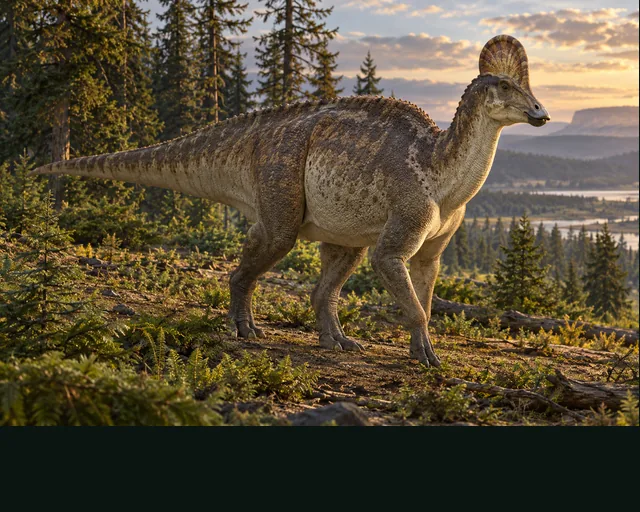
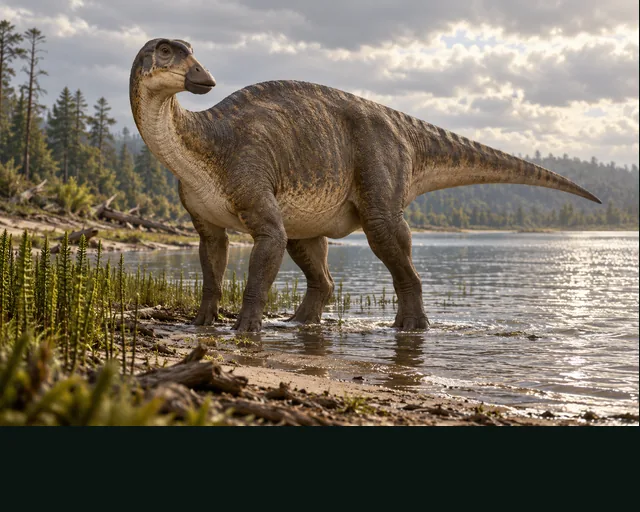
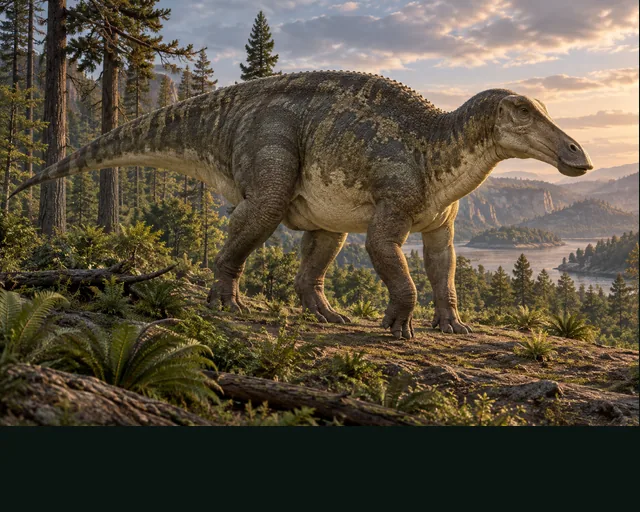
The skull of an adult could exceed a metre. It had a broad, duck-like beak, no bony crest, and a tail stiffened by rods of ossified tendon. Scientists think it walked on four legs most of the time and rose onto two for faster movement.
What did Edmontosaurus eat?
Edmontosaurus was a plant-eater. Its beak cropped vegetation, and its cheek teeth were packed into dental batteries, columns of teeth replaced continually, which could slice and grind. Scratches on the teeth led some researchers to suggest grazing rather than browsing, though the wear resembled that of other hadrosaurids. Older ideas that it fed in water like a duck have been rejected.
The Natural History Museum notes conifer needles, twigs and seeds found with a mummy now in Germany, but scientists are cautious. The plants could have been washed into the carcass after death, and the specimen was heavily prepared, so the question cannot now be settled.
Where and when Edmontosaurus lived
Edmontosaurus lived across western North America, with fossils reported from Colorado north to Alaska. E. regalis lived about 73 million years ago and is known from Alberta. E. annectens comes from the end of the Maastrichtian, about 66 million years ago, in Saskatchewan, Montana, South Dakota and Wyoming, where it shared its world with Triceratops and Tyrannosaurus shortly before the end-Cretaceous extinction. The Natural History Museum gives a broader span of 76 to 66 million years ago.
Bone beds with many skeletons have been used to suggest group living, though a bone bed alone does not show behaviour. A damaged tail in the Denver Museum was once read as a tyrannosaur attack, but more recent studies dispute that.
Classification and fossil record
The Paleobiology Database taxonomic record catalogues Edmontosaurus under Edmontosaurini. This is the immediate parent in that catalogue, rather than a complete list of evolutionary relationships.
The corroborated occurrence sample includes United States, Canada; those are modern discovery locations, not a complete ancient geographic range.
Research starting point
The catalogue links Edmontosaurus to Lambe, 1917, published in The Ottawa Naturalist. This identifies a research starting point; the catalogue’s citation alone does not verify every later reconstruction or species assignment.
For the meaning of taxonomic terms and how evidence is checked, see the glossary and editorial policy.
Quick answers
- Is Edmontosaurus a dinosaur?
- Yes. Edmontosaurus was a large duck-billed dinosaur, a hadrosaurid from the Late Cretaceous of western North America.
- How big was Edmontosaurus?
- Estimates vary. The Natural History Museum gives about 13 metres, other estimates give 9 to 12 metres, and a 2022 study of E. annectens suggested roughly 11 to 12 metres and 5.6 tonnes.
- When did Edmontosaurus live?
- E. regalis lived about 73 million years ago and E. annectens about 66 million years ago, near the end of the Cretaceous. Overall the genus spans roughly 76 to 66 million years.
- What did Edmontosaurus eat?
- It was a herbivore. Its beak and grinding teeth suggest tough plants such as conifer needles and shrubs, though the exact diet is still debated.
- What is the difference between Edmontosaurus and Anatotitan?
- None, according to current research. Anatotitan was based on skulls that a 2011 study showed to be fully grown Edmontosaurus annectens, so the name is treated as a synonym.