Jurassic Dinos editorial · Updated · Source-based review
What is Triceratops?
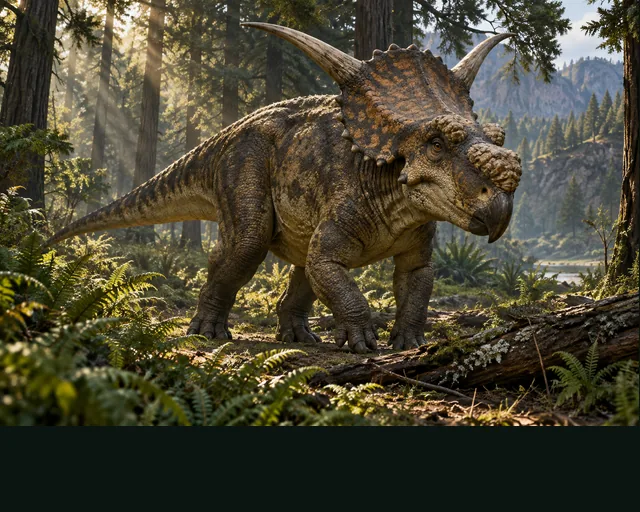
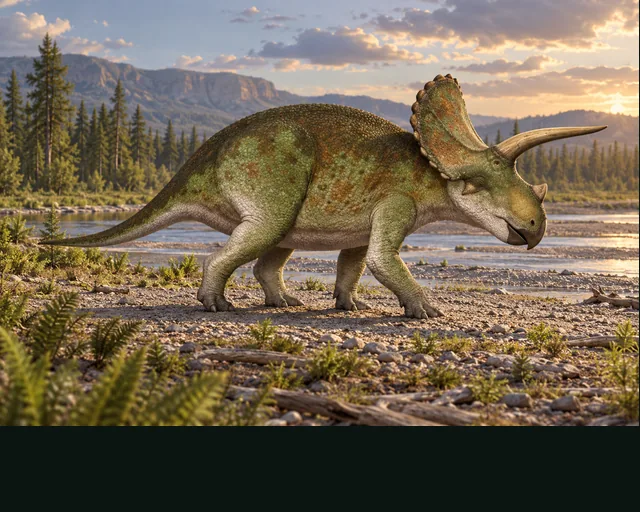
Triceratops was a latest Cretaceous North American ceratopsian with three prominent skull horns and a bony frill.
Distinctive features and evidence
It belongs to the final non-avian dinosaur communities of western North America. The horn arrangement provides a comparison with other ceratopsians, while a rhinoceros-like outline represents convergent shape rather than close mammal ancestry.
Genus overview and research references.
Triceratops fossil discoveries
The story starts in the spring of 1887, when George Lyman Cannon found a skull roof with two horns attached near Denver, Colorado. He sent it to the palaeontologist Othniel Charles Marsh, who took it for an unusually large bison and named it Bison alticornis. By the following year Marsh had realised that horned dinosaurs existed, and he named the fragmentary genus Ceratops.
The skull that became the type specimen was found in 1888 in Wyoming. According to the story, a cowboy tried to haul a skull out of a ravine with a lasso, but the horn broke off. The fossil collector John Bell Hatcher then recovered the skull for Marsh, who first called it a species of Ceratops, but once the nose horn was cleaned in the lab, he changed the name to Triceratops in 1889. Hatcher went on to collect 31 more skulls between 1889 and 1891.
Triceratops is easy to find. Barnum Brown claimed to have seen more than 500 skulls in the field, and horn, frill and tooth fragments are very common in the latest Cretaceous rocks of western North America. Skulls are far more common than other bones, which suggests that the sturdy skull was unusually likely to be preserved. A specimen nicknamed Lane, found in Wyoming in 2002, preserves exceptional detail of the skin, in the form of a thin clay layer that recorded the scales.
How big was Triceratops?
Triceratops was one of the largest horned dinosaurs, around 8 to 9 metres long, and the Natural History Museum gives 9 metres. Weight estimates range up to about 6 to 10 tonnes for the largest animals, though individual skeletons are smaller: a specimen called Kelsey was about 7 metres long with a 2-metre skull and was estimated at roughly 5.4 tonnes, and another called Big John, about 8 metres long and 3 metres tall, is thought to have lived around 60 years.
The head was huge, among the biggest of any land animal. The largest known skull is estimated at about 2.5 metres long when complete, nearly a third of the animal’s length. The two brow horns were around a metre long as bone, and in life a sheath of keratin, the same material as fingernails, would have made them longer and sharper. The skin of Lane had large pebbled scales up to about 9 centimetres across, with still larger scattered scales among them.
Triceratops looks like a rhinoceros, but the two are unrelated: Triceratops was a dinosaur and rhinoceroses are mammals. The resemblance is an example of convergent evolution, when different animals evolve similar shapes.
What were the horns and frill of Triceratops for?
For a long time the horns and frill were seen as weapons against predators. There is real evidence for fighting with a Tyrannosaurus: a brow horn and frill bone with partly healed tyrannosaur tooth marks, and the horn was broken and regrew. We cannot tell which animal started the encounter, but the Triceratops survived it. Other skulls have healed puncture holes that match the shape of a Triceratops horn, which suggests fights between Triceratops too, and one study found skull injuries in about 14 per cent of the skulls it examined.
Most researchers now think display was the main job: recognising their own species, attracting mates and showing dominance. The smallest known Triceratops skull already has a frill and horns, long before the animal could breed, which points to a role in visual signals. A frill may also have helped control body temperature. Other researchers question whether species recognition needs such structures, so the debate continues.
What did Triceratops eat, and did it live in herds?
Triceratops ate plants. A deep, narrow beak grasped and plucked vegetation, and tooth batteries in the cheeks sheared tough, fibrous material. Each battery held roughly 36 to 40 vertical columns, with three to five teeth stacked in every column. That adds up to hundreds of teeth, with only part of them in use at one time and continual replacement. Its low-slung head suggests that it mostly ate low-growing plants, though it may have knocked taller ones over. Museum accounts mention palm fronds, and other researchers have suggested cycads and ferns.
Many other horned dinosaurs left mass graves, but Triceratops mostly turns up alone. Only one bone bed dominated by Triceratops is documented, with three juveniles in Montana, and in 2012 three individuals of different sizes, from adult to juvenile, were found together in Wyoming. So the common picture of Triceratops herds is not well supported by fossils.
Is Triceratops the same as Torosaurus?
In 2010 John Scannella and Jack Horner argued that Torosaurus, a horned dinosaur with a longer frill that has two large holes, was just the fully grown form of Triceratops. They noted that ceratopsian skull bone can be reshaped as the animal ages. The proposal was heavily criticised. Later studies found Triceratops that were too old to be immature and Torosaurus that were too young to be fully mature, and in 2022 two Canadian specimens were identified as Torosaurus subadults, so many researchers now treat them as separate.
Seventeen species names have been proposed for Triceratops. Today two are accepted, T. horridus and T. prorsus, and a 2014 study found that they appear in different layers of the Hell Creek Formation, so they did not live together. Triceratops is a chasmosaurine, in the same branch as Chasmosaurus, which is not the same group as the centrosaurines such as Styracosaurus.
Where and when Triceratops lived
Triceratops lived in the last part of the Cretaceous, the late Maastrichtian, on the western landmass of Laramidia, which is now western North America. Reported ages are about 69 to 66 million years ago in one review and about 68 to 66 in the museum’s account. Its fossils come from several rock units, including the Hell Creek and Lance Formations, and it survived until the mass extinction 66 million years ago.
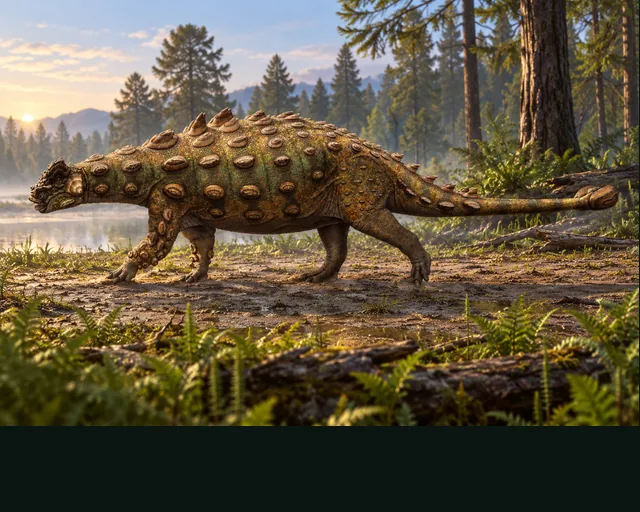
It was one of the most common large plant-eaters of its time, and in 1986 Robert Bakker estimated that it made up as much as five-sixths of the large dinosaurs. That figure is only an estimate. It shared the landscape with Tyrannosaurus, the duck-billed Edmontosaurus, Ankylosaurus and the dome-headed Pachycephalosaurus. Tyrannosaurus tooth marks on a Triceratops hip bone and sacrum show that it also fed on Triceratops carcasses.
Triceratops in the game
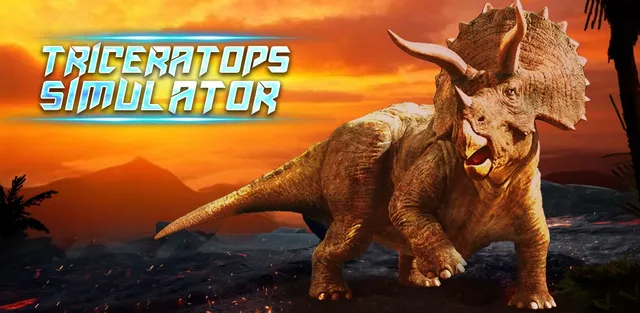
Triceratops Dinosaur Simulator lets you play a horned dinosaur on an island, with exploration, survival resources, combat upgrades, quests, weather and options to customise your dinosaur. Triceratops also appears as an opponent or neighbour in many other titles, including T-Rex: Dino Simulator and Apex Dominus Rex.
The battles, animations and abilities in these games are entertainment, not scientific evidence, so rely on the fossil record above.
Classification and fossil record
The Paleobiology Database taxonomic record catalogues Triceratops under Triceratopsini. This is the immediate parent in that catalogue, rather than a complete list of evolutionary relationships.
Discovery and naming history
Marsh first described Triceratops in 1889. Numerous subsequent skulls enlarged the evidence while many historical species names were reassessed, making growth and variation important parts of its modern interpretation. Historical overview.
The corroborated occurrence sample includes United States, Canada; those are modern discovery locations, not a complete ancient geographic range.
The sourced length estimate for Triceratops is 8–9 metres. This is an estimate for the reconstructed animal, not a measurement shared by every individual. See the body-size discussion and linked evidence for context.
Research starting point
The catalogue links Triceratops to Marsh, 1889, published in American Journal of Science. This identifies a research starting point; the catalogue’s citation alone does not verify every later reconstruction or species assignment.
For the meaning of taxonomic terms and how evidence is checked, see the glossary and editorial policy.
Quick answers
- Is Triceratops a dinosaur?
- Yes. Triceratops was a large four-legged plant-eating ceratopsian dinosaur with three skull horns and a bony frill, which lived in western North America at the end of the Cretaceous.
- When did Triceratops live?
- Triceratops lived in the late Maastrichtian, the last part of the Cretaceous, roughly 68 to 66 million years ago by museum figures, and disappeared in the mass extinction 66 million years ago.
- How big was Triceratops?
- About 8 to 9 metres long, with weight estimates up to roughly 6 to 10 tonnes for the largest. Its skull could be about 2 to 2.5 metres long.
- What did Triceratops eat?
- Plants. Its beak and many shearing teeth were suited to tough vegetation, probably mostly low-growing plants, and there is no evidence that it ate meat.
- Is Triceratops related to rhinos?
- No. Triceratops was a dinosaur and rhinoceroses are mammals. Their similar horns and bulky bodies are an example of convergent evolution, not shared ancestry.
- Was Triceratops the same animal as Torosaurus?
- That was proposed in 2010, but later studies mostly disagree. Many researchers now keep Torosaurus as a separate genus, so the question is still debated.