Jurassic Dinos editorial · Updated · Source-based review
What is Achelousaurus?
Achelousaurus was a centrosaurine horned dinosaur from Late Cretaceous Montana, recognized by skull ornaments including rough bosses.
Distinctive features and evidence
Juvenile and adult skull material helps distinguish changes during growth from differences between genera. Its frill spikes and facial bosses provide a more useful comparison with other ceratopsians than an imagined combat scenario.
Genus overview and research references.
Achelousaurus fossil discoveries
Every known Achelousaurus fossil was dug up in Glacier County, northern Montana, from rock called the Two Medicine Formation, and the collection is housed at the Museum of the Rockies. Jack Horner’s team began collecting horned-dinosaur bones around Landslide Butte in the mid-1980s. The holotype skull, MOR 485, was spotted by volunteer Sidney Hostetter in 1987, and a younger specimen, MOR 591, with a skull and about 60 per cent of a skeleton, was found in 1989 near Blacktail Creek.
Scott Sampson named the animal in 1994, using the skull MOR 485 as its reference specimen. The species name honours Horner, and the genus name refers to Achelous, a shape-shifting Greek river god who lost a horn in a fight with Hercules, a nod to the way this dinosaur seems to have lost its nose horn. The genus rests on a handful of mostly skull-based specimens, so much of the body is poorly known.
What did Achelousaurus look like?
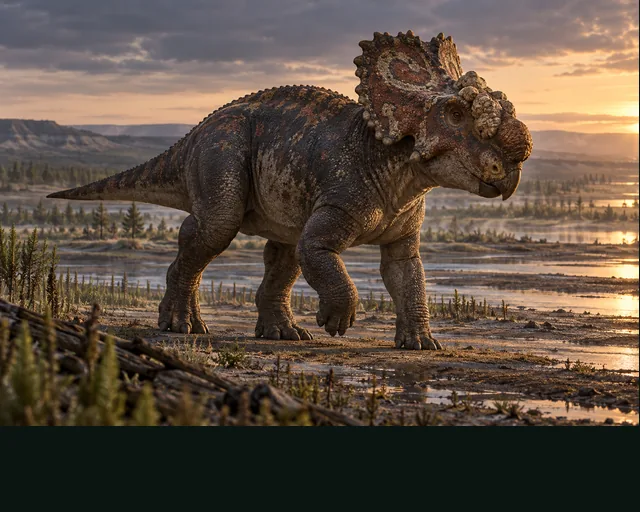
Achelousaurus was a four-legged horned dinosaur about 6 metres long, with a large head, a hooked beak and a short tail. Adults had no true horns on the nose or above the eyes. Instead they had rough, pitted lumps of bone called bosses, which probably carried a thick pad of keratin in life, though the exact shape is uncertain. Two curved spikes pointed backwards from the edge of the neck frill, bending out to the sides.
Younger animals still had real horn cores over the eyes, so the bosses developed as the individual matured. Some researchers have proposed that these bosses were used for head-butting contests, similar to musk oxen today, but that is an interpretation of bone structure, not an observed behaviour.
Is Achelousaurus related to Pachyrhinosaurus?
Yes. Achelousaurus is a centrosaurine ceratopsid, and analyses place it with Pachyrhinosaurus in a group called Pachyrostra, meaning “thick snouts”. It also sits close to Einiosaurus, which had a forward-curved nose horn instead of a boss.
Horner proposed that Einiosaurus gradually turned into Achelousaurus, which in turn led to Pachyrhinosaurus, as one lineage changing over time. Sampson did not accept this when he named the genus, and other researchers have argued for different branching patterns. Later work on growth stages has supported a close link between Einiosaurus and Achelousaurus, so the question is still being debated.
When and where did Achelousaurus live?
The fossils come from the uppermost part of the Two Medicine Formation, which is dated to roughly 77 to 74.8 million years ago in the Campanian stage. Databases that cover the whole formation or stage give a broader range. At the time the area was a seasonal, semi-arid coastal plain on the island continent of Laramidia, where dry conditions lasted most of the year and rain fell mainly in summer storms.
Horned dinosaur bones from the area show tooth marks from a large meat-eating dinosaur, which one researcher suggested was Albertosaurus, though this is only a suggestion.
Classification and fossil record
The Paleobiology Database taxonomic record catalogues Achelousaurus under Pachyrhinosaurini. This is the immediate parent in that catalogue, rather than a complete list of evolutionary relationships.
Discovery and naming history
Scott Sampson introduced Achelousaurus horneri in 1994. Its naming belongs to research on horned-dinosaur diversity, rather than a new family defined by a single unusual skull ornament. Historical overview.
The corroborated occurrence sample includes United States; those are modern discovery locations, not a complete ancient geographic range.
The sourced length estimate for Achelousaurus is about 6 metres. This is an estimate for the reconstructed animal, not a measurement shared by every individual. See the body-size discussion and linked evidence for context.
Research starting point
The catalogue links Achelousaurus to Sampson, 1994, published in Journal of Vertebrate Paleontology. This identifies a research starting point; the catalogue’s citation alone does not verify every later reconstruction or species assignment.
For the meaning of taxonomic terms and how evidence is checked, see the glossary and editorial policy.
Quick answers
- Is Achelousaurus a dinosaur?
- Yes. Achelousaurus was a plant-eating horned dinosaur, a centrosaurine ceratopsid, that lived in what is now Montana, USA, during the Late Cretaceous.
- When did Achelousaurus live?
- Its fossils come from the top of the Two Medicine Formation, dated to roughly 77 to 74.8 million years ago, in the Campanian stage of the Late Cretaceous.
- How big was Achelousaurus?
- About 6 metres long, according to published estimates. It was about as long as Einiosaurus but more heavily built, with a skull of roughly 1.6 metres in the adult holotype.
- Did Achelousaurus have horns?
- Adults had rough bony bosses on the nose and above the eyes rather than true horns, plus two curved spikes on the neck frill. Younger animals still had short brow horns.
- Where was Achelousaurus found?
- All known specimens come from the Two Medicine Formation in Glacier County, northern Montana, and are held by the Museum of the Rockies in Bozeman.