Jurassic Dinos editorial · Updated · Source-based review
What is Pachyrhinosaurus?
Pachyrhinosaurus was a Late Cretaceous North American centrosaurine with several recognized species.
Distinctive features and evidence
Skulls from Alberta and Alaska support regional and species comparisons. Its thick nasal ornamentation contrasts with the prominent pointed horn of some relatives, and different species should not be combined into one precise age range.
Genus overview and research references.
Pachyrhinosaurus fossil discoveries
Charles M. Sternberg collected the first skulls in Alberta in 1945 and 1946 and named Pachyrhinosaurus canadensis in 1950. Further remains came from the Scabby Butte site near Lethbridge, one of the first dinosaur localities found in the province, though its importance was only grasped after the Second World War.
The richest site is Pipestone Creek in Alberta, found in 1974 by the science teacher Al Lakusta. Excavations from 1986 to 1989 uncovered about 3,500 bones and 14 skulls, packed as densely as 100 bones per square metre. The bones came from animals of several ages, from juveniles to adults. Scientists think this was a mass death, perhaps caused by a failed river crossing during a flood. A team led by Philip Currie described the animal in 2008 as a second species, P. lakustai.
A third species, P. perotorum, was described from the Prince Creek Formation of Alaska in 2012, and the genus has been called the most species-rich of the centrosaurines.
What was the bump on Pachyrhinosaurus’s nose?
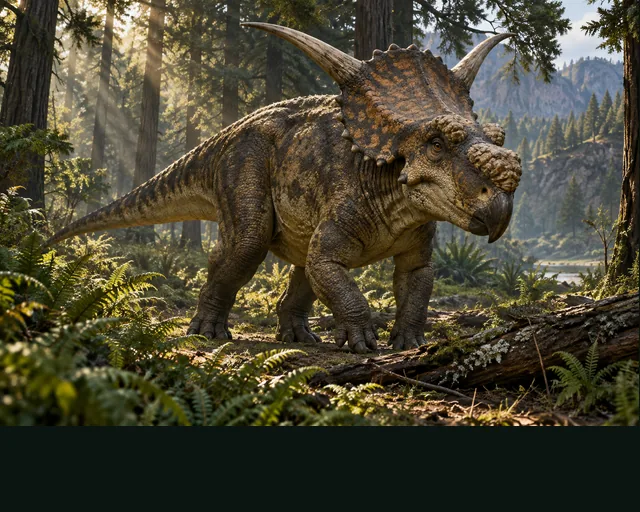
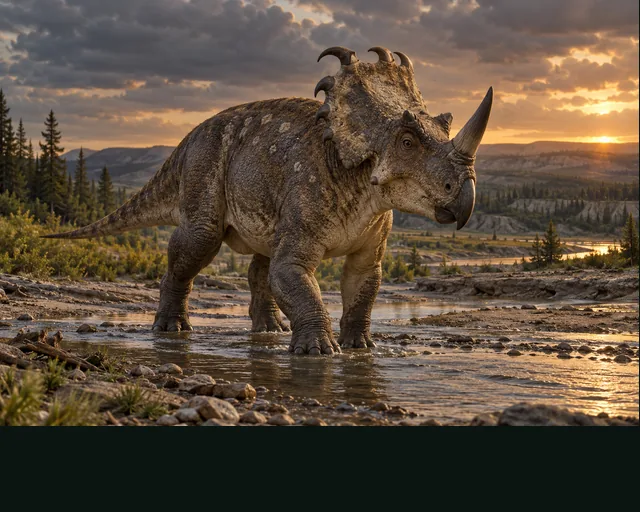
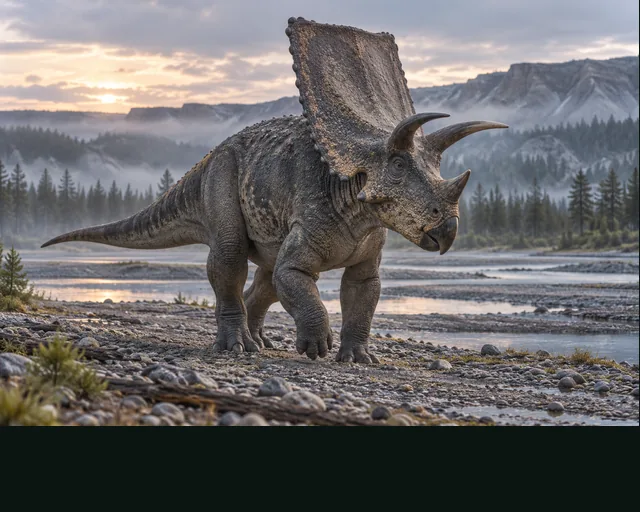
Instead of a nose horn, Pachyrhinosaurus carried a thick, rough boss, a lump of bone, over the nose, with a smaller one above each eye. Two horns rose from the top of the frill, the bony shield at the back of the skull. In the Alaskan species a study of a young nasal bone found that the boss was covered in a thick pad of horn-like material in life.
The bosses differ between species. In P. lakustai the nose and brow bosses were separated by a wide gap, while in P. canadensis and P. perotorum they almost joined. A big P. lakustai skull from Pipestone Creek, nicknamed Big Sam and found in 2024, is 138 centimetres long with a nasal boss 43 centimetres across, and was still being prepared in late 2025. Scientists have suggested the bosses were used in competition between males, but this remains an interpretation.
How big was Pachyrhinosaurus?
The biggest species, P. canadensis, is estimated at 6 to 8 metres long and 3 to 4 tonnes. Gregory Paul estimated the other two species at about 5 metres and 2 tonnes. Fossil skulls are often damaged, so these figures are estimates scaled from incomplete material.
Bone studies of the Alaskan species suggest rapid early growth: at one year old an animal had already reached about 28 per cent of adult size, but full size was not reached until around age twenty.
Is Pachyrhinosaurus related to Triceratops?
Only distantly. Both are ceratopsids, the horned-dinosaur family, but Triceratops belongs to the chasmosaurines, which tend to have longer frills and brow horns. Pachyrhinosaurus is a centrosaurine, like Centrosaurus and Achelousaurus, a group that often had a large nose horn or boss.
Where and when Pachyrhinosaurus lived
Pachyrhinosaurus lived in the last part of the Late Cretaceous in Alberta and Alaska, with a possible unnamed species in the Northwest Territories. The Natural History Museum gives a range of about 74 to 68 million years ago. The Horseshoe Canyon Formation of Alberta has been dated to about 74 to 67 million years ago and records warm, wet river deltas, swamps and coastal wetlands. Its other dinosaurs include Albertosaurus, the likely top predator, and Edmontosaurus.
Alaska was also warmer than today, but with cold, dark winters. The Alaskan bones show growth lines linked to slower growth in winter, but no unusual signs of injury or disease compared with southern ceratopsians.
Classification and fossil record
The Paleobiology Database taxonomic record catalogues Pachyrhinosaurus under Pachyrhinosaurini. This is the immediate parent in that catalogue, rather than a complete list of evolutionary relationships.
Discovery and naming history
Charles Sternberg found the first examples in Alberta in 1946 and named the genus in 1950. Later skulls from Alberta and Alaska enlarged the comparative record of species, growth stages and ornamentation. Historical overview.
The corroborated occurrence sample includes Canada, United States; those are modern discovery locations, not a complete ancient geographic range.
The sourced length estimate for Pachyrhinosaurus is 6–8 metres. This is an estimate for the reconstructed animal, not a measurement shared by every individual. See the body-size discussion and linked evidence for context.
Research starting point
The catalogue links Pachyrhinosaurus to Sternberg, 1950, published in National Museum of Canada Bulletin. This identifies a research starting point; the catalogue’s citation alone does not verify every later reconstruction or species assignment.
For the meaning of taxonomic terms and how evidence is checked, see the glossary and editorial policy.
Quick answers
- Is Pachyrhinosaurus a dinosaur?
- Yes. Pachyrhinosaurus was a plant-eating ceratopsid dinosaur, in the centrosaurine group, from the Late Cretaceous of Alberta and Alaska.
- How big was Pachyrhinosaurus?
- The largest species, P. canadensis, is estimated at 6 to 8 metres long and 3 to 4 tonnes. The other two species were probably smaller, around 5 metres.
- Did Pachyrhinosaurus have a horn on its nose?
- No. It had a large, thick bone boss over the nose instead of a horn, with a smaller boss over each eye and horns on the frill.
- Is Pachyrhinosaurus related to Triceratops?
- Only distantly. Both are ceratopsids, but Pachyrhinosaurus is a centrosaurine and Triceratops belongs to the chasmosaurines.
- Where was Pachyrhinosaurus found?
- In Alberta, Canada, and in northern Alaska, USA. A possible unnamed species is also known from the Northwest Territories of Canada.