Jurassic Dinos editorial · Updated · Source-based review
What is Centrosaurus?
Centrosaurus was a centrosaurine horned dinosaur from Canada’s Late Cretaceous Dinosaur Park Formation.
Distinctive features and evidence
Centrosaurus apertus is the species recognized in the overview. Compare its skull ornaments with those of Achelousaurus and Styracosaurus to understand ceratopsian diversity without assuming their horns had identical functions.
Genus overview and research references.
Centrosaurus fossil discoveries
Lawrence Lambe found and named the first Centrosaurus remains along the Red Deer River in Alberta. A paper by Lambe in 1904 described the bony frill of Centrosaurus and of the similar Monoclonius. The name points to the hornlets on the frill edge because the large nose horn was not yet known.
Later work uncovered huge bone beds in Dinosaur Provincial Park, also in Alberta. Some stretch for hundreds of metres and hold thousands of animals of all ages. Near the town of Hilda, a mega-bonebed has been described as possibly the largest bed of dinosaur bones ever found. Some Centrosaurus remains have also been reported from the Dinosaur Park Formation in Saskatchewan.
How big was Centrosaurus and what did it look like?
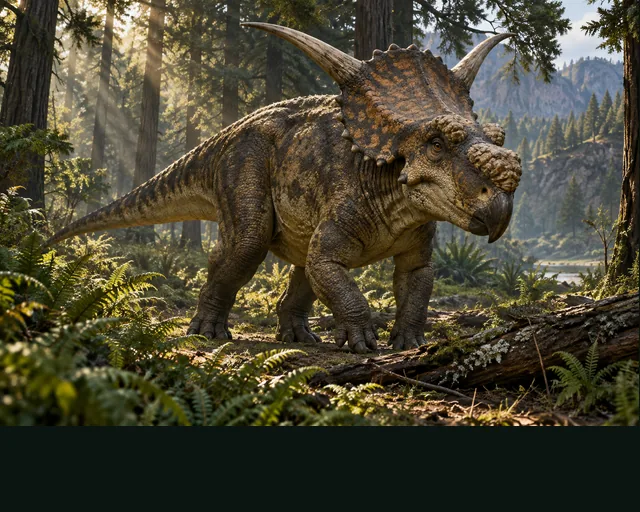
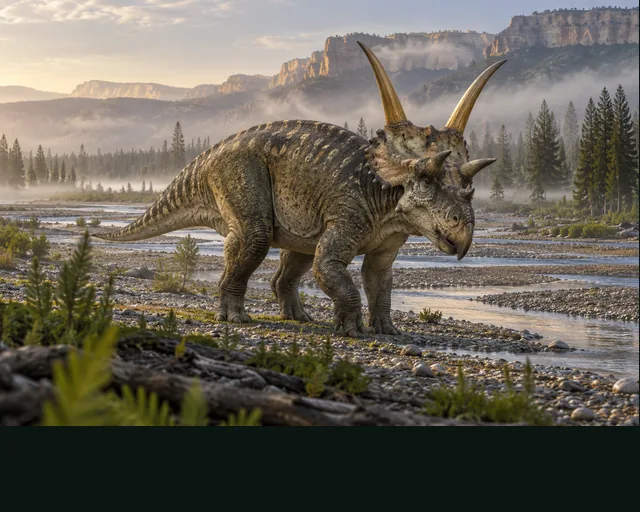
Centrosaurus was a stocky, four-legged horned dinosaur. Figures vary, from about 5 to 5.5 metres long in one summary to about 6 metres in the Natural History Museum listing, and from roughly 1 to 2.5 tonnes in weight, so treat size as approximate.
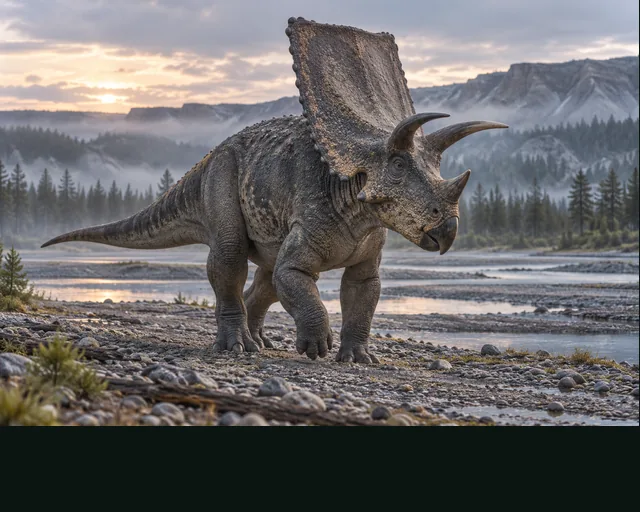
It had one large horn over the nose, which curved forwards in some specimens and backwards in others. Two hornlets hooked forwards over the frill, and a pair of small upward-pointing horns sat above the eyes. The frill itself was fairly short and had large openings. In older animals the skull decorations became less pronounced, and the frill of the biggest adults could pass half a metre in length.
Did Centrosaurus live in herds?
The giant bone beds led scientists to suggest that Centrosaurus was a herd animal that sometimes travelled in large groups. Other explanations for the deaths are also possible. One idea is that otherwise non-herding animals gathered at a waterhole during a drought, and another is that herds died while crossing a flooded river.
A single specimen with a bone cancer in its lower leg shows that a sick animal could survive for some time, which has been linked to group living. This is an interpretation, since bones cannot show how the herd behaved.
What were the horns and frill of Centrosaurus for?
The function of horned-dinosaur frills and horns has been debated since the first discoveries. Suggested uses include defence, fighting within the species, and display. A 2009 study of skull injuries in Triceratops and Centrosaurus found that they were more likely caused by horn-to-horn combat than by predator attacks. The slender frill of Centrosaurus would have made a poor shield, and it was most likely used to recognise other members of the species or to show off. The thicker, solid frill of Triceratops may have protected its neck.
Centrosaurus, Styracosaurus and Monoclonius
Centrosaurus gives its name to the subfamily Centrosaurinae, which also includes Pachyrhinosaurus, Achelousaurus and Einiosaurus. Its closest relatives appear to be Styracosaurus and Monoclonius, and Monoclonius resembles it so closely that some scientists have treated them as the same animal.
The species list has changed. A species named in 2005, C. brinkmani, was moved to its own genus, Coronosaurus, in 2012. C. nasicornus was shown by a 2014 growth study to be a middle growth stage of C. apertus. Today only C. apertus is seen as valid. In the Dinosaur Park Formation, Centrosaurus is found lower than Styracosaurus, which suggests that Styracosaurus replaced it as the environment changed.
Where and when Centrosaurus lived
Centrosaurus is known from the Dinosaur Park Formation of Alberta and Saskatchewan, in the Campanian age of the Late Cretaceous. Sources give slightly different ages: about 76.5 to 75.5 million years ago in one dating, and 76 to 74 million years ago in the Natural History Museum listing.
Though it was among the commonest dinosaurs of its time and place, Centrosaurus has not been found outside southern Alberta, apart from the Saskatchewan material. Thomas Lehman has noted that large plant-eaters of this period tended to have small ranges, which is very unlike modern large herbivores.
Classification and fossil record
The Paleobiology Database taxonomic record catalogues Centrosaurus under Centrosaurini. This is the immediate parent in that catalogue, rather than a complete list of evolutionary relationships.
The corroborated occurrence sample includes Canada; those are modern discovery locations, not a complete ancient geographic range.
The sourced length estimate for Centrosaurus is 5–6 metres. This is an estimate for the reconstructed animal, not a measurement shared by every individual. See the body-size discussion and linked evidence for context.
Research starting point
The catalogue links Centrosaurus to Lambe, 1905, published in Proceedings and Transactions of the Royal Society of Canada, series 2. This identifies a research starting point; the catalogue’s citation alone does not verify every later reconstruction or species assignment.
For the meaning of taxonomic terms and how evidence is checked, see the glossary and editorial policy.
Quick answers
- Is Centrosaurus a dinosaur?
- Yes. Centrosaurus was a horned, plant-eating ceratopsid dinosaur of the centrosaurine group from the Late Cretaceous of Canada.
- When did Centrosaurus live?
- It lived in the Campanian age of the Late Cretaceous, about 76.5 to 75.5 million years ago in one dating, or 76 to 74 million years ago in the Natural History Museum listing.
- How big was Centrosaurus?
- Centrosaurus was roughly 5 to 6 metres long. Weight estimates vary from about 1 tonne to 2.5 tonnes, so size is only approximate.
- What were the horns of Centrosaurus for?
- Scientists think horns and frills were mainly used for display, species recognition and fighting within the species, not for defence, since the frill was thin.
- Where was Centrosaurus found?
- Centrosaurus fossils come from Alberta, Canada, notably Dinosaur Provincial Park and the Hilda mega-bonebed. Material has also been reported from Saskatchewan.