Jurassic Dinos editorial · Updated · Source-based review
What is Diabloceratops?
Diabloceratops was an early centrosaurine horned dinosaur from Late Cretaceous Utah.
Distinctive features and evidence
Its discovery expanded the known geographic and temporal range of ceratopsids. Its skull ornaments offer a comparison with younger centrosaurines, while an earliest-known claim needs the date and context of the research that made it.
Genus overview and research references.
Diabloceratops fossil discoveries
The type specimen of Diabloceratops eatoni, catalogued UMNH VP 16699, was found at Last Chance Creek in Kane County, Utah, and Don DeBlieux collected it in 2002. It is a partial skull with part of the lower jaw, intact on the right side and weathered on the left, and it was found in sandstone from the Wahweap Formation. James Kirkland and Donald DeBlieux described it in 2010.
The specific name honours Jeffrey Eaton, a palaeontologist at Weber State University and a friend of Kirkland who helped establish the Grand Staircase-Escalante National Monument, where the fossil was found. The remains are held by the Natural History Museum of Utah. A second specimen collected in 1998 was assigned to the genus in 2010, but later researchers have suggested it may belong to a different, more advanced centrosaurine, so the species may rest on a single skull.
What did Diabloceratops look like?
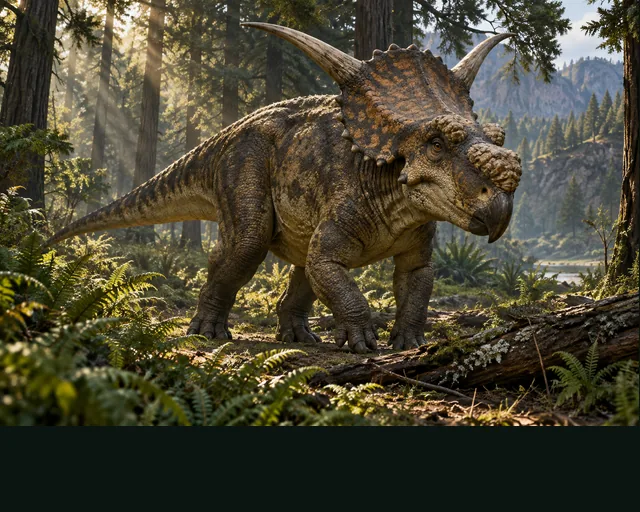
Diabloceratops was a ground-living, four-legged plant eater with a large bony neck frill. On the snout there was a small nose horn, with possibly another one ahead of it, and the horns over the eyes were relatively small. Along the frill rose two very long spikes, like those of Styracosaurus and Einiosaurus. The skull is deeper and shorter than in any other centrosaurine.
The describing team estimated an adult length of up to about 4.5 metres and a body mass of about 1.3 tonnes. That is one published estimate from a partial skull, not a measured skeleton, so treat it as approximate.
Why does Diabloceratops matter?
When it was named, Diabloceratops was the oldest known ceratopsid and the first centrosaurine known from south of Montana. That is a statement about the record in 2010, and new finds can change it. Its skull still has an extra opening that shrank or vanished in later ceratopsids, a trait it shares with earlier, more primitive horned dinosaurs. Kirkland and DeBlieux saw this as a sign that the horned dinosaurs formed a gradual series and not one tidy group.
A 2019 analysis even placed it just outside Ceratopsidae, while later studies went on treating it as an early member of the centrosaurines. The group also includes Centrosaurus and Achelousaurus, which appear later in the record.
Where and when Diabloceratops lived
The rock layer that produced the skull has been dated to about 81.27 million years ago, with a range of about 81.42 to 81.01 million years, in the Campanian stage. At that time the Western Interior Seaway was at its widest, nearly cutting southern Laramidia off from the rest of North America. The landscape had lakes, floodplains and rivers flowing east, and the climate seems to have been wet and seasonal.
Neighbours in the formation included the hadrosaur Acristavus, the duck-billed lambeosaur Adelolophus, and the theropod Lythronax, thought to be the top predator. Fish, turtles, crocodilians and many small mammals lived there too.
Classification and fossil record
The Paleobiology Database taxonomic record catalogues Diabloceratops under Centrosaurinae. This is the immediate parent in that catalogue, rather than a complete list of evolutionary relationships.
Discovery and naming history
James Kirkland and Donald DeBlieux described Diabloceratops eatoni in 2010. Its skull adds an early centrosaurine comparison to the later horned dinosaurs more commonly encountered in games. Historical overview.
The corroborated occurrence sample includes United States; those are modern discovery locations, not a complete ancient geographic range.
Research starting point
The catalogue links Diabloceratops to Kirkland and Deblieux, 2010, published in New Perspectives on Horned Dinosaurs: The Royal Tyrrell Museum Ceratopsian Symposium. Indiana University Press, Bloomington. This identifies a research starting point; the catalogue’s citation alone does not verify every later reconstruction or species assignment.
For the meaning of taxonomic terms and how evidence is checked, see the glossary and editorial policy.
Quick answers
- Is Diabloceratops a dinosaur?
- Yes. Diabloceratops was a horned dinosaur, an early centrosaurine ceratopsian, known from Late Cretaceous rocks in Utah.
- When did Diabloceratops live?
- Diabloceratops lived in the Campanian stage of the Late Cretaceous. Its rock layer has been dated to about 81.3 million years ago, within a margin of roughly 0.2 million years.
- How big was Diabloceratops?
- The describing team estimated up to about 4.5 metres in length and about 1.3 tonnes in weight. This is a single estimate based on a partial skull.
- Why is it called Diabloceratops?
- The name means devil-horned face, from the Spanish word for devil and Latinised Greek for horned face.
- Where was Diabloceratops found?
- The type skull came from the Wahweap Formation at Last Chance Creek in Kane County, Utah, in the Grand Staircase-Escalante National Monument.