Jurassic Dinos editorial · Updated · Source-based review
What is Einiosaurus?
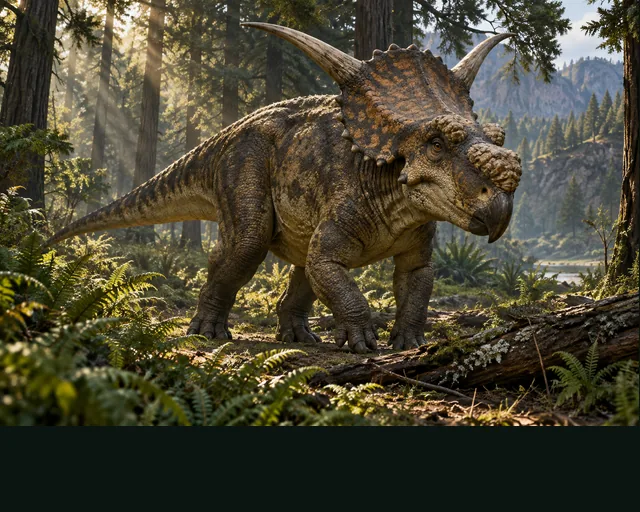
Einiosaurus was a Late Cretaceous Montana centrosaurine with a distinctive forward-curving nasal horn.
Distinctive features and evidence
The species name procurvicornis refers to that curvature. Its horn is useful for comparing ceratopsian skull diversity, but shape alone does not prove how an individual used it.
Genus overview and research references.
Einiosaurus fossil discoveries
All known Einiosaurus fossils come from northwestern Montana and are held at the Museum of the Rockies. They were found in 1985 by a team led by Jack Horner at Landslide Butte, on land of the Blackfeet reservation, after Horner lost access to his earlier dig site and needed a new place to work. Two bone beds, the Dino Ridge Quarry and the Canyon Bone Bed, were excavated between 1985 and 1989.
Between them they yielded at least fifteen individuals of different ages: three adult skulls plus a very large number of other bones. Two skulls from the Canyon Bone Bed were so heavy in their plaster jackets that a military helicopter was used to lift them out. Excavations ended in 1990, after commercial collectors were allowed onto the reservation and dug sites with bulldozers, which destroyed much of the scientific value of those places.
How Einiosaurus got its name
The team first expected these horned dinosaurs to be a known species, Styracosaurus ovatus. Horner later called them transitional forms with no formal names. Scott Sampson formally named Einiosaurus procurvicornis in a conference abstract in 1994, and described it fully in 1995. The holotype, the specimen that anchors the name, is a partial adult skull including the nasal horn.
Sampson chose a Blackfeet word, eini, for bison, to honour the tribe and because he saw horned dinosaurs as the buffalo of the Cretaceous. The species name procurvicornis means forward-bent horn.
How big was Einiosaurus?
Einiosaurus was a medium-sized horned dinosaur, and estimates differ. Gregory Paul suggested in 2010 about 4.5 metres in length and 1.3 tonnes, while the Natural History Museum gives about 6 metres. The largest known skull, the holotype, is about 1.56 metres long.
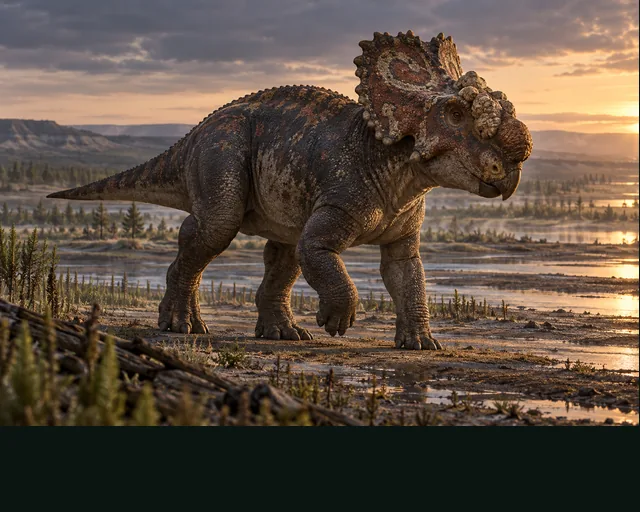
The nasal horn is the signature feature. Adult horns split into two kinds: two cores were small and upright, and four were large and curved strongly forward. The brow horns above the eyes were low and rounded, and in older individuals they could be replaced by a rounded lump or pit, as is seen in other centrosaurines. The back of the frill carried a pair of large spikes pointing backwards.
Is Einiosaurus a centrosaurine?
Yes. Einiosaurus belongs to the horned-dinosaur family Ceratopsidae and the subfamily Centrosaurinae, which usually had a prominent nose horn, unlike the chasmosaurines, such as Triceratops. Analyses place it in the group Pachyrhinosaurini with Achelousaurus, though how the closest relatives branch is still debated. Related genera include Styracosaurus, whose exact position varies between analyses, and Pachyrhinosaurus.
A long-running argument is whether Einiosaurus gradually evolved into Achelousaurus, as Horner proposed and Wilson and Scannella supported in 2016, or whether the lineages split, as Sampson proposed. A 2010 suggestion that it should be a species of Centrosaurus has not been accepted.
Where and when Einiosaurus lived
Einiosaurus comes from the Two Medicine Formation, whose rocks date to between about 83 and 74 million years ago in the Campanian. The Natural History Museum gives about 74 million years for the animal itself. The environment was warm, semiarid and very seasonal, with a long dry season and short, stormy wet season.
The bone beds are thought to record droughts, when animals crowded around the last water and died. Because single-species bone beds are known for centrosaurines, some researchers have suggested they lived in herds, but bone beds are indirect evidence of behaviour.
Classification and fossil record
The Paleobiology Database taxonomic record catalogues Einiosaurus under Pachyrhinosaurini. This is the immediate parent in that catalogue, rather than a complete list of evolutionary relationships.
Research starting point
The catalogue links Einiosaurus to Sampson, 1994, published in Journal of Vertebrate Paleontology. This identifies a research starting point; the catalogue’s citation alone does not verify every later reconstruction or species assignment.
For the meaning of taxonomic terms and how evidence is checked, see the glossary and editorial policy.
Quick answers
- Is Einiosaurus a dinosaur?
- Yes. Einiosaurus was a plant-eating horned dinosaur, a centrosaurine ceratopsid known from Late Cretaceous rocks in northwestern Montana.
- What does Einiosaurus mean?
- It means "bison lizard". The first part comes from eini, a Blackfeet word for bison, chosen by Scott Sampson to honour the Blackfeet tribe.
- How big was Einiosaurus?
- Estimates range from about 4.5 metres and 1.3 tonnes (Gregory Paul, 2010) to about 6 metres (Natural History Museum). The largest skull is about 1.56 metres long.
- What was special about the horn of Einiosaurus?
- Its nasal horn was flattened from side to side and, in some adults, curved strongly forward. Sampson used this shape to tell it apart from relatives.
- Where was Einiosaurus found?
- Only in northwestern Montana, in the Two Medicine Formation at Landslide Butte, on the Blackfeet reservation. All of the known fossils are held at the Museum of the Rockies.