Jurassic Dinos editorial · Updated · Source-based review
What is Styracosaurus?
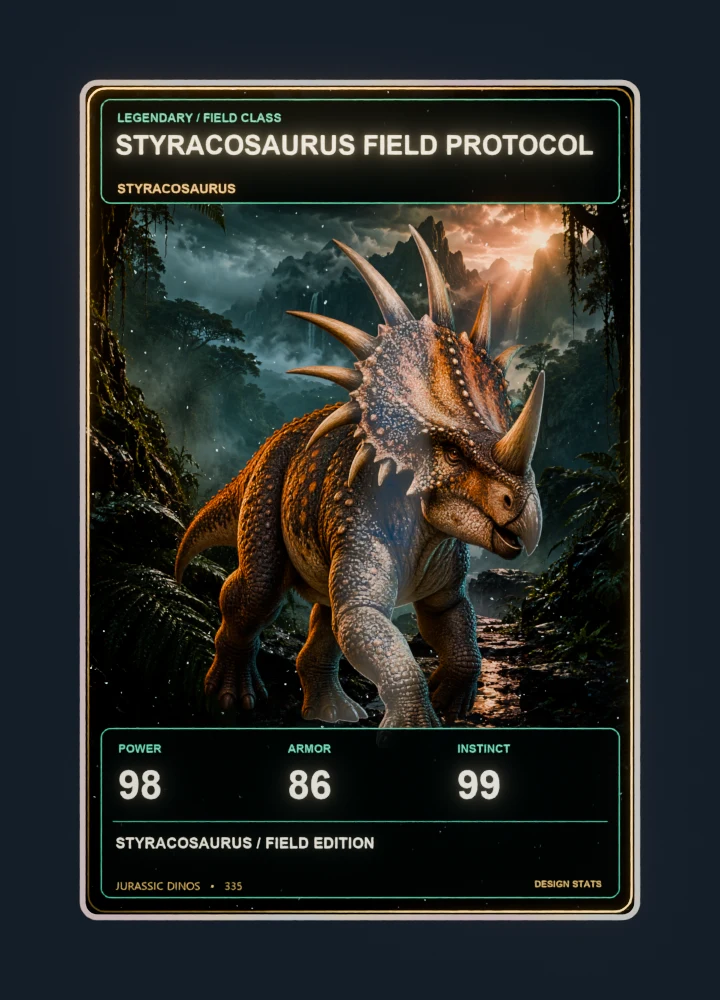
Styracosaurus was a Late Cretaceous North American horned dinosaur with long spikes around its frill.
Distinctive features and evidence
Its nasal horn and frill ornamentation distinguish it from Triceratops. Proposed display and defensive functions should be linked to research rather than inferred solely from the impressive outline.
Genus overview and research references.
Styracosaurus fossil discoveries
The first Styracosaurus was found in the summer of 1913 by Charles H. Sternberg, on a Canadian government survey expedition up the Red Deer River in Alberta. It was a mostly complete skull lying on its side, which Lawrence Lambe described that year. The rest of the skeleton was only dug up in 1935, by Charles Sternberg’s son Levi, and the Canadian Museum of Nature acquired it in 1955, which reunited the whole animal.
Barnum Brown collected a second, nearly complete skeleton in 1915. It was first thought to belong to Monoclonius and was later named Styracosaurus parksi, but it is now accepted as another specimen of the same species as the type. Styracosaurus is fairly rare even in Dinosaur Provincial Park, where most of the skulls come from, but there are more recent finds. A skeleton of a large individual was found near the town of Duchess in 2015, and a small, probably young animal was collected in 2009. At least one confirmed bone bed with many Styracosaurus skull parts has been explored.
How big was Styracosaurus?
Styracosaurus was about 5 to 5.5 metres long and weighed roughly 1.8 to 2.7 tonnes, which is the figure the Natural History Museum gives as a top weight. The type skeleton gives a length of about 5.5 to 5.8 metres and a hip height of about 1.65 metres. The legs were short, the body bulky and the tail rather short.
That was large but not the largest of the horned dinosaurs. The museum notes that relatives such as Pentaceratops and Torosaurus reached bigger sizes, and that Triceratops may have been the largest at around 9 metres. Compared with those, Styracosaurus was a compact member of its family.
How many spikes did Styracosaurus have?
Styracosaurus had a frill topped with long spikes and a single tall horn on its nose, and the exact arrangement varied from animal to animal. Accounts differ on how many large frill spikes there were: some describe four, others six or even eight. The four longest were about 50 to 55 centimetres, similar in length to the nose horn, which was estimated at close to 60 centimetres in the type skull but had a missing tip. Some individuals also had hooks or knobs along the back edge of the frill, and some did not.
Young animals had small pyramid-shaped brow horns that were replaced by pits in adults. A skull found in 2015 had unequal horns on its two sides, and the researchers compared that to deer, whose antlers are often uneven. Variation like this is one reason why dividing horned dinosaurs into species is so hard.
What were the spikes of Styracosaurus used for?
Display is the favoured explanation. Researchers have proposed that the frill was an anchor for jaw muscles, a heat-exchange surface like an elephant’s ears, a shield, or a signal to rivals and mates, and the first idea has found little support in the bones. Horned dinosaurs differ strongly from one species to the next, which fits a role in recognition or courtship. Whether the horns were used in fights is unclear. A comparison of skull injuries found them more common in Triceratops than in Centrosaurus, a close relative of Styracosaurus with similar horns, which may mean the Centrosaurus group relied more on visual display.
Styracosaurus is often shown in herds, and the bone bed shows a mass death of many animals. Researchers have suggested, however, that the animals might have gathered at a waterhole during a drought and died together, so that site does not prove that they lived as a herd.
What did Styracosaurus eat?
Styracosaurus ate plants. A deep beak at the front of the mouth grasped plants, and shearing teeth at the back sliced them. These teeth were stacked in batteries and replaced as they wore. Because the head hung low, it probably fed mainly on low-growing plants, although it could have knocked taller ones down with its horns and body. Suggestions for its menu include palms, cycads and ferns.
The Natural History Museum says there is no direct evidence of a predator attacking Styracosaurus. It shared its habitat with large tyrannosaurids such as Daspletosaurus and Gorgosaurus, and in the Two Medicine Formation of Montana Daspletosaurus appears to have specialised in preying on horned dinosaurs, so such an attacker is plausible.
Is Styracosaurus a centrosaurine, and what about Rubeosaurus?
Styracosaurus belongs to the centrosaurines, a branch of horned dinosaurs with a tall nose horn and short frills, a group that takes its name from Centrosaurus. It also includes Pachyrhinosaurus, Einiosaurus and Achelousaurus. Triceratops is a different type, a chasmosaurine, a branch whose members tended to have a short nose horn and prominent brow horns.
The genus has had a complicated history. A second species from Montana, S. ovatus, was given its own genus, Rubeosaurus, in 2010. In 2020 researchers argued that it fell inside the variation of Styracosaurus and treated the name as a duplicate, while others suggested that it is a separate Styracosaurus species or that one supposed specimen deserves a genus of its own, Stellasaurus. Today Styracosaurus albertensis is the one clearly accepted species.
Where and when Styracosaurus lived
Styracosaurus lived in the Campanian age of the Late Cretaceous, with the Natural History Museum giving about 76 to 75 million years ago. It is known mainly from the Dinosaur Park Formation of Alberta, in the upper part of that rock unit.
The area was a low-lying land of rivers and floodplains, warmer than modern Alberta, without frost and with wet and dry seasons. The Western Interior Seaway was spreading from the east, making the landscape more swampy over time. Conifers formed the tall canopy, with ferns and flowering plants below. Neighbours included other horned dinosaurs such as Centrosaurus and Chasmosaurus, duck-billed dinosaurs, the armoured Euoplocephalus and tyrannosaurids.
Styracosaurus in the game
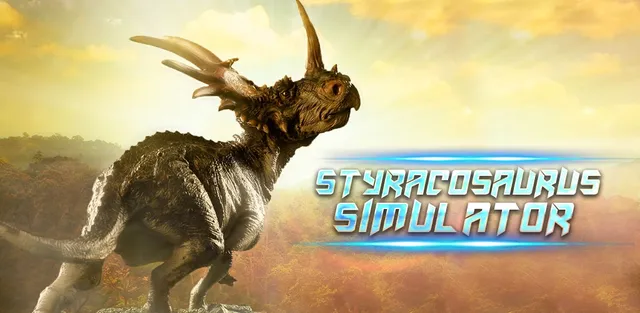
Styracosaurus: Horned Dino Sim is a horned-dinosaur game. Its store listing describes horn charges, grazing, protecting a herd and building a family. Styracosaurus is also named as a dinosaur you can meet in several other titles, such as Apex Dominus Rex and T-Rex: Dino Simulator.
Game animations and abilities are entertainment, not scientific evidence, and the real fossil record is described above.
Classification and fossil record
The Paleobiology Database taxonomic record catalogues Styracosaurus under Centrosaurini. This is the immediate parent in that catalogue, rather than a complete list of evolutionary relationships.
Discovery and naming history
Lawrence Lambe named Styracosaurus in 1913. The later reassignment of material once called Styracosaurus ovatus to Rubeosaurus illustrates continuing debate about species and genus boundaries among closely related horned dinosaurs. Historical overview.
The corroborated occurrence sample includes Canada; those are modern discovery locations, not a complete ancient geographic range.
The sourced length estimate for Styracosaurus is 5–5.5 metres. This is an estimate for the reconstructed animal, not a measurement shared by every individual. See the body-size discussion and linked evidence for context.
Research starting point
The catalogue links Styracosaurus to Lambe, 1913, published in The Ottawa Naturalist. This identifies a research starting point; the catalogue’s citation alone does not verify every later reconstruction or species assignment.
For the meaning of taxonomic terms and how evidence is checked, see the glossary and editorial policy.
Quick answers
- Is Styracosaurus a dinosaur?
- Yes. Styracosaurus was a plant-eating horned dinosaur, a ceratopsian, from the Late Cretaceous of Alberta, Canada, with a long nose horn and a frill ringed with spikes.
- When did Styracosaurus live?
- Styracosaurus lived in the Campanian age of the Late Cretaceous, roughly 76 to 75 million years ago by the Natural History Museum's figures.
- How big was Styracosaurus?
- About 5 to 5.5 metres long and roughly 1.8 to 2.7 tonnes, so large but smaller than Triceratops, which was around 9 metres.
- What did Styracosaurus eat?
- Plants. Its beak and shearing teeth suit tough vegetation, probably low-growing plants, and suggestions include palms, cycads and ferns.
- What was the frill of Styracosaurus for?
- Most researchers think display, such as species recognition or courtship, was its main job. Defence and temperature control have also been suggested, but evidence is limited.
- Was Styracosaurus related to Triceratops?
- Both were horned ceratopsids, but they belong to different branches. Styracosaurus sits in the centrosaurine branch, with a tall nose horn, while Triceratops sits in the chasmosaurine branch.