Jurassic Dinos editorial · Updated · Source-based review
What was Coronosaurus?
Coronosaurus was a horned dinosaur from Late Cretaceous Alberta. It had a prominent nose horn and a frill bearing irregular clusters of bony projections. Those crown-like clusters inspired its name and help distinguish it from other centrosaurine ceratopsids.
What makes the fossil distinctive?
The frill is more informative than a simple count of horns. Researchers examine the position, shape and growth of the projections along its edge. An artist’s symmetrical arrangement can hide the irregularity and variation present in the fossils.
Where was it found and how was it named?
Remains from two bonebeds in the Oldman Formation were first named Centrosaurus brinkmani in 2005. Reassessment led to the separate genus Coronosaurus in 2012. Multiple individuals allow comparisons that would be impossible with a single fragment, though they also reveal natural variation.
What can we infer, and what remains uncertain?
A change of genus reflects a revised interpretation of relationships and diagnostic anatomy. It does not mean the fossils suddenly became a new kind of physical object. Compare Coronosaurus with Centrosaurus and Styracosaurus to see how different frill designs can occur within one branch of horned dinosaurs. Their precise use in display or combat remains a separate question from their shape.
What makes its frill distinctive?
Irregular clusters of bony projections form a crown-like border, rather than a simple row of identical spikes.
How can you check the evidence?
The Paleobiology Database record catalogues Coronosaurus under Centrosaurini. Its linked bibliography identifies this research starting point: M. J. Ryan, D. C. Evans, and K. M. Shepherd. 2012. A new ceratopsid from the Foremost Formation (middle Campanian) of Alberta. Canadian Journal of Earth Sciences 49:1251-1262. Open the bibliographic record. A catalogue entry establishes the source trail; it does not independently verify every later illustration or behavioural claim.
Use the dated genus overview to follow the references behind the discovery and anatomy discussed above. When sources disagree, compare which specimen and rock layer each author studied. A reconstructed whole animal can combine original bones with comparisons to relatives; those two kinds of evidence should not be confused. The account above explains the particular limits that matter for Coronosaurus, rather than supplying unsupported size, speed or lifespan figures.
Read the image and keep exploring
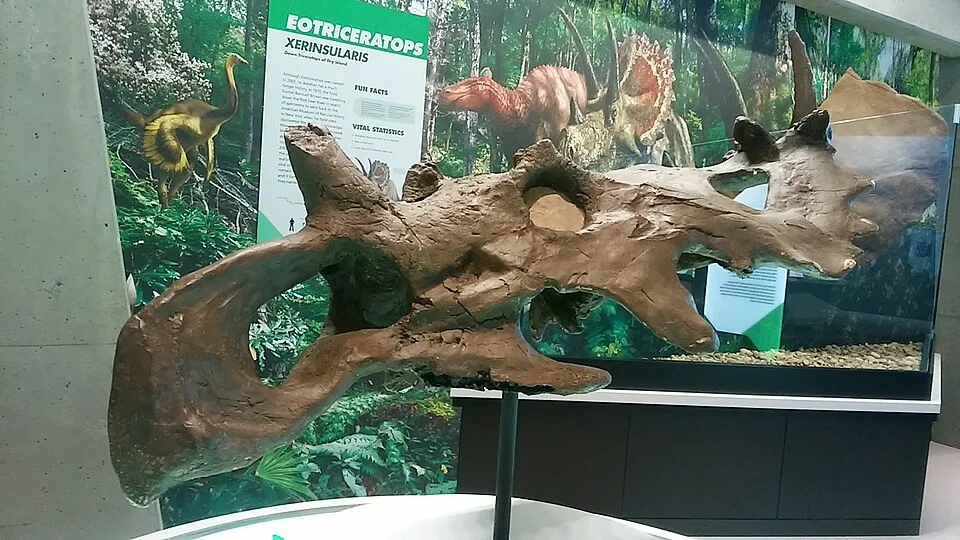
The foreground Coronosaurus skull display highlights its projecting frill ornament; neighbouring museum labels refer to other exhibits. A displayed specimen or skeletal mount can include restored parts. Its appearance should be read alongside the original specimen description.
Compare Centrosaurus, Styracosaurus, Einiosaurus. Find more names in the C index and explore ornithischian field notes. The glossary explains unfamiliar fossil terms.
Quick answers
- Where have Coronosaurus fossils been found?
- The discoveries discussed here come from Canada. Modern place names describe discovery locations, not a complete ancient geographic range.
- When did Coronosaurus live?
- It is placed in the Cretaceous period. See the discovery discussion for qualifications about the particular rock layers and dating.
- Where can I compare Coronosaurus with related dinosaurs?
- Follow the related field notes below. Comparisons explain shared anatomy; they do not imply that all the animals lived together.