Jurassic Dinos editorial · Updated · Source-based review
What is Chasmosaurus?
Chasmosaurus was a Late Cretaceous Canadian horned dinosaur with large openings in its bony frill.
Distinctive features and evidence
The frill openings inspired its name. Species assignments have changed, so descriptions should identify which specimens support an anatomical claim instead of treating every historical Chasmosaurus label as equivalent.
Genus overview and research references.
Chasmosaurus fossil discoveries
The first piece of Chasmosaurus was found in 1898 at Berry Creek, Alberta, by Lawrence Lambe of the Geological Survey of Canada. It was a single bone from the neck frill, the holotype NMC 491. Lambe thought it belonged to a known short-frilled horned dinosaur and called it Monoclonius belli, naming it after the collector Walter Bell.
In 1913 Charles H. Sternberg and his sons found several complete skulls in the middle of the Dinosaur Park Formation, which convinced Lambe that a new genus was needed. His first name, Protorosaurus, was already used for a Permian reptile, so in 1914 he created Chasmosaurus instead. A largely complete skeleton with skin impressions, found by the Sternbergs in 1913, was also assigned to the genus. All excavated Chasmosaurus specimens come from the Dinosaur Park Formation in Alberta.
What did the Chasmosaurus frill look like?
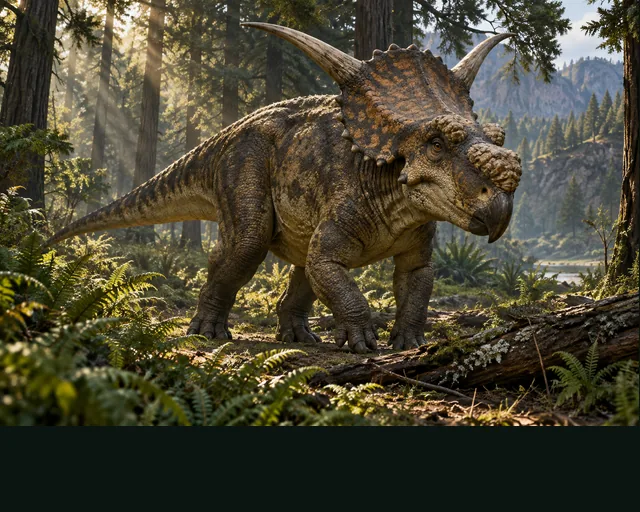
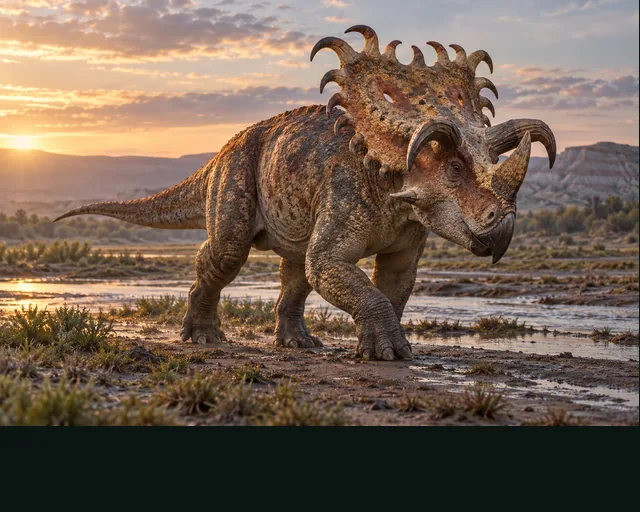
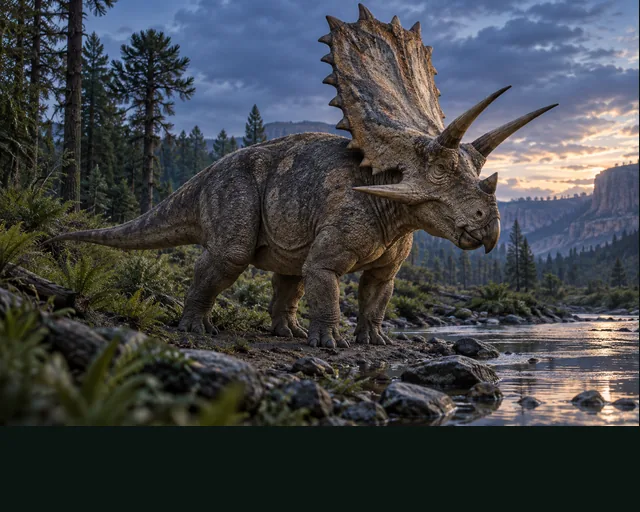
Chasmosaurus was a medium-sized horned dinosaur. It had three facial horns, one on the nose and two above the eyes, but these were usually short or almost missing. The frill was long, and the rear was V-shaped. It had six to ten ornamental bumps along each side and three at the back. Two very large triangular holes pierced it, which gave the genus its name.
Because of the holes and short horns, the frill could not have protected much. It may have helped the animal look impressive or served in display, and thermoregulation has also been suggested. Some skin impressions show large, five- or six-sided scales, up to about 55 millimetres across, set among smaller bumpy ones. No colour is known.
How many species of Chasmosaurus are there?
The answer has changed repeatedly. Today C. belli is the clearest species. Several others, such as C. kaiseni and C. canadensis, were separated by their long brow horns, but a 2016 analysis found that horn length varied too much to be a reliable difference. One species named in 2001, C. irvinensis, was later given the genus name Vagaceratops, then returned to Chasmosaurus in 2019, and a 2020 study argued for keeping it separate. Another proposed genus, Mojoceratops, has been questioned as a growth stage of Chasmosaurus. A 2026 study moved the type specimen of C. russelli into its own genus, Cryptarcus, leaving other “russelli” specimens uncertain.
A Texas species once called Chasmosaurus is now Agujaceratops. When reading older books, check which specimen a description is based on.
Was a young Chasmosaurus found?
A juvenile C. belli found in Alberta by Phil Currie and colleagues was about 1.5 metres long and estimated to be around three years old. Its limb proportions were similar to the adult’s, and the frill was narrower at the back and shorter in proportion to the skull. Skin impressions lay under the skeleton, and the surrounding rock suggests that the animal drowned, possibly during a river crossing. Some scientists have suggested that Chasmosaurus cared for its young, as has been proposed for Triceratops, but that is a hypothesis built on limited evidence.
Chasmosaurus compared with Centrosaurus
Chasmosaurus belongs to the Chasmosaurinae, which usually have long frills, while their sister group, the Centrosaurinae, usually have shorter ones. It lived on the eastern side of the island continent Laramidia and shared its habitat with successive species of Centrosaurus. Chasmosaurus had a longer snout and jaws, which may mean it was more selective about which plants it ate, helping the two avoid competing. A 2020 study suggested that Vagaceratops, once placed in Chasmosaurus, could be an ancestor of Kosmoceratops. Another ceratopsid with a very different build is the much larger Triceratops.
Classification and fossil record
The Paleobiology Database taxonomic record catalogues Chasmosaurus under Chasmosaurinae. This is the immediate parent in that catalogue, rather than a complete list of evolutionary relationships.
The corroborated occurrence sample includes Canada, United States; those are modern discovery locations, not a complete ancient geographic range.
The sourced length estimate for Chasmosaurus is 4.3–5 metres. This is an estimate for the reconstructed animal, not a measurement shared by every individual. See the body-size discussion and linked evidence for context.
Research starting point
The catalogue links Chasmosaurus to Lambe, 1914, published in The Ottawa Naturalist. This identifies a research starting point; the catalogue’s citation alone does not verify every later reconstruction or species assignment.
For the meaning of taxonomic terms and how evidence is checked, see the glossary and editorial policy.
Quick answers
- Is Chasmosaurus a dinosaur?
- Yes. Chasmosaurus was a horned, plant-eating ceratopsid dinosaur from the Late Cretaceous of Alberta, Canada.
- When did Chasmosaurus live?
- It lived in the Campanian age of the Late Cretaceous, roughly 76 to 74 million years ago according to the Natural History Museum.
- How big was Chasmosaurus?
- Chasmosaurus was medium-sized: about 4.3 to 5 metres long and roughly 1.5 to 2.5 tonnes in weight, according to the museum and a 2010 estimate.
- What was the Chasmosaurus frill for?
- The frill had huge openings, so it could not have protected much. Scientists suggest display, species recognition or temperature control, though none is proven.
- Where was Chasmosaurus found?
- All excavated Chasmosaurus specimens come from the Dinosaur Park Formation in Dinosaur Provincial Park, Alberta, Canada.