Jurassic Dinos editorial · Updated · Source-based review
What is Pentaceratops?
Pentaceratops was a Late Cretaceous North American ceratopsid known especially from New Mexico.
Distinctive features and evidence
The species Pentaceratops sternbergii anchors the genus, while other assignments have been debated. Exceptionally large skulls need individual identification before they are used to reconstruct the standard proportions of the animal.
Genus overview and research references.
Pentaceratops fossil discoveries
The first bones were collected in 1921 by the fossil hunter Charles H. Sternberg in the San Juan Basin of New Mexico, working for Uppsala University in Sweden. A year later he began an independent dig near the Fossil Forest, where he found a complete skeleton that the American Museum of Natural History acquired. Henry Fairfield Osborn named the genus in 1923, and gave the species the name sternbergii in honour of the collector.
Pentaceratops turned out to be a common fossil in two New Mexican rock units, the Fruitland and Kirtland formations. Geologists have used it as an index fossil: its first appearance marks the start of a time interval for land animals known as the Kirtlandian. About a dozen skulls and skeletons have been found, so its anatomy is known quite well. A juvenile has also turned up in Colorado, in the Williams Fork Formation.
Why is it called the five-horned face?
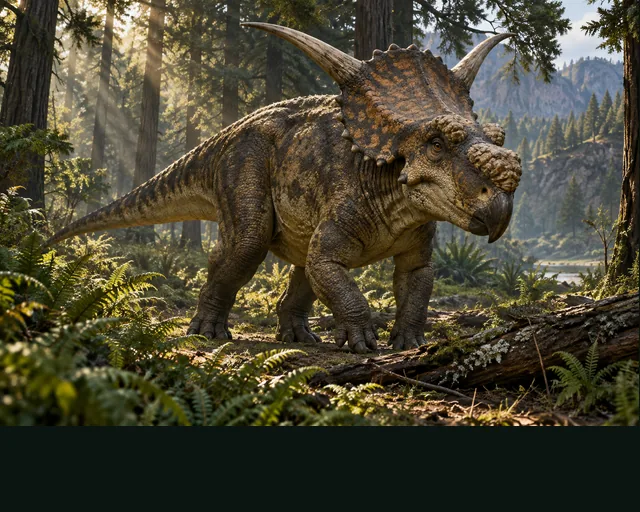
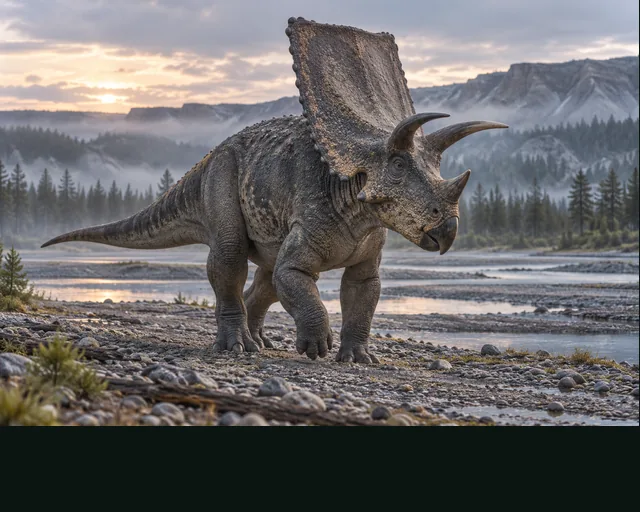
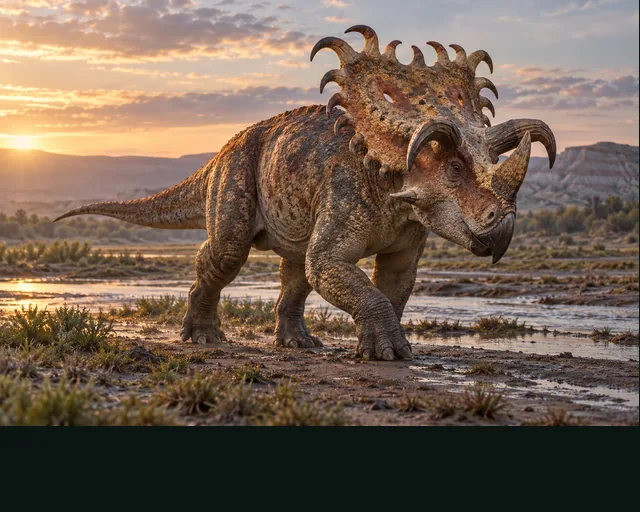
The name counts five horns: the three obvious ones seen in Triceratops, plus two more. The obvious ones are a short nose horn and two long brow horns that curve strongly forward. The extra two are spikes on the cheek bones, called epijugals, which stick out sideways under the eyes.
The frill was very long, longer than that of Triceratops, with two large openings and a row of triangular bony points along its edge. Specimens suggest a skull of about 2.2 to 2.3 metres, and the Natural History Museum notes a skull almost three metres long.
How big was Pentaceratops?
Estimates differ. Dodson estimated a body length of about 6 metres, and Gregory Paul estimated 5.5 metres and about 2.5 tonnes in 2016. The Natural History Museum lists 6.8 metres. Treat all of these as approximate figures.
One giant skull found in New Mexico in 1941 was once placed in Pentaceratops and was famous as the largest skull of any land animal. In 2011 it was moved to its own genus, Titanoceratops, because of features that resemble Triceratops. This means that the biggest skull in the old literature may not be a Pentaceratops at all.
How many species of Pentaceratops are there?
Probably one clearly valid species. A second species, P. fenestratus, was named in 1930 from Sternberg’s earlier finds. Later work treated it as the same as P. sternbergii, although a 2020 study argued it was distinct but too poorly preserved to classify. A northern species, P. aquilonius, was named in 2014 from Alberta fossils, but a 2016 study suggested it was similar to Spiclypeus and called the name doubtful.
Pentaceratops is a chasmosaurine, in the same group as Triceratops and Chasmosaurus. Its closest relative in some analyses is Utahceratops.
Where and when Pentaceratops lived
Most of the remains come from the Kirtland Formation in New Mexico, and the animal lived about 76 to 73 million years ago in the Campanian. Other dinosaurs found in the same setting include the crested hadrosaur Parasaurolophus, a pachycephalosaur, an armoured dinosaur and a tyrannosauroid.
Like all ceratopsians, Pentaceratops was a plant eater. It probably took the main plants of its day, such as ferns, cycads and conifers, using its beak to snip them and its tooth batteries to chop them up.
Classification and fossil record
The Paleobiology Database taxonomic record catalogues Pentaceratops under Chasmosaurinae. This is the immediate parent in that catalogue, rather than a complete list of evolutionary relationships.
Discovery and naming history
Fossils discovered in 1921 led to the naming of Pentaceratops sternbergii in 1923. Its New Mexican record offers a regional comparison with other ceratopsians rather than proof that all familiar horned genera shared one community. Historical overview.
The corroborated occurrence sample includes United States; those are modern discovery locations, not a complete ancient geographic range.
The sourced length estimate for Pentaceratops is 5.5–6.8 metres. This is an estimate for the reconstructed animal, not a measurement shared by every individual. See the body-size discussion and linked evidence for context.
Research starting point
The catalogue links Pentaceratops to Osborn, 1923, published in American Museum Novitates. This identifies a research starting point; the catalogue’s citation alone does not verify every later reconstruction or species assignment.
For the meaning of taxonomic terms and how evidence is checked, see the glossary and editorial policy.
Quick answers
- Is Pentaceratops a dinosaur?
- Yes. Pentaceratops was a horned, plant-eating ceratopsid dinosaur that lived in North America during the Late Cretaceous.
- Why is it called Pentaceratops?
- The name means five-horned face. It counts the nose horn, two brow horns and two sideways-pointing spikes on the cheek bones.
- How big was Pentaceratops?
- Estimates run from about 5.5 to 6.8 metres long. A famous giant skull once assigned to it now belongs to a different genus, Titanoceratops.
- When did Pentaceratops live?
- About 76 to 73 million years ago, during the Campanian stage of the Late Cretaceous, mostly in what is now New Mexico.
- Where was Pentaceratops found?
- Mostly in the San Juan Basin of New Mexico, USA, in the Kirtland and Fruitland formations. A juvenile was found in Colorado.