Jurassic Dinos editorial · Updated · Source-based review
What is Kosmoceratops?
Kosmoceratops was an ornate Late Cretaceous horned dinosaur from Utah’s Kaiparowits Formation.
Distinctive features and evidence
An adult skull and associated skeleton, together with younger material, anchor the genus. Its ornamentation provides a comparison with Nasutoceratops from the same regional fossil record without reducing diversity to a horn-count contest.
Genus overview and research references.
Kosmoceratops fossil discoveries
Since 2000 the Natural History Museum of Utah and the Bureau of Land Management have searched the Kaiparowits Formation inside Grand Staircase-Escalante National Monument. Before that work, the only horned-dinosaur remains known from the formation were isolated teeth. Volunteer Scott Richardson found the Kosmoceratops fossils at two sites in 2006 and 2007, and the species name, richardsoni, honours him.
Scott Sampson and colleagues named the genus in 2010. The type specimen is a nearly complete adult skull plus parts of the backbone, ribs, pelvis and a limb, and about 45 percent of the body skeleton was thought to be preserved at the time. The snout is bent by pressure after burial. A subadult skull about half the adult’s size was also found, and four specimens were reported in all.
What did Kosmoceratops look like?
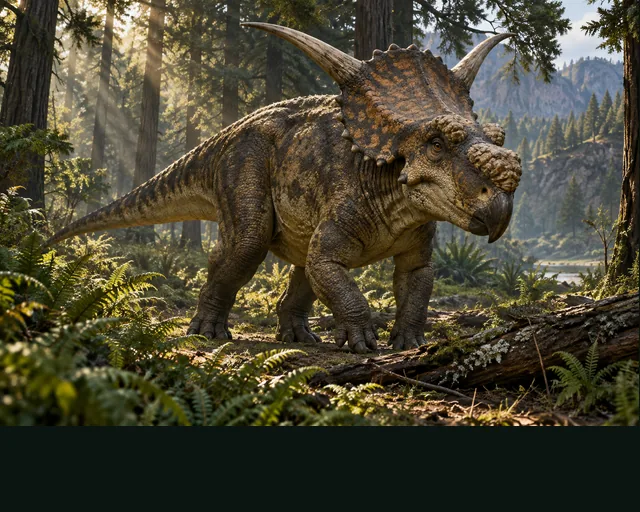
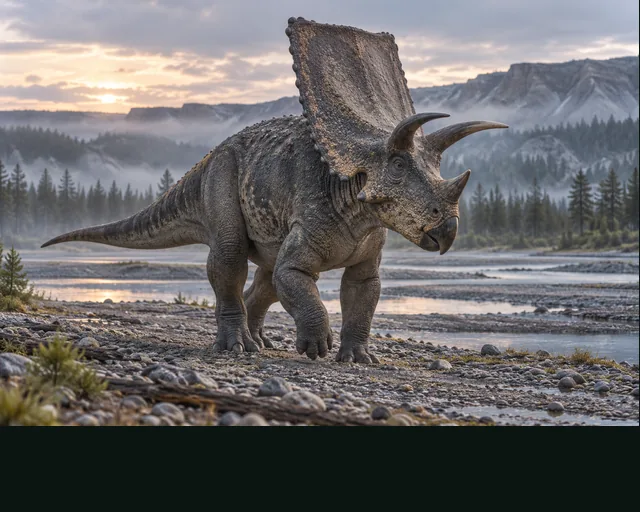
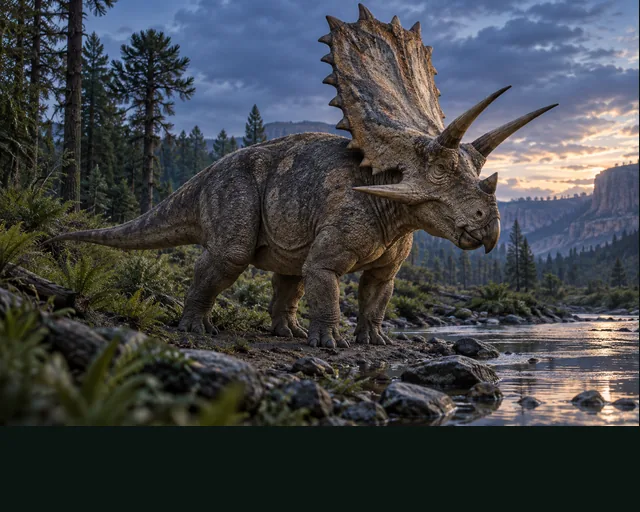
Kosmoceratops is best known for its head. The describing team counted fifteen well-developed horns and horn-like structures, the most ornate skull of any known dinosaur. There was one blade-shaped horn on the nose, a pair above the eyes, a pair of smaller cheek horns, and ten hook-like bony knobs along the back edge of the neck frill.
The brow horns were unusual. Instead of pointing forwards or backwards, as in most of its relatives, they stuck out sideways and upwards and then curved downwards to a point, a little like the horns of a bison. The frill was short from front to back and about twice as wide as it was long, with small openings. Eight of the ten hooks curved forwards over the frill and two pointed to the sides.
Published summaries estimate a length of about 4.5 metres and a weight of around 1.2 tonnes. We saw this figure in only one source, so treat it as a rough estimate for a heavily built four-legged animal.
Why did Kosmoceratops have so many horns?
Nobody knows for certain. Scientists have suggested that horns and frills worked as weapons against predators, as signals for recognising other species, or as display and combat tools in competition for mates. Sampson argued in 2010 that most of these structures would have made poor weapons against predators and were more likely used to intimidate rivals and attract partners.
Others disagree. Kevin Padian and John Horner proposed in 2011 that such oddities mainly helped animals tell species apart, and Rob Knell and Sampson replied that competition for mates fits the evidence better. A 2018 test found no statistical support for the species-recognition idea among horned dinosaurs, but the debate is not settled.
Is Kosmoceratops a chasmosaurine?
Yes. Kosmoceratops is a ceratopsid in the subgroup Chasmosaurinae, the horned dinosaurs that tend to have long frills, which includes Chasmosaurus, Pentaceratops and, among the most famous, Triceratops. In 2010 the describers linked it most closely to Vagaceratops from Alberta, Canada, partly because both have forward-curving hooks on the frill. Later studies have argued over that link, and some place Vagaceratops closer to Chasmosaurus. Spiclypeus, from Montana, has a similar frill and is also considered a close relative.
Bone slices from the thigh bones of Kosmoceratops show fast growth. The animals sampled were subadults to adults, which argues against a 2011 suggestion that Kosmoceratops was a juvenile Vagaceratops.
Where and when Kosmoceratops lived
Kosmoceratops lived in the late Campanian of the Late Cretaceous, about 76.4 to 75.5 million years ago in the original dating, though later recalibration suggests roughly 76 to 75.9 million years. At the time North America was split by a shallow sea, the Western Interior Seaway. Kosmoceratops lived on the western landmass, Laramidia, on a wet, humid coastal plain within about 100 kilometres of the sea. Swamps, ponds and lakes were fringed by tall cypress trees and ferns, and the Gulf Coast of the United States has been suggested as a modern comparison.
Neighbours included the horned dinosaurs Utahceratops and Nasutoceratops, the duck-billed Gryposaurus and Parasaurolophus, the tyrannosaur Teratophoneus and the large crocodile relative Deinosuchus. The describers argued that northern and southern Laramidia held different horned dinosaurs, but later work has questioned the dating behind that idea.
Classification and fossil record
The Paleobiology Database taxonomic record catalogues Kosmoceratops under Chasmosaurinae. This is the immediate parent in that catalogue, rather than a complete list of evolutionary relationships.
The corroborated occurrence sample includes United States; those are modern discovery locations, not a complete ancient geographic range.
Research starting point
The catalogue links Kosmoceratops to Sampson and Loewen, 2010, published in PLoS One. This identifies a research starting point; the catalogue’s citation alone does not verify every later reconstruction or species assignment.
For the meaning of taxonomic terms and how evidence is checked, see the glossary and editorial policy.
Quick answers
- Is Kosmoceratops a dinosaur?
- Yes. Kosmoceratops was a plant-eating horned dinosaur, a chasmosaurine ceratopsid, from the Late Cretaceous of Utah in the United States.
- When did Kosmoceratops live?
- Kosmoceratops lived in the late Campanian of the Late Cretaceous, about 76.4 to 75.5 million years ago, with a later recalibration suggesting roughly 76 to 75.9 million years.
- How many horns did Kosmoceratops have?
- The describing team counted fifteen horns and horn-like structures: one nose horn, two brow horns, two cheek horns and ten hooks on the back of the neck frill.
- Is Kosmoceratops a chasmosaurine?
- Yes. It belongs to Chasmosaurinae, the group of horned dinosaurs that includes Chasmosaurus, Pentaceratops and Triceratops, although the exact relationships inside the group are debated.
- Where was Kosmoceratops found?
- Kosmoceratops was found in the Kaiparowits Formation in Grand Staircase-Escalante National Monument, southern Utah, in fossils first collected in 2006 and 2007.