Jurassic Dinos editorial · Updated · Source-based review
What is Nasutoceratops?
Nasutoceratops was a Late Cretaceous Utah horned dinosaur from the Kaiparowits Formation.
Distinctive features and evidence
A subadult skull, body material and skin impressions contribute to its description. The large-nosed name points to skull anatomy, while the individual’s growth stage should be kept in view when comparing proportions.
Genus overview and research references.
Nasutoceratops fossil discoveries
Nasutoceratops comes from a long-running survey of the Kaiparowits Formation by the Natural History Museum of Utah and the Bureau of Land Management in Grand Staircase-Escalante National Monument. Before that survey, the only horned-dinosaur remains known from the formation were uninformative isolated teeth. The first site was found in 2006 by graduate student Eric Lund.
The type specimen is a mostly complete skull of a subadult together with a left forelimb, shoulder girdle, neck and back vertebrae, and three small patches of fossil skin. Two more specimens, an adult skull with partial snout bones and a single frill bone, were added from other quarries. Together they cover roughly 80 per cent of the skull but only about 10 per cent of the rest of the skeleton. Scott Sampson, Lund, Mark Loewen, Andrew Farke and Katherine Clayton named the animal in 2013, and Lund, Sampson and Loewen published a fuller description in 2016.
Why does Nasutoceratops have such a big nose and long horns?
The name points to the nostril region, which is hugely enlarged, taking up about three-quarters of the length of the skull in front of the eyes. The snout itself is short and deep. The nasal bones have internal cavities that may have held air, which is not known in other horned dinosaurs, but what the deep snout was for is unknown. Sampson said in 2013 that it probably was not for a sharper sense of smell, because the smell-sensing tissue sits further back in the head.
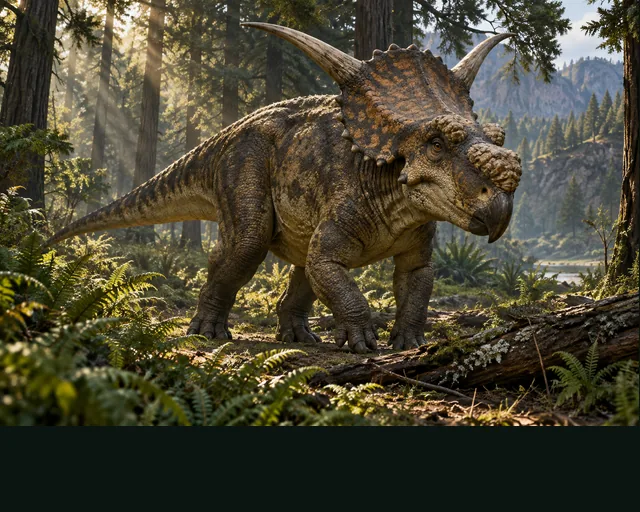
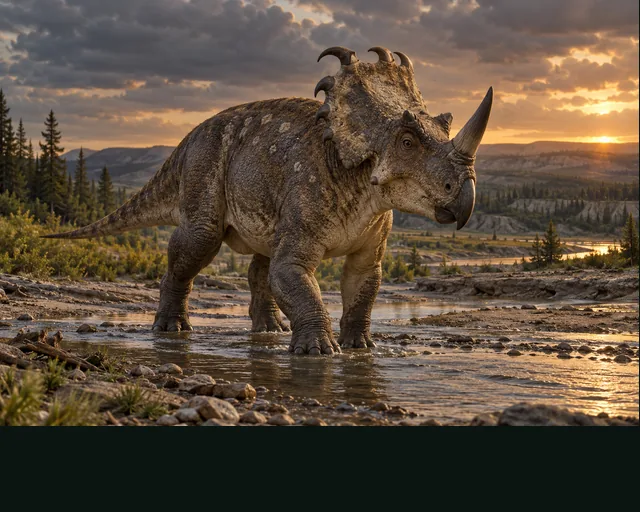
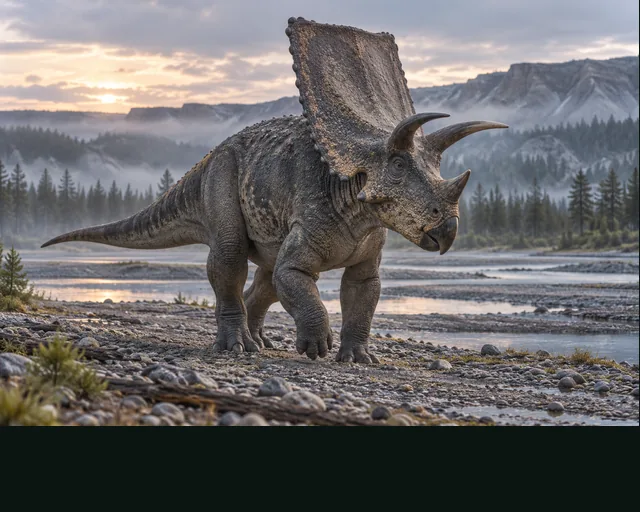
The brow horns are even more distinctive. Their bony cores reach about 457 millimetres and are the longest known of any centrosaurine, curving forward and outward and ending in an upward twist. By contrast the nose horn is low and blade-like, and the frill is nearly circular and lacks the big hooks and spikes of many relatives. The skin patches show small round and hexagonal scales. They tell us about texture, not colour.
What were the horns of Nasutoceratops for?
Nobody knows for sure. For horned dinosaurs in general, researchers have proposed signalling, species recognition and contests between rivals. Lund and colleagues suggested in 2016 that the forward-pointing, twisted brow horns could have locked with those of rivals, as happens in many modern bovids, and they could not rule out fighting. Loewen described them as probably visual signs of dominance, with use as weapons if signals failed. These are hypotheses, not recorded behaviour.
Is Nasutoceratops a centrosaurine?
Both are ceratopsids, but Nasutoceratops belongs to the centrosaurine branch, the group of Centrosaurus and Styracosaurus. The 2013 analysis found it to be the sister of Avaceratops from Montana, near the base of that branch. Later work named a group, Nasutoceratopsini, for these long-horned relatives, though a 2021 analysis did not recover it as a natural group and a 2023 one did. Its neighbour in the same formation, Kosmoceratops, belongs to the other main branch of the family.
The discovery also fed a debate about southern and northern dinosaur communities. Because Nasutoceratops differs from northern centrosaurines of the same age, the describers saw support for separate communities on the island continent of Laramidia. Later finds weakened that idea for the wider group.
Where and when Nasutoceratops lived
Nasutoceratops lived in the late Campanian, about 76 to 75.5 million years ago. Laramidia was then the western part of North America, separated from the east by the Western Interior Seaway, and the Kaiparowits region lay within about 100 kilometres of that sea. The setting was a wet, humid coastal plain with rivers, swamps and lakes, with cypress trees, ferns and floating aquatic plants in the swamps. Neighbours included Kosmoceratops, the duckbill Parasaurolophus, the tyrannosaur Teratophoneus, crocodiles and turtles.
Classification and fossil record
The Paleobiology Database taxonomic record catalogues Nasutoceratops under Nasutoceratopsini. This is the immediate parent in that catalogue, rather than a complete list of evolutionary relationships.
Discovery and naming history
Utah finds beginning in 2006 included a partial skeleton, skulls and skin impressions. The informative subadult became the type specimen of Nasutoceratops titusi in 2013, making growth stage relevant to skull comparisons. Historical overview.
The corroborated occurrence sample includes United States; those are modern discovery locations, not a complete ancient geographic range.
Research starting point
The catalogue links Nasutoceratops to Sampson and Lund, 2013, published in Proceedings of the Royal Society B: Biological Sciences. This identifies a research starting point; the catalogue’s citation alone does not verify every later reconstruction or species assignment.
For the meaning of taxonomic terms and how evidence is checked, see the glossary and editorial policy.
Quick answers
- Is Nasutoceratops a dinosaur?
- Yes. Nasutoceratops was a horned ceratopsid dinosaur, a plant eater related to Centrosaurus, found in Utah.
- When did Nasutoceratops live?
- It lived in the late Campanian of the Late Cretaceous, roughly 76 to 75.5 million years ago, based on dating of the Kaiparowits Formation.
- How big was Nasutoceratops?
- A single published estimate gives about 4.5 metres long and 1.5 tonnes, but the best specimen was a subadult and only the skull is well known, so this is rough.
- Is Nasutoceratops a centrosaurine?
- Yes. It is a centrosaurine ceratopsid, but an early-diverging one with long brow horns and a plain frill, closely related to Avaceratops.
- What does Nasutoceratops mean?
- The name means "large-nosed horned face", referring to its enlarged nostril region. The species name honours Alan Titus.