Jurassic Dinos editorial · Updated · Source-based review
What was Akainacephalus?
Akainacephalus was a heavily armoured dinosaur from Late Cretaceous Utah. Its skull bears a dense arrangement of pointed bony ornaments, reflected in a name meaning thorn head. A substantial partial skeleton preserves the connection between this distinctive head and a club-tailed ankylosaur body.
What makes the fossil distinctive?
The skull surface is not smooth. Closely arranged conical and pyramid-like structures cover much of the snout and forehead, with prominent projections around the eyes and cheeks. Researchers use the arrangement and shape of these features to distinguish the animal from other ankylosaurids. Calling all these structures horns can obscure their different anatomical positions.
Where was it found and how was it named?
The skeleton was excavated from the Kaiparowits Formation over several field seasons beginning in 2008. The preserved material includes a complete skull, a tail club, armour plates and parts of the limbs and backbone. The species name johnsoni honours volunteer fossil preparator Randy Johnson, whose work helped make the head available for scientific study.
What can we infer, and what remains uncertain?
Its ornamented skull invites comparison with Asian ankylosaurids as well as North American forms. Researchers use those similarities alongside other characters to investigate relationships and dispersal; a similar-looking head is not sufficient proof of a particular journey between continents. The bones also do not preserve the exact living colours of the armour. Compare the head with Zuul, then compare both with a nodosaur that lacks a tail club, to see the diversity hidden inside the label armoured dinosaur.
Is its armour a separate shell like a turtle’s?
No. Ankylosaur armour consists of bony structures in the skin, with additional coverings in life. It should not be reconstructed as a single turtle-like shell.
How can you check the evidence?
The Paleobiology Database record catalogues Akainacephalus under Ankylosaurini. Its linked bibliography identifies this research starting point: J. P. Wiersma and R. B. Irmis. 2018. A new southern Laramidian ankylosaurid, Akainacephalus johnsoni gen. et sp. nov., from the upper Campanian Kaiparowits Formation of southern Utah, USA. PeerJ 6(e5016). Open the bibliographic record. A catalogue entry establishes the source trail; it does not independently verify every later illustration or behavioural claim.
Use the dated genus overview to follow the references behind the discovery and anatomy discussed above. When sources disagree, compare which specimen and rock layer each author studied. A reconstructed whole animal can combine original bones with comparisons to relatives; those two kinds of evidence should not be confused. The account above explains the particular limits that matter for Akainacephalus, rather than supplying unsupported size, speed or lifespan figures.
Read the image and keep exploring
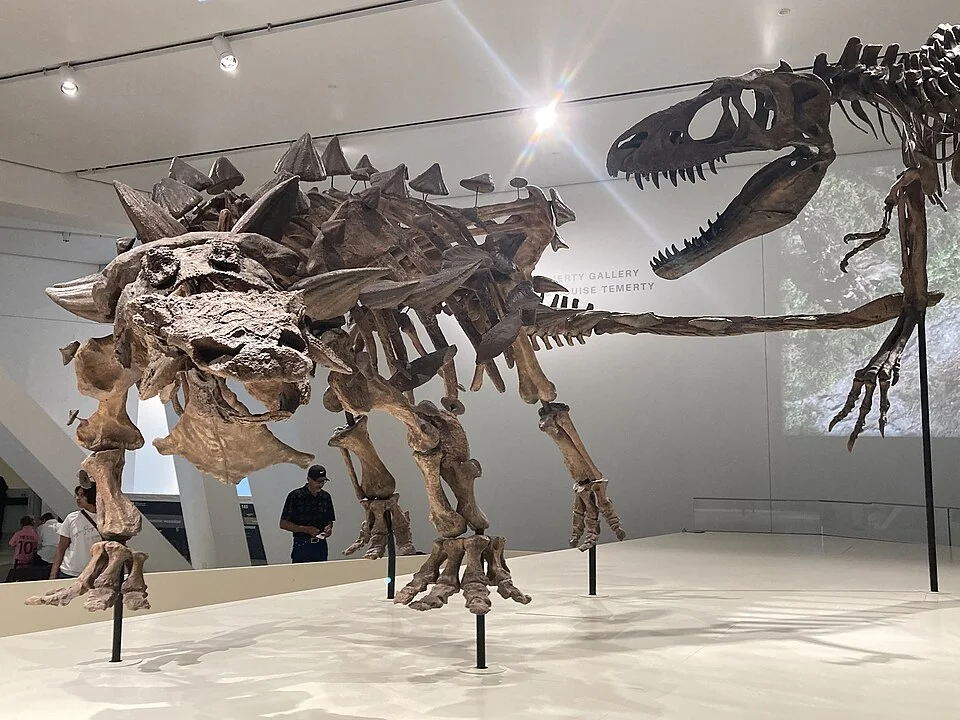
A mounted Akainacephalus skeleton presents its armoured body; the skull ornament is important for distinguishing the genus. A displayed specimen or skeletal mount can include restored parts. Its appearance should be read alongside the original specimen description.
Compare Ankylosaurus, Zuul, Saichania. Find more names in the A index and explore ornithischian field notes. The glossary explains unfamiliar fossil terms.
Quick answers
- Where have Akainacephalus fossils been found?
- The discoveries discussed here come from United States. Modern place names describe discovery locations, not a complete ancient geographic range.
- When did Akainacephalus live?
- It is placed in the Cretaceous period. See the discovery discussion for qualifications about the particular rock layers and dating.
- Where can I compare Akainacephalus with related dinosaurs?
- Follow the related field notes below. Comparisons explain shared anatomy; they do not imply that all the animals lived together.