Jurassic Dinos editorial · Updated · Source-based review
What is Saichania?
Saichania was a robust Late Cretaceous Asian ankylosaurid with strongly connected neck and shoulder elements.
Distinctive features and evidence
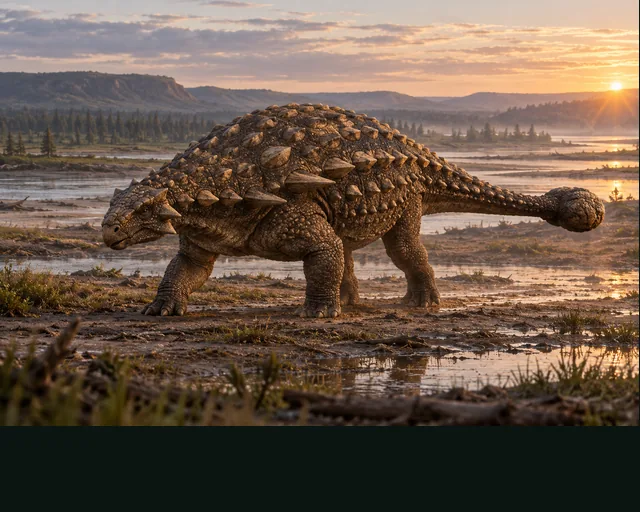
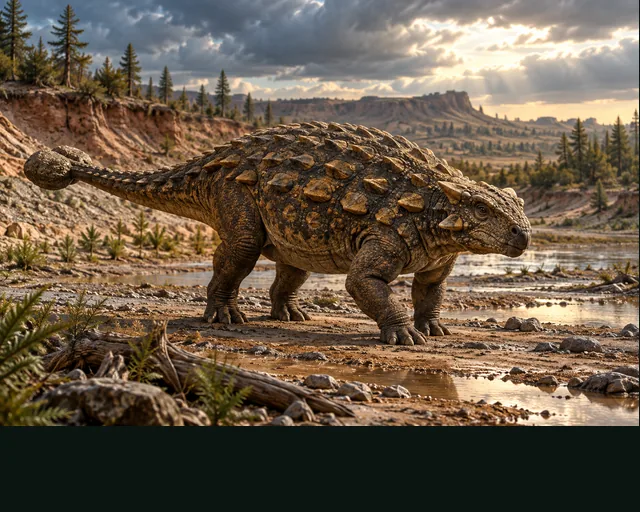
Its low body and protective cranial armor supply anatomical evidence. A reconstruction can illustrate the arrangement without claiming a tested defensive performance or inventing a confrontation with a particular predator.
Genus overview and research references.
Saichania fossil discoveries
In 1970 and 1971, a Polish-Mongolian expedition working in the Gobi Desert near Chulsan found armoured dinosaur fossils. Teresa Maryańska named Saichania in 1977. The holotype, the specimen that fixes the name, is a skull together with the front of the body, including neck and back vertebrae, the left shoulder and arm, and wide areas of armour still lying where it grew in life. It is the preservation of this specimen that gave the animal its name, meaning “beautiful”.
The record has been less tidy since. A juvenile skeleton described in detail in 2011 seemed to provide the missing rest of the body. In 2014, Victoria Arbour concluded that this skeleton had been completed with a cast of the holotype’s skull, and that the rest of it probably belonged to another ankylosaur, possibly Pinacosaurus. So for Saichania the best-documented part is still the front of the animal.
How big was Saichania?
Saichania is described as a medium-sized ankylosaur about 5 to 7 metres long. The Natural History Museum lists 6.6 metres. One published estimate puts its weight at roughly 1.4 to 2 tonnes. Large tail clubs have been found that might point to bigger individuals, but they cannot be tied to Saichania, because only the front of the holotype has been described in full. These numbers are therefore approximate, not measured from a complete skeleton.
What made Saichania so heavily built?
Like other ankylosaurids, Saichania was low and broad, with short legs and heavy armour. Even among that group it seems unusually sturdy. The neck vertebrae, shoulder girdle, ribs and breastbone were fused or locked together, and the rib shafts carried plates of bone that overlapped the next rib. The neck was guarded by two half-rings of armour, each made of six keeled segments, and rows of keeled and conical bony plates covered the back and sides.
The skull was broad, about 45 centimetres long, with bulbous armour tiles on the snout and horn-like corners at the back and cheeks. The small, leaf-shaped teeth and a horny beak suggest it cropped plants. These features describe the armour; they do not show how it was used.
Did Saichania breathe differently in the desert?
The skull of Saichania contains unusually complex air passages. Maryańska described a large nasal cavity divided into upper and lower parts, and bony scrolls inside it, called turbinates, which are rarely preserved in dinosaurs. A strongly bony palate was also present. It has been suggested that these structures might have helped cool inhaled air and reduce water loss, which would suit a hot, dry habitat. A salt gland near the nostril has been suggested as well, though the evidence for that is limited.
These are interpretations of bone shapes, not observations of the living animal, so they remain hypotheses.
Is Saichania an ankylosaurid?
Yes. Saichania belongs to Ankylosauridae, a family of armoured dinosaurs, and later analyses usually place it in the subgroup Ankylosaurinae. Maryańska linked it with Pinacosaurus, noting that both have a distinctive nasal cavity structure. It is often found close to Tarchia, and for comparison with a well-known relative, see Euoplocephalus.
The genus has also been affected by name changes. Arbour considered the Chinese genera Tianzhenosaurus and Shanxia to be junior synonyms, meaning later names for the same animal, of Saichania, and she reassigned a skull previously given to Tarchia. Other researchers contested that skull reassignment, so the limits of Saichania are still debated.
Where and when Saichania lived
Saichania was found in the Baruungoyot Formation of Mongolia, and the holotype comes from a layer dated to the late Campanian, around 73 million years ago. The Natural History Museum gives about 80 million years ago, so published dates differ. If Arbour’s reassignment of one skull is correct, Saichania also lived later, in the Nemegt Formation, where the large predator Tarbosaurus lived.
The Baruungoyot environment has been reconstructed as desert with dunes and oases. Other dinosaurs there included Lamaceratops, Bagaceratops and Tylocephale, and large predators have not yet been found in those layers. Saichania shared the habitat with the ankylosaurids Tarchia and Zaraapelta, and Arbour suggested their differently decorated heads may have helped each species recognise its own.
Classification and fossil record
The Paleobiology Database taxonomic record catalogues Saichania under Ankylosaurinae. This is the immediate parent in that catalogue, rather than a complete list of evolutionary relationships.
Discovery and naming history
Fossils recovered in Mongolia in the early 1970s led to the name Saichania chulsanensis in 1977. The preserved armor and skull allow comparisons with other ankylosaurids without assuming identical body coverings across the group. Historical overview.
The corroborated occurrence sample includes Mongolia, China; those are modern discovery locations, not a complete ancient geographic range.
The sourced length estimate for Saichania is 5–7 metres. This is an estimate for the reconstructed animal, not a measurement shared by every individual. See the body-size discussion and linked evidence for context.
Research starting point
The catalogue links Saichania to Maryanska, 1977, published in Palaeontologia Polonica. This identifies a research starting point; the catalogue’s citation alone does not verify every later reconstruction or species assignment.
For the meaning of taxonomic terms and how evidence is checked, see the glossary and editorial policy.
Quick answers
- Is Saichania a dinosaur?
- Yes. Saichania was an armoured, plant-eating ankylosaurid dinosaur from the Late Cretaceous of Mongolia and possibly China.
- When did Saichania live?
- It lived in the Late Cretaceous. The holotype layer is dated to the late Campanian, about 73 million years ago, while the Natural History Museum gives about 80 million years ago.
- How big was Saichania?
- About 5 to 7 metres long, with one estimate of 1.4 to 2 tonnes. The estimate is uncertain because only the front of the best specimen has been fully described.
- Is Saichania an ankylosaurid?
- Yes. It belongs to the armoured dinosaur family Ankylosauridae and is usually placed in the subgroup Ankylosaurinae, close to Tarchia and Pinacosaurus.
- What did Saichania eat?
- Plants. Its horny beak and small leaf-shaped teeth fit a plant diet, though no stomach contents are known, so this is inferred from anatomy.
- Where was Saichania found?
- In the Baruungoyot Formation near Chulsan in the Gobi Desert of Mongolia, and possibly in the later Nemegt Formation if one skull reassignment is correct.