Jurassic Dinos editorial · Updated · Source-based review
What is Ankylosaurus?
Ankylosaurus was an armored dinosaur from the final part of the Cretaceous in western North America.
Distinctive features and evidence
Its broad body and low skull distinguish the genus, although no complete skeleton is known. Compare it with Euoplocephalus and other armored dinosaurs instead of assuming a famous reconstruction captures every member of Ankylosauria.
Genus overview and research references.
Ankylosaurus fossil discoveries
The first specimen was found in 1906 by an expedition from the American Museum of Natural History led by Barnum Brown, in Hell Creek Formation rocks close to Gilbert Creek in Montana. A collector named Peter Kaisen spotted it and consisted of the upper skull, a pair of teeth, a shoulder fragment, vertebrae from the neck, back and tail, ribs, and over thirty armour plates. Brown named it in 1908 and, from only a few bones, drew a reconstruction that looked like a stegosaur, with a drooping tail and no club.
A far better skeleton turned up in 1910, when Brown’s team found one in the Scollard Formation of Alberta, Canada. It had a complete skull, jaws, limb bones and armour, and it still provides the only tail club known for the genus. A larger skull was collected in 1947, and some tail vertebrae came from Montana in the 1960s. Altogether, only five incomplete specimens plus scattered armour plates and teeth are known, and no complete skeleton has been found.
Oddly, the best-known ankylosaur is quite poorly known. A 2017 study by Victoria Arbour and Jordan Mallon concluded that Ankylosaurus is the best known of its group but was quite unusual compared with its relatives, and so not representative.
How big was Ankylosaurus?
Ankylosaurus is possibly the largest known member of its family. It is estimated at about 6 to 8 metres long and 4.8 to 8 tonnes. The Natural History Museum lists 8 metres and 8 tonnes. Estimates rest on just a few skulls: Kenneth Carpenter reckoned the largest-skulled individual at about 6.25 metres long, while Arbour and Mallon used comparisons with relatives to estimate 7.6 to 10 metres, and they then suggested about 8 metres as more plausible.
The smallest skull is 55.5 centimetres long and the largest 64.5 centimetres, with both skulls wider than long. The body was broad, with hind legs longer than the forelegs.
Ankylosaurus armour and tail club
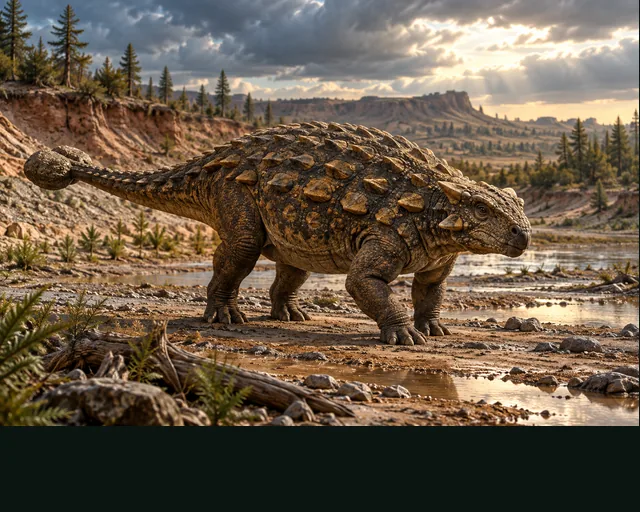
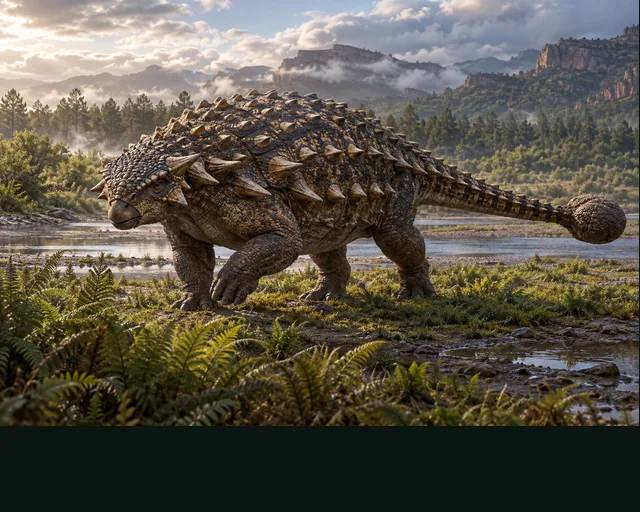
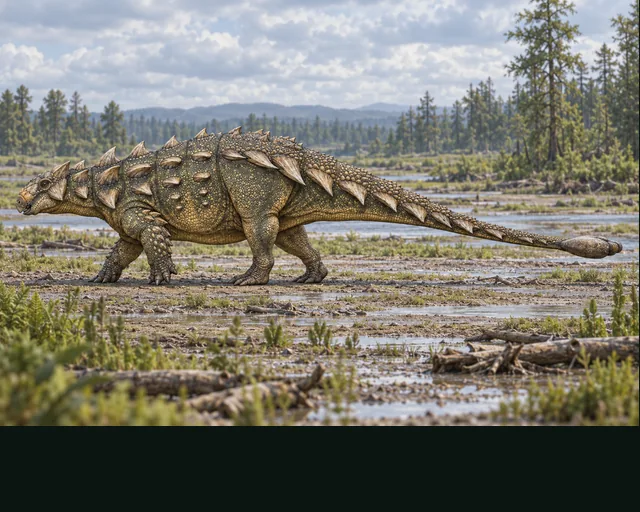
Armour was the signature of the animal. Bone plates and knobs called osteoderms were embedded in the skin, ranging from about a centimetre across to over 35 centimetres long. Because they have never been found in their original positions, their exact layout on the body is unknown. Bony half-rings protected the neck, and horns pointed backwards from the skull. Its plates were smoother than those of Euoplocephalus. Old pictures show long side spikes, but these are not known from Ankylosaurus and come from mixing it up with other armoured dinosaurs.
The club on the tail was made of two large armour plates with smaller ones, supported by tail vertebrae that were locked together and strengthened with ossified tendons. It seems to have been an active weapon that could break the bones of an attacker, although researchers cannot tell if it was used against predators, against rivals of its own kind, or both. The tail club evidence comes from one specimen, so its variation is unknown.
What did Ankylosaurus eat?
Ankylosaurus was a plant-eater. Its wide muzzle and beak suggest cropping plants without picking carefully, probably ferns and low shrubs, and perhaps fruit. The teeth were small and leaf-shaped, with the wear on the face of the crown. If it was warm-blooded, it may have needed about 60 kilograms of ferns a day, which is similar to the amount eaten by a large elephant. The broad ribcage suggests it digested food in a large fermenting gut, like some plant-eating lizards.
The odd snout has led to other ideas. The nostrils sat far back and faced down and sideways, and in 2017 Arbour and Mallon compared this with burrowing reptiles, suggesting that it may have dug in the soil for roots or even eaten some animal matter. These are possibilities, not findings, and the main picture is of a low browser.
Is Ankylosaurus a typical ankylosaur?
Ankylosaurus gave its name to the family Ankylosauridae, the armoured dinosaurs with tail clubs. Analyses place Anodontosaurus and Euoplocephalus as its nearest kin. Another armoured group, the nodosaurids, had no tail club, and includes Edmontonia, which lived in the same region. Ankylosaurs and stegosaurs together form the group Thyreophora.
The snout stands out. It had large sinuses and looping nasal passages, which may have helped to regulate heat and water, and possibly to make low-pitched sounds, though researchers disagree on these functions. It also seems to have had a keen sense of smell. Since Euoplocephalus is better known, many details here are cautiously extended from it.
Where and when Ankylosaurus lived
Ankylosaurus lived in the Maastrichtian, the final stage of the Cretaceous, about 68 to 66 million years ago, and was among the last dinosaur genera before the end-Cretaceous extinction. It has been found in the Hell Creek, Lance, Ferris, Scollard and Frenchman formations, across Montana, Wyoming, Alberta and Saskatchewan, on the western shore of the Western Interior Seaway. The region had a warm, monsoon-like climate, with floodplain forests of small flowering trees.
Its neighbours included Tyrannosaurus, Triceratops and the duck-billed Edmontosaurus. Ankylosaurus seems to have been rare. One idea is that it lived in uplands where fossils form less often, while the nodosaur Edmontonia lived on lowlands, because their remains have not been found together.
Ankylosaurus in the game
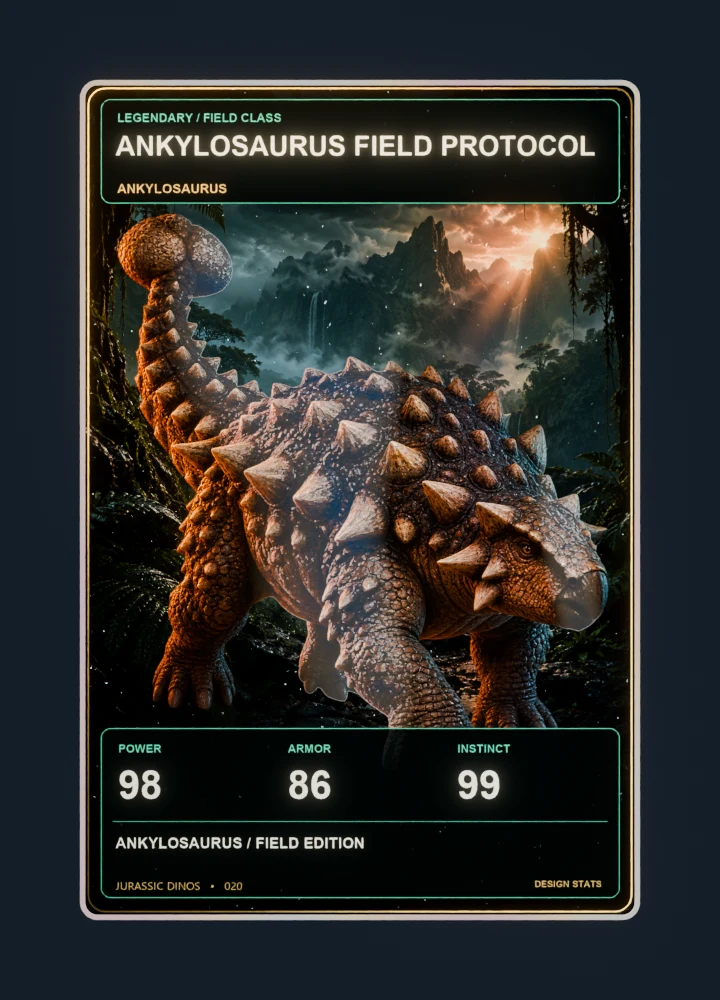
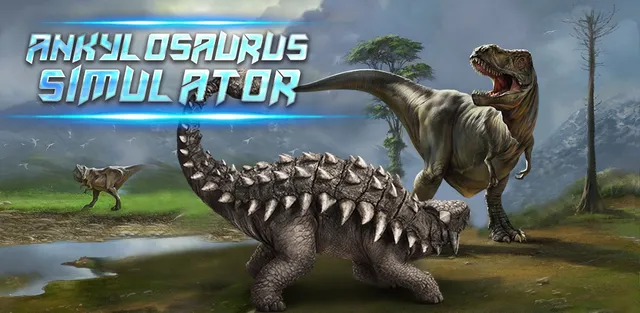
Ankylosaurus Dino Simulator puts you in the role of an Ankylosaurus. According to its store listing, you use your tail to attack other dinosaurs, collect meat, grow and upgrade skills, customise the body colours, raise a family and decorate a nest, with a 24-hour day and night cycle.
The game is entertainment. Real Ankylosaurus was a plant-eater, so features such as collecting meat and hunting are game design, not evidence about its behaviour.
Classification and fossil record
The Paleobiology Database taxonomic record catalogues Ankylosaurus under Ankylosaurinae. This is the immediate parent in that catalogue, rather than a complete list of evolutionary relationships.
Discovery and naming history
Barnum Brown named Ankylosaurus in 1908. Several later finds improved its anatomical record, but no complete skeleton is known, so restorations combine evidence from different preserved parts. Historical overview.
The corroborated occurrence sample includes United States, Canada; those are modern discovery locations, not a complete ancient geographic range.
The sourced length estimate for Ankylosaurus is 6–8 metres. This is an estimate for the reconstructed animal, not a measurement shared by every individual. See the body-size discussion and linked evidence for context.
Research starting point
The catalogue links Ankylosaurus to Brown, 1908, published in Bulletin of the American Museum of Natural History. This identifies a research starting point; the catalogue’s citation alone does not verify every later reconstruction or species assignment.
For the meaning of taxonomic terms and how evidence is checked, see the glossary and editorial policy.
Quick answers
- Is Ankylosaurus a dinosaur?
- Yes. Ankylosaurus was an armoured, club-tailed dinosaur from the end of the Cretaceous in western North America, in the family Ankylosauridae.
- When did Ankylosaurus live?
- Ankylosaurus lived about 68 to 66 million years ago, in the Maastrichtian, the very last stage of the Cretaceous Period.
- How big was Ankylosaurus?
- It is estimated at about 6 to 8 metres long and 4.8 to 8 tonnes, perhaps the largest ankylosaurid, though no complete skeleton exists.
- Is Ankylosaurus an ankylosaurid?
- Yes. Ankylosaurus is the type genus of the family Ankylosauridae, and analyses place Anodontosaurus and Euoplocephalus as its nearest kin.
- What did Ankylosaurus eat?
- It was a plant-eater, probably cropping ferns and low shrubs, perhaps fruit. Some researchers suggest it may also have dug for roots.
- Where was Ankylosaurus found?
- Fossils come from western North America, in Montana, Wyoming, Alberta and Saskatchewan. The first specimen was found in Montana in 1906.