Jurassic Dinos editorial · Updated · Source-based review
What is Edmontonia?
Edmontonia was a Late Cretaceous North American nodosaurid armored dinosaur.
Distinctive features and evidence
Its name comes from a historical geological formation name. Compare nodosaurid armor with ankylosaurid anatomy rather than adding a tail club merely because both groups are commonly called armored dinosaurs.
Genus overview and research references.
Edmontonia fossil discoveries
Edmontonia is known from good material, including skulls and skeletons with much of the armour still in its original arrangement. The type species, Edmontonia longiceps, was named by Charles M. Sternberg in 1928. Its holotype, the specimen that defines the name, includes a skull, a right lower jaw and much of the skeleton behind the skull, with armour. It was found near Morrin, Alberta, in 1924.
The second main species, Edmontonia rugosidens, has a more tangled history. Barnum Brown found the nearly complete front half of an armoured dinosaur in Alberta in 1915, but it was first assigned to a different genus, Palaeoscincus. Only in 1940 did Loris Russell move these specimens, and the 1928 skeleton that names the species, into Edmontonia. For some of the 1970s and 1980s, both species were even shown under the name Panoplosaurus.
How big was Edmontonia?
Size estimates vary widely, which is common for armoured dinosaurs. The Natural History Museum gives about 4 metres. Other published estimates are longer: one length estimate is about 6.6 metres, and Gregory Paul suggested in 2010 that both main species were about 6 metres long and about 3 tonnes. Treat any single figure as approximate.
The skull reached up to about half a metre. The front of the snout had a horny beak and no teeth in the premaxillae, the front bones of the upper jaw, while the rows behind it held small teeth.
What was Edmontonia’s armour like?
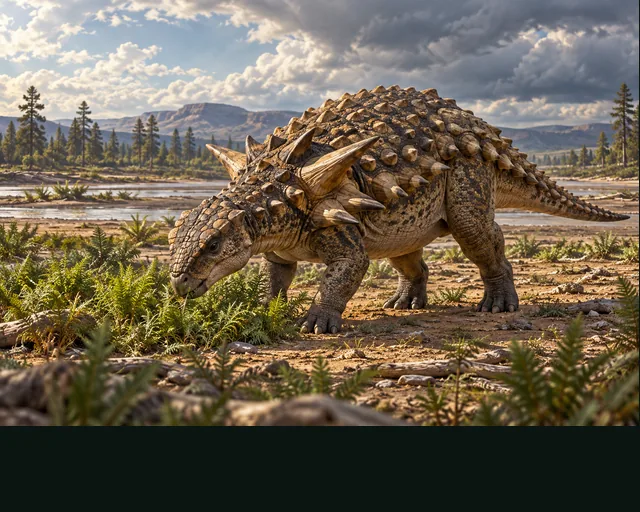
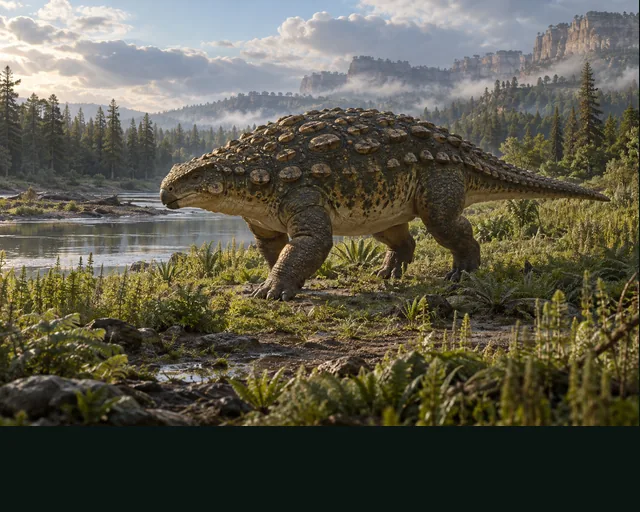
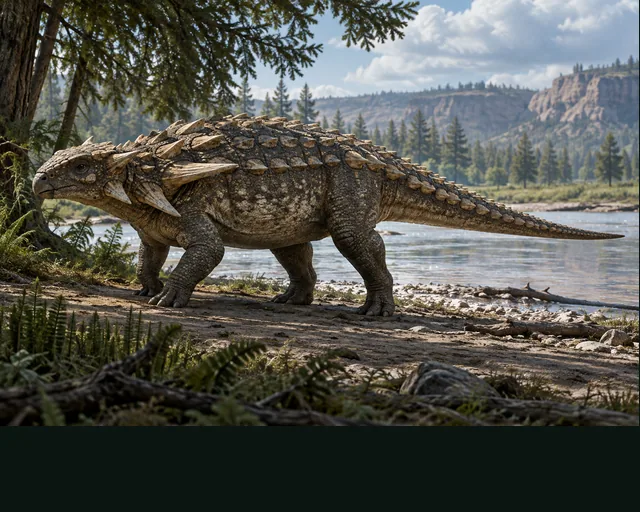
Edmontonia was bulky and broad, with small oval, ridged bone plates across its back and head. Three half-rings of larger keeled plates protected the neck and shoulders. On each side, four large spikes stuck out from the shoulder region, and in E. rugosidens the second of them was split into smaller points. The tail armour is unknown.
The shoulder spikes point forward, which surprised early researchers. Charles Gilmore suggested they had shifted as the body was buried, but Kenneth Carpenter and Gregory Paul found they could not be rotated without breaking the fit with the rest of the armour. Scientists have suggested the spikes were used for defence, to intimidate rivals or predators, or in contests between individuals, but this is interpretation, not observed behaviour.
Is Edmontonia a nodosaurid?
Yes. Russell placed Edmontonia in the Nodosauridae in 1930, and later analyses have agreed. Its closest known relative is Panoplosaurus, and more recent work places both within a group called Panoplosaurini. Nodosaurids differ from ankylosaurids such as Euoplocephalus, which carried a bony tail club.
The two groups are not identical in the head, either. Edmontonia has a secondary palate, a bony roof that separates the mouth from the nasal passages, as ankylosaurids do. Researchers think this may be a case of similar traits evolving separately in the two lineages. A skull study in 2006 also found multiple air passages in its snout, though simpler than the coiled ones of ankylosaurids.
Where and when Edmontonia lived
Edmontonia lived in western North America in the Late Cretaceous, but the species are of different ages. E. rugosidens comes from the Dinosaur Park Formation in Alberta, about 76.5 to 75 million years ago, while E. longiceps comes from the Horseshoe Canyon Formation, at about 72 million years ago. The museum’s broader range is 76 to 74 million years ago.
In the Horseshoe Canyon environment, hadrosaurs such as Edmontosaurus made up about half of the known dinosaurs, and the Albertosaurus tyrannosaur was the main large predator. Tree rings from the area show strong seasons, which researchers think may explain why many armoured skeletons were buried with their plates still in place.
Classification and fossil record
The Paleobiology Database taxonomic record catalogues Edmontonia under Nodosauridae. This is the immediate parent in that catalogue, rather than a complete list of evolutionary relationships.
The corroborated occurrence sample includes United States, Canada; those are modern discovery locations, not a complete ancient geographic range.
Research starting point
The catalogue links Edmontonia to Sternberg, 1928, published in Transactions of the Royal Society of Canada, series 3. This identifies a research starting point; the catalogue’s citation alone does not verify every later reconstruction or species assignment.
For the meaning of taxonomic terms and how evidence is checked, see the glossary and editorial policy.
Quick answers
- Is Edmontonia a dinosaur?
- Yes. Edmontonia was an armoured, plant-eating ornithischian dinosaur from the Late Cretaceous of western North America, in the family Nodosauridae.
- How big was Edmontonia?
- Estimates range from about 4 metres to about 6.6 metres long, and Gregory Paul suggested about 3 tonnes in 2010. The wide spread reflects different methods and species.
- Did Edmontonia have a tail club?
- No tail club is known. Edmontonia was a nodosaurid, and its tail armour is not known from fossils, whereas ankylosaurids such as Euoplocephalus had bony tail clubs.
- What does the name Edmontonia mean?
- It means "of Edmonton". The genus was named for the Edmonton Formation, the rock unit in Alberta where the first fossils were found.
- When did Edmontonia live?
- Edmontonia lived in the Late Cretaceous, with species ranging from roughly 76.5 to 72 million years ago depending on the rock unit.