Jurassic Dinos editorial · Updated · Source-based review
What is Gastonia?
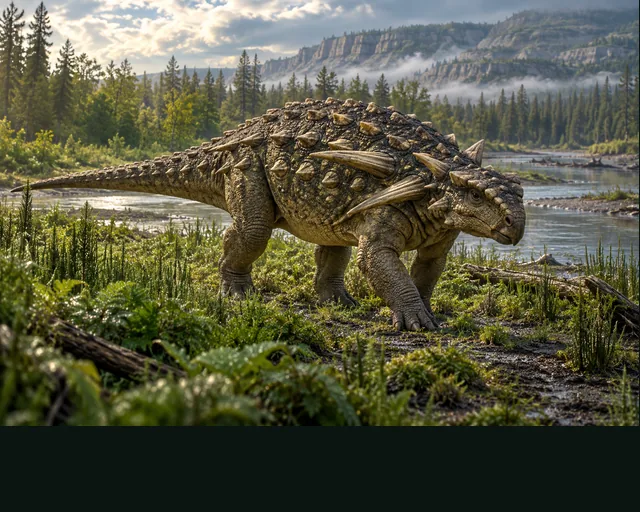
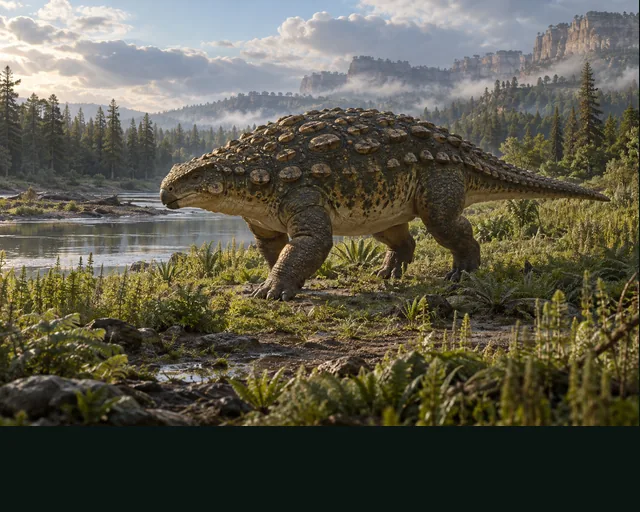
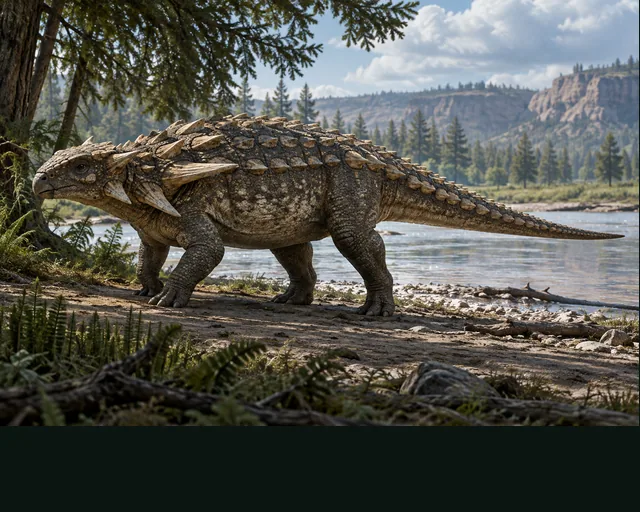
Gastonia was an Early Cretaceous North American armored dinosaur with a pelvic shield and large shoulder spikes.
Distinctive features and evidence
Its armor provides a comparison with Polacanthus and other early ankylosaurs. The arrangement is a skeletal observation; proposed defensive uses require interpretation and should not become an exact performance statistic.
Genus overview and research references.
Gastonia fossil discoveries
Gastonia is better known than most early armoured dinosaurs. Its fossils come from the Cedar Mountain Formation in eastern Utah, where James Kirkland named and described the genus in 1998 from material that had been collected since 1989. The first species, Gastonia burgei, was found in the Yellow Cat Quarry, a bone bed that also produced a skull and four partial skeletons and the original fossils of the giant raptor Utahraptor.
This dinosaur is among the most common in the Cedar Mountain Formation, with a count of ten skulls reported in 2014. A second species, G. lorriemcwhinneyae, was described in 2016 from a large bone bed found by Lorrie McWhinney in 1999. Having many individuals gives scientists far more to work with than a single skeleton, although the bones in these bone beds are jumbled, so it is hard to know exactly how many spikes one animal carried.
A display skeleton built from casts of bones from several individuals was mounted at the Denver Museum of Nature and Science, described as the first early ankylosaur mounted for display at that museum.
How big was Gastonia?
Gastonia was a medium-sized ankylosaur. Kirkland estimated a length of about 6 metres in 1998. Gregory Paul later suggested about 5 metres and a weight of around 1.9 tonnes in 2010, but this is a single estimate rather than a measurement. The Natural History Museum lists 4.6 metres, and the museum mount, composite and partly reconstructed, is about 4.6 metres long and 1.1 metres high at the hips. A reasonable summary is a body roughly 4.6 to 6 metres long.
The animal was low and broad, with short, powerful limbs, a long neck, a probably small head and a moderately long tail without a club.
What armour did Gastonia have?
Gastonia was covered in osteoderms, bony plates formed in the skin. Kirkland described a pair of keeled plates at the neck, which he called quarter rings, in contrast to the half rings of many ankylosaurs. A pelvic shield of fused plates, arranged in rosette patterns, covered the hips, and there were hundreds of tiny round scutes between the larger pieces.
The sides of the body carried large flat spikes. In Kirkland’s reconstruction they were recurved and some had a groove along the rear edge that received the front of the next spike, and others stood in vertical rows beside the midline of the rump. Because the armour was found disarticulated, some details, such as whether spikes also lined the sides of the pelvic shield, are disputed. Paul disagreed with that part of Kirkland’s reconstruction.
Is Gastonia a nodosaurid or an ankylosaurid?
That depends on the study. Kirkland placed Gastonia in Ankylosauridae, in the subgroup Polacanthinae alongside Polacanthus. Later researchers often treated polacanthines as members of Nodosauridae instead, and the Paleobiology Database lists Gastonia under Nodosauridae. In 2014 Victoria Arbour found it to be an early ankylosaurid outside the polacanthines. The skeleton itself mixes traits: the shoulder blade resembles that of nodosaurids, while the square coracoid and a down-turned head are features of ankylosaurids. For comparison, see other armoured dinosaurs such as Nodosaurus and Sauropelta.
What did Gastonia’s armour do, and where did it live?
Gastonia lived in a partly wooded landscape of river forests and open ground with a dry climate and a short wet season. It was the only ankylosaur in its community, which also contained plant-eaters such as the sauropod Cedarosaurus and the giant predator Utahraptor.
Kirkland suggested its armour protected it from a predator like Utahraptor and that the spikes may also have played a role in contests between members of the species. These are hypotheses based on anatomy, not observed behaviour. The number of Gastonia found together in bone beds has also been taken as a hint that these ankylosaurs were not always solitary, although that is an interpretation of how the fossils were buried.
Classification and fossil record
The Paleobiology Database taxonomic record catalogues Gastonia under Nodosauridae. This is the immediate parent in that catalogue, rather than a complete list of evolutionary relationships.
The corroborated occurrence sample includes United States; those are modern discovery locations, not a complete ancient geographic range.
The sourced length estimate for Gastonia is 4.6–6 metres. This is an estimate for the reconstructed animal, not a measurement shared by every individual. See the body-size discussion and linked evidence for context.
Research starting point
The catalogue links Gastonia to Kirkland, 1998, published in Lower and Middle Cretaceous Terrestrial Ecosystems (S. G. Lucas, J. I. Kirkland, & J. W. Estep, eds.), New Mexico Museum of Natural History and Science Bulletin. This identifies a research starting point; the catalogue’s citation alone does not verify every later reconstruction or species assignment.
For the meaning of taxonomic terms and how evidence is checked, see the glossary and editorial policy.
Quick answers
- Is Gastonia a dinosaur?
- Yes. Gastonia was an armoured ornithischian dinosaur, a type of ankylosaur, that lived in what is now Utah during the Early Cretaceous.
- How big was Gastonia?
- Estimates range from about 4.6 to 6 metres in length. One estimate suggested around 5 metres and 1.9 tonnes, though the weight is an estimate from a composite skeleton.
- Is Gastonia a nodosaurid?
- Authors disagree. Some assign it to Nodosauridae, Kirkland placed it among the ankylosaurid polacanthines, and a 2014 analysis found it to be an early ankylosaurid.
- What did Gastonia eat?
- Gastonia had a toothless beak and small cheek teeth, which suggests it ate plants. No stomach contents are known, so this is inferred from its skull.
- Where was Gastonia found?
- Gastonia fossils come from the Cedar Mountain Formation in eastern Utah, USA, including the Yellow Cat Quarry where the original specimens were found.