Jurassic Dinos editorial · Updated · Source-based review
What is Sauropelta?
Sauropelta was an Early Cretaceous North American nodosaurid known from informative skeletal remains.
Distinctive features and evidence
Its long tail and armor provide a comparison with other ankylosaurs. Nodosaurid identity should not be used to add the tail club characteristic of some ankylosaurids, and its earliest-known status depends on the reference being used.
Genus overview and research references.
Sauropelta fossil discoveries
Barnum Brown collected the first Sauropelta in the early 1930s in the Cloverly Formation of southern Montana (Big Horn County). Two further specimens from the same dig were important. One preserves most of a skull and the neck armour. Another is one of the best-preserved nodosaurid skeletons known, with much of its armour still in its original position, and is exhibited at the American Museum of Natural History.
John Ostrom led later expeditions in the 1960s, and in 1970 he named the genus from the finds of both teams. Brown had used the informal name Peltosaurus in lectures, and it appeared in print as a caption in 1972, but it was already used for a lizard and is not valid. Because the armour was found in place, researchers could reconstruct how the defences were arranged.
How big was Sauropelta and what armour did it have?
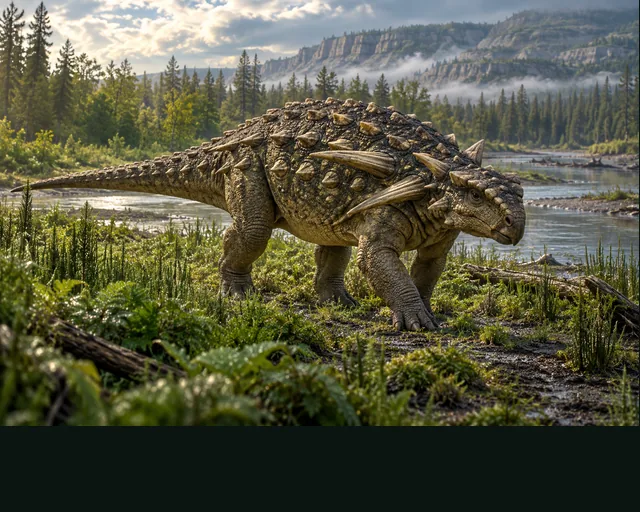
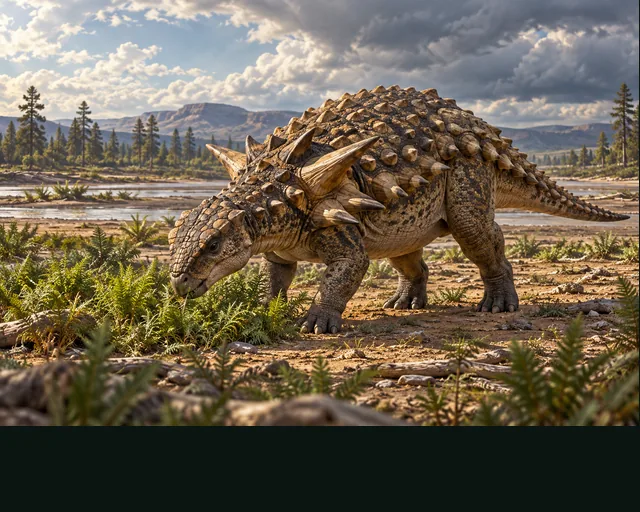
Sauropelta was a medium-sized nodosaurid, about 5.2 to 6 metres long, with an estimated weight of 1.5 to 2 tonnes. The Natural History Museum lists about 6.5 metres. The tail made up nearly half of its length and was stiffened by ossified tendons, and one skeleton preserved forty tail vertebrae even though some were missing.
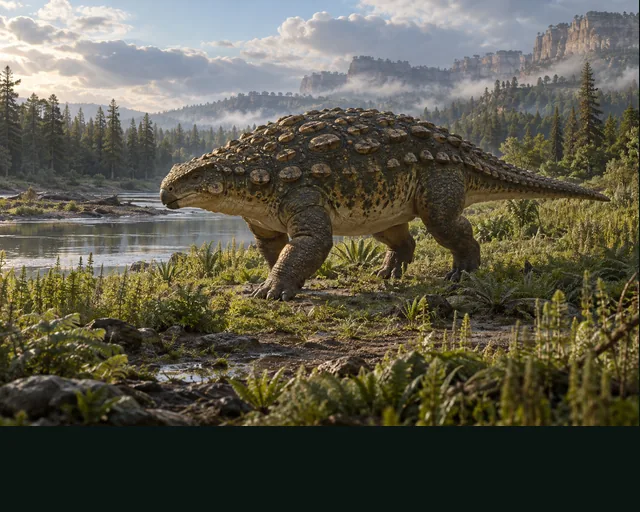
Its armour was extensive. Two parallel rows of domed plates ran along the top of the neck, and big pointed spines ran down each side of the neck, growing in size towards the shoulders. Small bony nodules covered the back and tail between larger conical scutes, and over the hips they locked together into a sacral shield. The bases of the neck spines were fused in pairs, which would have limited how freely the neck could move.
Is Sauropelta an ankylosaur?
Yes. Sauropelta is a nodosaurid, one of the two main families within the ankylosaurs, along with the Ankylosauridae. Nodosaurids generally had narrower snouts than ankylosaurids and lacked the heavy tail club, so Sauropelta had no club. Geologically younger nodosaurids include Edmontonia.
Sauropelta is the earliest known nodosaurine, and its remains are often treated as a baseline for the group. Its exact position among nodosaurids is still unsettled, but it is sometimes grouped with Silvisaurus and Pawpawsaurus as an earlier branch.
Sauropelta in the Cloverly world
Almost all specimens come from the Little Sheep Mudstone part of the Cloverly Formation in Wyoming and Montana, dated to about 108.5 million years ago, although the Natural History Museum and the Paleobiology Database give broader spans that begin around 121 million years ago. The land was a river floodplain covered in conifer forest, beside a shallow sea that would later grow into the Western Interior Seaway. Grasses had not appeared yet, so Sauropelta would have browsed on plants such as conifers and cycads.
Its neighbours included the plant eater Tenontosaurus, the predator Deinonychus and the large carcharodontosaurid Acrocanthosaurus. Large four-footed tracks named Tetrapodosaurus from British Columbia and Alberta were attributed to Sauropelta in 1984, though the tracks themselves do not preserve the animal.
Classification and fossil record
The Paleobiology Database taxonomic record catalogues Sauropelta under Nodosauridae. This is the immediate parent in that catalogue, rather than a complete list of evolutionary relationships.
The corroborated occurrence sample includes United States; those are modern discovery locations, not a complete ancient geographic range.
Research starting point
The catalogue links Sauropelta to Ostrom, 1970, published in Peabody Museum Bulletin. This identifies a research starting point; the catalogue’s citation alone does not verify every later reconstruction or species assignment.
For the meaning of taxonomic terms and how evidence is checked, see the glossary and editorial policy.
Quick answers
- Is Sauropelta a dinosaur?
- Yes. Sauropelta was an armoured dinosaur, a plant-eating nodosaurid ankylosaur from the Early Cretaceous of North America.
- When did Sauropelta live?
- Most fossils date to about 108.5 million years ago in the Early Cretaceous, although some sources give a longer span starting around 121 million years ago.
- How big was Sauropelta?
- It was about 5.2 to 6 metres long and weighed roughly 1.5 to 2 tonnes, according to estimates. The Natural History Museum lists about 6.5 metres.
- Is Sauropelta an ankylosaur?
- Yes. It is an ankylosaur in the family Nodosauridae, which lacked the tail clubs of the Ankylosauridae and had narrower snouts.
- Where was Sauropelta found?
- It was found in the Cloverly Formation of Montana and Wyoming in the United States, with possible remains in Utah.