Jurassic Dinos editorial · Updated · Source-based review
What is Deinonychus?
Deinonychus was a North American Cretaceous dromaeosaurid whose study reshaped ideas about active dinosaurs.
Distinctive features and evidence
Its enlarged toe claw and skeleton were central to John Ostrom’s anatomical work. The name’s popularity should not turn disputed pack-hunting scenarios or movie portrayals into established observations.
Genus overview and research references.
Deinonychus fossil discoveries
The first Deinonychus bones were collected in 1931 near Billings, Montana, by a team led by Barnum Brown of the American Museum of Natural History. Brown was mainly after the plant-eater Tenontosaurus. He noted a small meat-eater lying close to it, nicknamed it “Daptosaurus”, but never published a description.
The modern story begins in August 1964, when John Ostrom of Yale’s Peabody Museum led an expedition that found more skeleton near Bridger, Montana. Two further summers produced over 1,000 bones from at least three individuals. The remains were jumbled, so the type specimen, YPM 5205, was limited to the left foot and part of the right foot that clearly belonged together. Ostrom published the name in February 1969 and a long monograph that July.
The skeleton took years to understand. Ostrom had at first described a flat, trapezoid-shaped pelvic bone, but in 1974 he realised it was actually a shoulder bone. A new specimen found in the same year, MCZ 4371, added thigh bones, a sacrum and better hip bones. Mounted skeletons are displayed at the American Museum of Natural History and at Harvard’s Museum of Comparative Zoology.
Unprepared blocks from Brown’s dig gave a surprise in 2000. Gerald Grellet-Tinner and Peter Makovicky found eggshell fragments pressed against belly ribs of the skeleton, and concluded that they most likely came from a Deinonychus egg. They estimated the egg at about 7 centimetres across. It might mean the animal was brooding, or that an egg was still inside its body when it died. The individual was 13 or 14 years old and fully grown.
How big was Deinonychus, and did it have feathers?
Gregory Paul estimated that the largest known Deinonychus reached about 3.3 to 3.4 metres in length, with a skull about 41 centimetres long and a hip height near 0.87 metres. Paul put the weight at 60 to 73 kilograms, while Campione and colleagues proposed about 100 kilograms, and the Natural History Museum uses 100 kilograms. Estimates of mass vary because only a few fully grown skeletons are known.
The jaws held about seventy curved, blade-like teeth. Each hand carried three claws, and each foot had a sickle-shaped claw on its second toe that was held off the ground while the animal walked on the other two toes. Ostrom reconstructed the claw as longer than 120 millimetres once the horny sheath is included.
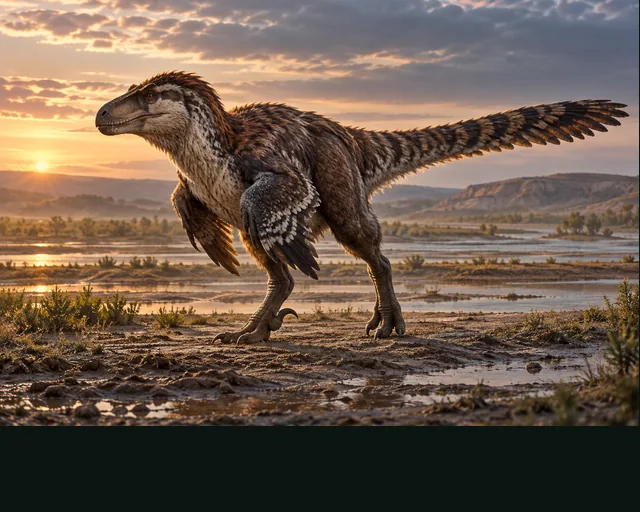
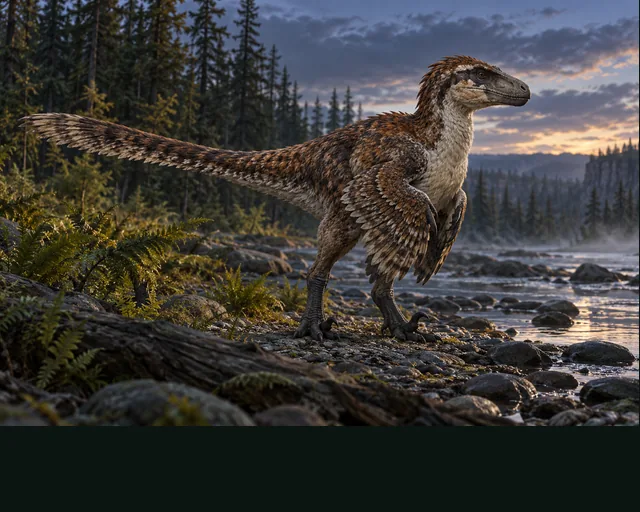
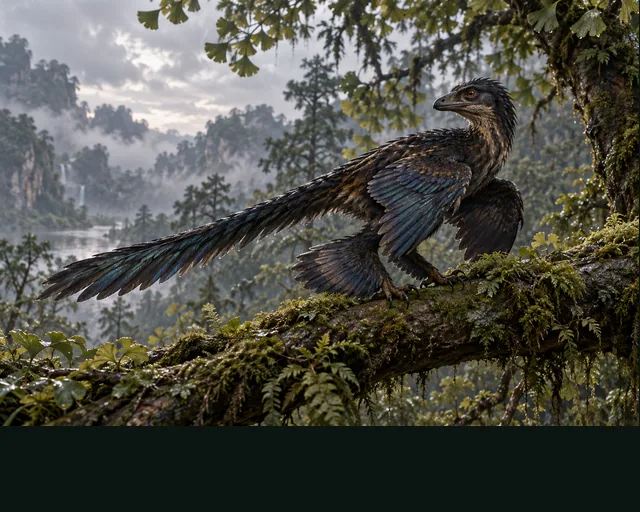
No skin impressions of Deinonychus have been found, so its covering is inferred. Close relatives such as Microraptor have preserved feathers with vanes, and a Velociraptor forearm shows the bumps where flight-style feathers were anchored. Scientists therefore think Deinonychus was most likely feathered, but this has not been seen directly.
What did Deinonychus eat?
Deinonychus is classed as a meat-eater. The best clue to its prey comes from the Cloverly and Antlers formations, where its teeth turn up again and again beside the bones of Tenontosaurus, a plant-eating dinosaur far heavier than Deinonychus. One Tenontosaurus arm bone even carries marks that may be Deinonychus bites. A 2020 chemical study of teeth suggested that adults ate Tenontosaurus at least some of the time, though that does not show whether they hunted it or scavenged.
Bite force is disputed. A 2010 study used tooth punctures in Tenontosaurus bone to estimate 4,100 to 8,200 newtons, in the range of a similar-sized alligator. A 2022 study based on a real Deinonychus skull calculated only 706 newtons. Puncture marks from Deinonychus are rare, which suggests it seldom bit through bone.
How did Deinonychus use its sickle claw?
Ostrom pictured Deinonychus kicking with the sickle claw to slash at prey, but that idea has weakened. In 2005 Phil Manning and colleagues tested a robotic Deinonychus leg against a pig carcass and got only shallow punctures, with no slashing. They suggested the claws worked better for climbing or gripping.
In 2011 Denver Fowler and colleagues compared dromaeosaur feet and legs with those of hawks and eagles. In their “raptor prey restraint” model the animal leapt on its prey, pinned it down with its weight and gripped with the claws while it began to feed, using its arms and tail for balance. This is a model based on comparison with living birds, not an observed behaviour.
Popular media often show Deinonychus as a sprinter, but Ostrom’s own leg measurements led him to conclude that it was far from slow yet not especially fast for a dinosaur, and slower than an ostrich.
Did Deinonychus hunt in packs?
This is one of the best-known debates about the animal. A Montana quarry holds several Deinonychus beside Tenontosaurus bones, and an Oklahoma site has a partial Deinonychus skeleton and many teeth among Tenontosaurus remains. Ostrom and Maxwell suggested the group hunted together, since an adult tenontosaur could weigh one to four tonnes, far more than a lone Deinonychus.
In 2007 Roach and Brinkman argued that the sites look more like Komodo dragons crowding at a carcass, where animals compete and larger ones eat first. Currie and Eberth criticised that comparison in 2010. A later chemical study found that young and adults ate different foods yet lived together, which fits an animal as tolerant of company as crocodiles are, but not mammal-style pack hunting. The safest summary is that Deinonychus may have been social, while coordinated pack hunting is not shown by the evidence.
Is Deinonychus a Velociraptor?
No, they are different genera, but they are close relatives. Both are dromaeosaurids, the family of small to medium hunters with a large toe claw, and Velociraptor lived later in Central Asia. The word “raptor” is not a scientific term, which the Natural History Museum points out, and many dromaeosaurids, including Deinonychus, do not have it in their names. Other relatives are Dromaeosaurus and Microraptor. Its exact position inside the family has shifted between studies.
Deinonychus matters because of what Ostrom made of it. A fast-looking, agile predator undermined the old image of slow, cold-blooded giants and opened what is called the dinosaur renaissance. Ostrom also noticed bird-like features in its forefoot, which led him to revive the idea that birds descend from dinosaurs. Michael Crichton called the raptors in Jurassic Park Velociraptor, but according to Ostrom he based them on Deinonychus, and the film models followed.
Where and when Deinonychus lived
Deinonychus lived in the Early Cretaceous of North America. Bones come from Montana, Wyoming and Oklahoma, in the Cloverly and Antlers formations, and teeth that may belong to it were found in Maryland. The Natural History Museum gives about 115 to 108 million years ago, while other accounts stretch the range to about 98 million years ago, so sources do not agree on the end date.
The habitat was humid, with floodplains, deltas and forests, perhaps like present-day Louisiana. Plant-eaters in the neighbourhood included Tenontosaurus, Zephyrosaurus and the armoured Sauropelta. In Oklahoma the predator Acrocanthosaurus lived alongside it.
Deinonychus in the games
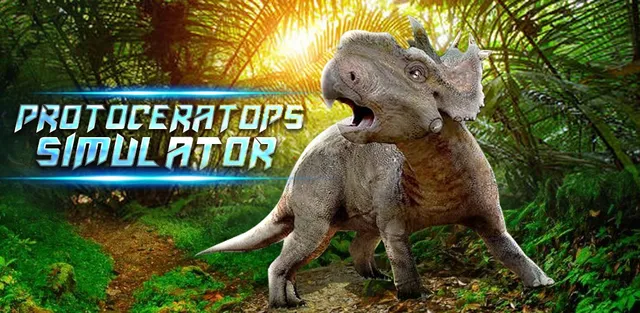
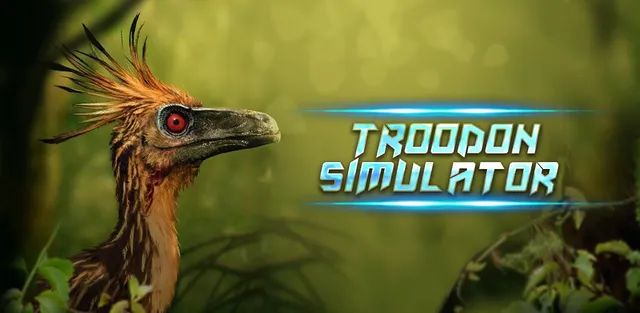
Deinonychus appears in two Jurassic Dinos Android games. The store listing for Protoceratops: Dino Survival names it among the Cretaceous meat-eaters players meet while defending a nest and raising young. The listing for Troodon: Smart Dino Simulator, a night-hunting game, also lists it among the dinosaurs players face and calls it a “deadly pack hunter”.
Those are game roles. Pack hunting by Deinonychus is debated, and game animations, abilities and enemy roles are entertainment, not scientific evidence.
Classification and fossil record
The Paleobiology Database taxonomic record catalogues Deinonychus under Eudromaeosauria. This is the immediate parent in that catalogue, rather than a complete list of evolutionary relationships.
The sourced length estimate for Deinonychus is 3.3–3.4 metres. This is an estimate for the reconstructed animal, not a measurement shared by every individual. See the body-size discussion and linked evidence for context.
Research starting point
The catalogue links Deinonychus to Ostrom, 1969, published in Postilla. This identifies a research starting point; the catalogue’s citation alone does not verify every later reconstruction or species assignment.
For the meaning of taxonomic terms and how evidence is checked, see the glossary and editorial policy.
Quick answers
- Is Deinonychus a dinosaur?
- Yes. Deinonychus was a dromaeosaurid theropod dinosaur, a close relative of Velociraptor, that lived in North America during the Early Cretaceous.
- When did Deinonychus live?
- Deinonychus lived in the Early Cretaceous. The Natural History Museum gives about 115 to 108 million years ago, while some accounts extend the range to about 98 million years ago.
- How big was Deinonychus?
- The largest known Deinonychus reached about 3.3 to 3.4 metres in length. Weight estimates range from about 60 to 100 kilograms because few adult skeletons are known.
- Is Deinonychus a Velociraptor?
- No. Deinonychus and Velociraptor are separate genera of dromaeosaurid. Velociraptor lived later in Asia, and Deinonychus is the larger and older of the two.
- Did Deinonychus have feathers?
- No feathers or skin have been found with Deinonychus, but close relatives preserve feathers, so scientists think it was probably feathered. This is an inference, not a direct observation.
- What did Deinonychus eat?
- Deinonychus was a meat-eater. Its teeth and possible tooth marks occur with bones of the plant-eater Tenontosaurus, but fossils cannot show whether it hunted or scavenged them.