Jurassic Dinos editorial · Updated · Source-based review
What is Velociraptor?
Velociraptor was a small Late Cretaceous Asian dromaeosaurid, with species recorded in Mongolia and China.
Distinctive features and evidence
Velociraptor mongoliensis and Velociraptor osmolskae come from different formations. Its fossils should be distinguished from the much larger movie raptors and from the separate genera Deinonychus and Achillobator.
Genus overview and research references.
Velociraptor fossil discoveries
The first Velociraptor fossil was a crushed but complete skull, found by Peter Kaisen on 11 August 1923 at the Flaming Cliffs in the Gobi Desert of Mongolia during an American Museum of Natural History expedition. Henry Fairfield Osborn named the genus and its type species, Velociraptor mongoliensis, in 1924.
The most famous Velociraptor of all was found in 1971 by a Polish and Mongolian team. This is the ‘Fighting Dinosaurs’ fossil, which preserves a Velociraptor and a Protoceratops locked together. It is regarded as a national treasure of Mongolia. Since the 1990s, joint Mongolian expeditions with American teams have recovered several well-preserved skeletons, and more than a dozen skeletons have now been described. Skull bones from China were given their own species name, V. osmolskae, in 2008, though later analyses suggest this form may not belong in the genus at all. In 2021 a headless skeleton once counted as Velociraptor was named as a separate genus, Shri devi, and other researchers have argued that further Velociraptor-like skulls may represent additional species.
How big was Velociraptor?
Smaller than most people expect. Adults were about 1.5 to 2.07 metres long including the tail and stood roughly half a metre high at the hips. The Natural History Museum gives 1.8 metres. Weight estimates differ: recent research gives roughly 14 to 20 kilograms, while the museum lists about 7 kilograms, and some estimates go as high as 28 kilograms for the biggest individuals. The skull was low and long, up to about 23 centimetres, with an upturned snout.
The animals in the Jurassic Park films were not Velociraptor-sized. The film raptors were modelled on the larger Deinonychus, and Velociraptor itself is often compared to a turkey in size. The enlarged second toe claw, held off the ground, could reach more than 6.5 centimetres along its outer edge.
Did Velociraptor have feathers?
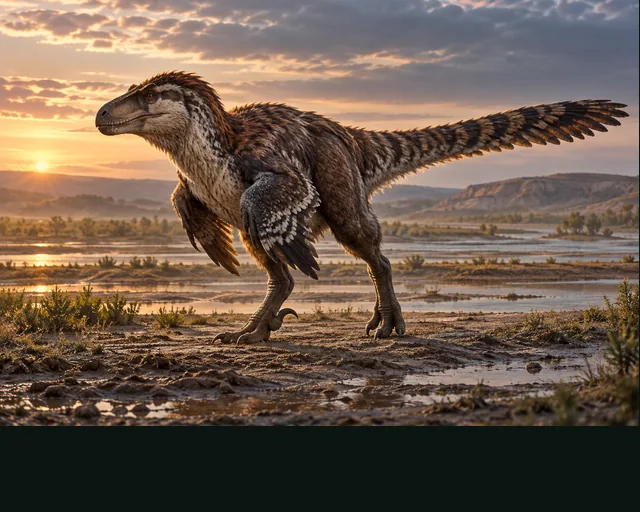
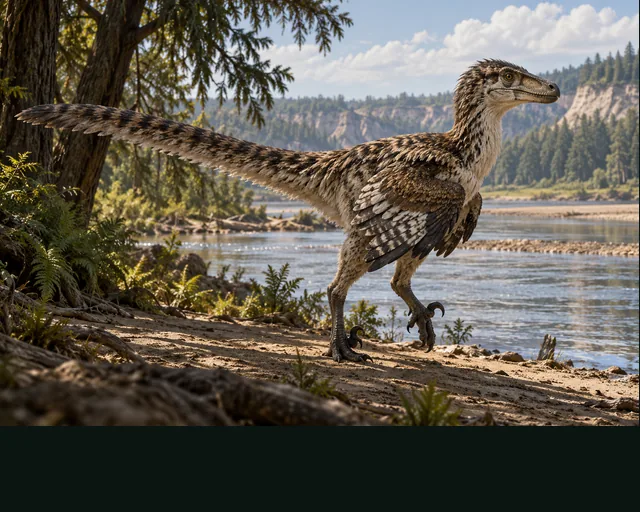
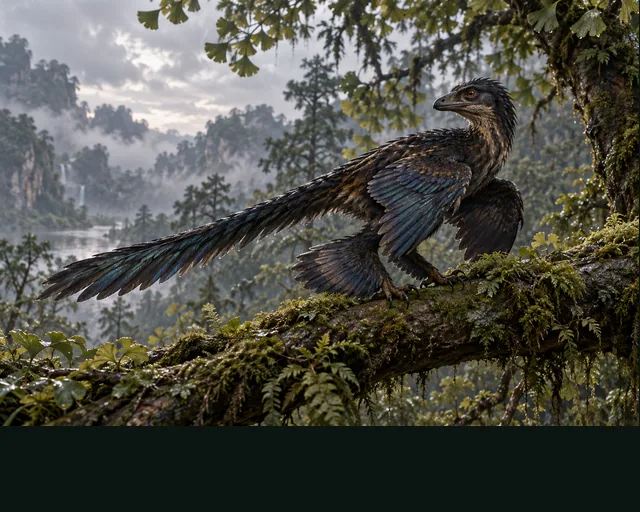
Almost certainly. Researchers reported six quill knobs, small bumps on the forearm bone where large wing feathers attach, on a specimen in 2007, which would be direct evidence. That specimen’s number was later corrected, and whether it really is Velociraptor needs further study, so the case does not rest on it alone. Close relatives such as Microraptor and Zhenyuanlong preserve feathers, and that, along with the quill knobs, is why the Natural History Museum now describes Velociraptor as having a fine feather-like covering.
Velociraptor probably could not fly. If its ancestors could, the large feathers may have served for display, covering a nest or boosting speed when running uphill, though these are only suggestions. The scaly film versions were made before dinosaurs with feathers were widely known.
What did Velociraptor eat and how did it hunt?
Velociraptor was a meat-eater. The Fighting Dinosaurs fossil is the best direct evidence: the Velociraptor lies beneath the Protoceratops with a sickle claw apparently in its throat, while the plant-eater’s beak grips the raptor’s arm. Both animals were probably buried quickly by collapsing sand. That suggests the claw was used to pierce or pin prey, not to slash open the belly, and a 2005 television experiment with an artificial leg found a claw could not rip through skin. Another proposal, from 2011, compares Velociraptor with eagles and hawks that pin prey under their weight and grip with their claws.
Other finds show it also scavenged. Shed teeth lay near a tooth-marked Protoceratops jaw, and one skeleton has a pterosaur bone in its stomach area. The popular picture of Velociraptor hunting in packs has little support: no group of Velociraptor skeletons has been found together, and the only clear evidence of group travel among dromaeosaurs is a set of Chinese footprints from a large species.
Where and when Velociraptor lived
Velociraptor mongoliensis comes from the Djadochta Formation of Mongolia, which is about 75 to 71 million years old, in the Campanian age of the Late Cretaceous. The museum gives about 74 to 70 million years ago. The rocks record a dry, semi-arid landscape of wind-blown sand dunes with only occasional streams, and many animals there were buried alive by sandstorms or collapsing dunes.
Velociraptor shared this environment with Protoceratops, the oviraptorid Oviraptor, the armoured Pinacosaurus and the troodontid Saurornithoides. Scientists have suggested from eye-socket bones that Velociraptor may have been active at night or in low light, which would fit the idea that the Fighting Dinosaurs clash occurred at twilight, though that is an inference.
Is Velociraptor a raptor, and how is it related to Deinonychus?
Velociraptor is a dromaeosaurid, the family popularly called raptors, and belongs to a branch called Eudromaeosauria. It is often placed in its own subfamily, Velociraptorinae, but several recent analyses suggest that group is not a natural unit. Its close relatives include Deinonychus and Achillobator, which were both larger. Troodontids such as Troodon are related but not dromaeosaurids, even though many have a similar enlarged toe claw.
Osborn first put Velociraptor in the family Megalosauridae, a catch-all group for meat-eating dinosaurs at the time. It was later recognised as a dromaeosaurid.
Velociraptor in the game
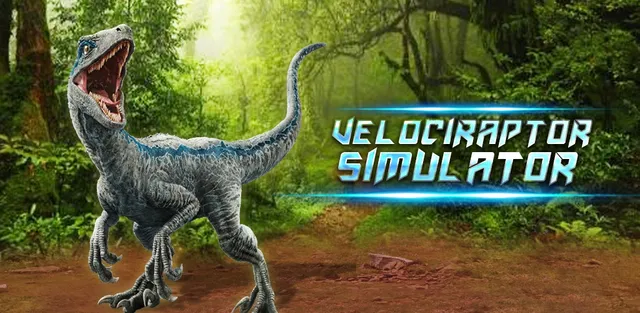
Velociraptor Dino Simulator puts you in the role of a raptor in a survival game. Its store listing describes finding food and water, fighting other dinosaurs, levelling up, unlocking abilities and exploring a changing-weather world. Velociraptor also appears as an opponent in other titles including Protoceratops: Dino Survival, which draws on the Fighting Dinosaurs fossil.
Game animations and abilities are entertainment, not scientific evidence, so rely on the fossil record described above.
Classification and fossil record
The Paleobiology Database taxonomic record catalogues Velociraptor under Velociraptorinae. This is the immediate parent in that catalogue, rather than a complete list of evolutionary relationships.
Discovery and naming history
Velociraptor mongoliensis was described in 1924 from Mongolian material. A second species was named in 2008 from Chinese skull remains, so geographic and anatomical statements should specify which species and specimen they concern. Historical overview.
The corroborated occurrence sample includes Mongolia, China; those are modern discovery locations, not a complete ancient geographic range.
The sourced length estimate for Velociraptor is 1.5–2.07 metres. This is an estimate for the reconstructed animal, not a measurement shared by every individual. See the body-size discussion and linked evidence for context.
Research starting point
The catalogue links Velociraptor to Osborn, 1924, published in American Museum Novitates. This identifies a research starting point; the catalogue’s citation alone does not verify every later reconstruction or species assignment.
For the meaning of taxonomic terms and how evidence is checked, see the glossary and editorial policy.
Quick answers
- Is Velociraptor a dinosaur?
- Yes. Velociraptor was a small feathered meat-eating theropod dinosaur from the Late Cretaceous of Mongolia and China, and it belongs to the dromaeosaurid or raptor family.
- How big was Velociraptor?
- About 1.5 to 2 metres long including the tail, half a metre tall at the hips and roughly turkey-sized. It was much smaller than the raptors in the Jurassic Park films.
- Did Velociraptor have feathers?
- Almost certainly. Quill knobs reported on one forearm and feathers in close relatives point to a feathered body, although the single quill-knob specimen is being re-examined.
- When did Velociraptor live?
- Velociraptor lived in the Campanian age of the Late Cretaceous, roughly 75 to 71 million years ago, though the Natural History Museum gives a slightly later range.
- What did Velociraptor eat?
- Other animals. Fossils show it fighting Protoceratops, feeding on a Protoceratops carcass, and carrying a pterosaur bone, so it both hunted and scavenged.