Jurassic Dinos editorial · Updated · Source-based review
What is Oviraptor?
Oviraptor was a Late Cretaceous Mongolian theropod whose egg-thief name records an early interpretation of its discovery.
Distinctive features and evidence
The original association with eggs was once interpreted as theft. A naming story is not proof of feeding behavior, and nests assigned to related oviraptorids should not be silently credited to Oviraptor itself.
Genus overview and research references.
Oviraptor fossil discoveries
Oviraptor was found on a 1923 expedition into the Gobi, at a red sandstone site called Bayn Dzak, or the Flaming Cliffs, in Mongolia. The team belonged to the American Museum of Natural History and was led by Roy Chapman Andrews. Henry Fairfield Osborn described the animal in 1924, in the same paper that named Velociraptor and Saurornithoides.
The type specimen, catalogued as AMNH 6517, is a partial skeleton without its back half. It includes a badly crushed skull, some neck and back vertebrae, the wishbone (furcula), parts of the left arm and hand, and some ribs. It was lying just above a clutch of about fifteen eggs, separated from them by only a few centimetres of sediment. Much later, in 2018, Mark Norell and colleagues reported a few extra bones from the same spot, a shin bone and two foot bones from a nestling or very small juvenile.
It is easy to overstate how much of Oviraptor is known. For decades, a beautifully preserved, tall-crested oviraptorid skeleton from the same formation was labelled as Oviraptor in books. In 2002 James Clark and colleagues showed that it shares more skull features with Citipati, so the true Oviraptor skull is the squashed one without a crest.
Why was Oviraptor called an egg thief?
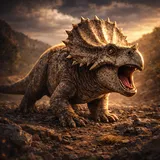
The name is a story about how the fossil was first read. Because the skeleton lay on top of a nest, and ceratopsian dinosaurs such as Protoceratops were common in the same rocks, Osborn assumed the eggs were Protoceratops eggs and that the animal had died while raiding them. He even chose the species name philoceratops, meaning “lover of ceratopsian eggs”. He did, however, add that the name might turn out to give a wrong impression of the animal.
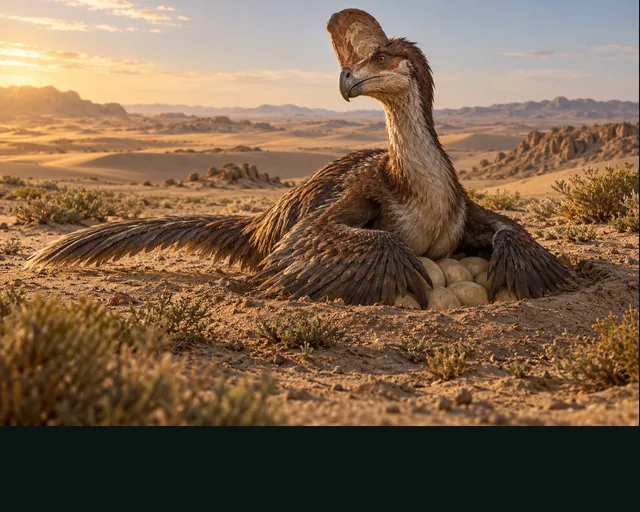
In the 1990s that caution proved wise. Related oviraptorids, including Citipati, were found fossilised crouching over their own egg clutches with the arms spread around the nest. That posture is a brooding pose, like those of living birds. Researchers concluded that the Oviraptor holotype was most likely a parent that died on its own nest, and the nest is now treated as its own. The story is still a useful lesson in how a first interpretation can be overturned by later finds.
Not everything about the nesting is settled. A 2019 study of well-preserved oviraptorid nests from the Nanxiong Formation of China argued that an adult lying on a clutch was not necessarily keeping it warm: the eggs were laid in several rings, which would make it hard for body heat to reach the inner ones, and the animal might have been laying. The team could not tell if the young bones found with the Oviraptor holotype came from that nest.
How big was Oviraptor and what did it look like?
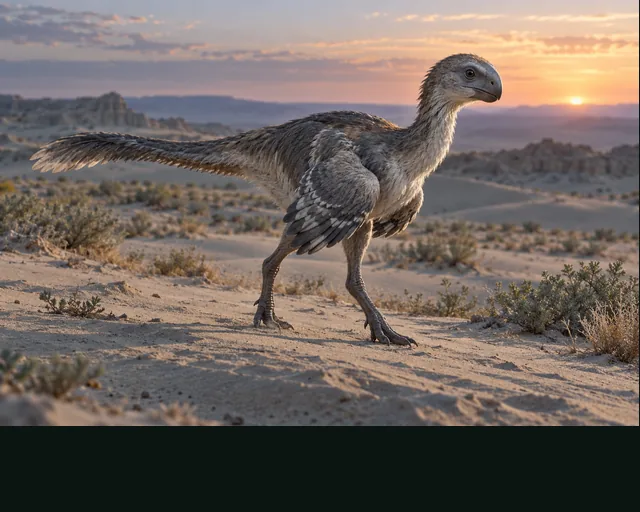
Oviraptor was a small, light dinosaur. Estimates for the holotype are about 1.6 to 2 metres long, and body mass figures differ, from around 20 kilograms in the museum’s directory to 33 to 40 kilograms in a later published estimate. Because the back half of the skeleton was never found, those numbers come from comparisons with better-known relatives.
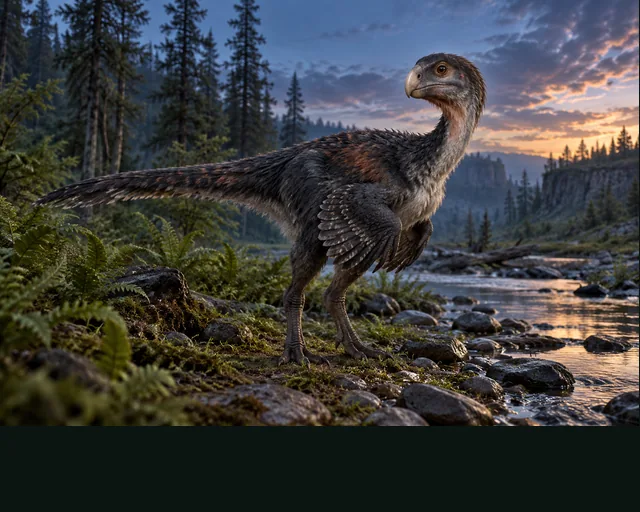
The skull was short and deep, about 18 centimetres long as preserved, with large openings. There were no teeth: the jaws ended in a strong horny beak, a little like that of a parrot, and the lower jaw was short and deep. The top of the skull suggests there was a crest, although the crest bones themselves are missing. The arms were long, and each hand had three slender fingers ending in curved claws.
Relatives show that oviraptorids carried feathers, and the end of the tail was made of fused vertebrae called a pygostyle. In living birds this structure supports a fan of tail feathers, and some researchers have suggested that the muscular, flexible tails of oviraptorosaurs could have been used in display. That is a hypothesis drawn from relatives, since the Oviraptor skeleton does not preserve its tail.
What did Oviraptor eat?
Oviraptor has one of the more contested diets among small theropods, mainly because its beak is unlike that of most meat-eaters. One direct clue exists: in 1995 Norell and colleagues reported lizard bones inside the body cavity of the holotype, showing that this individual ate at least some animal prey.
Beyond that, scientists disagree. In 1977 Rinchen Barsbold argued that the strong jaws could crack mollusc shells. Later work questioned this because toothless oviraptorid jaws lack broad crushing surfaces, and the rocks of the Djadokhta Formation point to dry conditions. A 2010 study led by Nicholas Longrich thought plants were probably the largest part of the diet, while Stig Jansen in 2008 compared the beak with those of parrots and turtles and suggested an omnivore that could catch and tear small prey. In 2018 Gregory Funston and colleagues argued for a strong, nipping bite that would suit nuts and seeds. The Natural History Museum lists hard fruits, eggs and possibly shellfish. The safest summary is an omnivore with a powerful beak, whose exact menu is not known.
Where and when Oviraptor lived
Oviraptor comes from the Bayn Dzak Member of the Djadokhta Formation in Mongolia, a Late Cretaceous unit. The age is not pinned down tightly: the Natural History Museum gives 85 to 75 million years ago, one published summary of the formation gives about 75 to 71 million years ago, and the Paleobiology Database lists a wider window. For that reason, this page says only that it lived late in the Cretaceous.
The environment resembled the present-day Gobi, with sand dunes, seasonal streams, and occasional dust storms. Such a storm is the favoured explanation for how the nest and the adult were buried fast enough for the skeleton to remain mostly together. Other animals from the same member include Protoceratops, Velociraptor and Pinacosaurus.
In terms of relatives, Oviraptor is the type genus of the family Oviraptoridae, a group that includes Citipati, Conchoraptor and Khaan. The 2002 skull study suggested Oviraptor sits near the base of the family, as its jaws are longer than those of most later members.
Oviraptor in the game
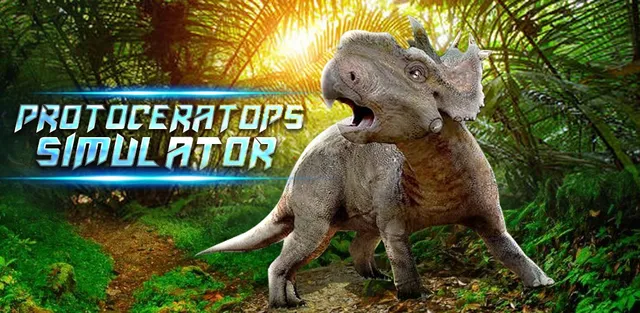
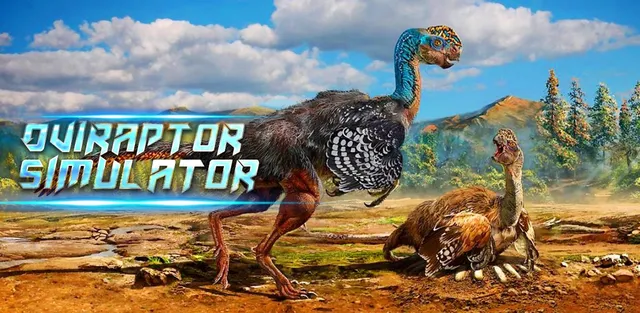
Two Android games on this site feature the animal. Oviraptor: Feathered Dino Sim lets you play as the dinosaur, and its listing describes running, combat, building and protecting a nest, hatching young and raising a family. Protoceratops: Dino Survival places Oviraptor among its opponents and calls it a “nest raider”, which is exactly the old egg-thief idea that fossils later overturned.
These features are entertainment. Abilities, speeds and fights in the games are designed for play and are not scientific evidence about how Oviraptor behaved.
Classification and fossil record
The Paleobiology Database taxonomic record catalogues Oviraptor under Oviraptoridae. This is the immediate parent in that catalogue, rather than a complete list of evolutionary relationships.
Discovery and naming history
Material collected in Mongolia in 1923 was named by Henry Fairfield Osborn in 1924. Its proximity to eggs originally inspired an egg-theft interpretation, but later oviraptorid nest evidence changed the broader reproductive story. Historical overview.
The corroborated occurrence sample includes Mongolia; those are modern discovery locations, not a complete ancient geographic range.
Research starting point
The catalogue links Oviraptor to Osborn, 1924, published in American Museum Novitates. This identifies a research starting point; the catalogue’s citation alone does not verify every later reconstruction or species assignment.
For the meaning of taxonomic terms and how evidence is checked, see the glossary and editorial policy.
Quick answers
- Is Oviraptor a dinosaur?
- Yes. Oviraptor was a small feathered theropod dinosaur from the Late Cretaceous of Mongolia, and it gives its name to the family Oviraptoridae.
- Did Oviraptor steal eggs?
- Probably not. The first skeleton was found over a nest and was read as an egg raid, but later oviraptorid finds in brooding poses suggest it was a parent on its own nest.
- How big was Oviraptor?
- Estimates put Oviraptor at roughly 1.6 to 2 metres long. Weight estimates differ between sources, and the back of the skeleton is missing, so the figures are approximate.
- What did Oviraptor eat?
- Its diet is debated. A lizard was found in the holotype's body cavity, but the beak may also have handled seeds, fruit, eggs or other food, so omnivore is the cautious label.
- Where was Oviraptor found?
- The holotype came from the Flaming Cliffs (Bayn Dzak) site in the Gobi of Mongolia, in the Djadokhta Formation, during the American Museum's 1923 expedition.