Jurassic Dinos editorial · Updated · Source-based review
What is Citipati?
Citipati was a Late Cretaceous Mongolian oviraptorid known from exceptionally preserved skeletons and nests.
Distinctive features and evidence
Individuals preserved over eggs provide unusually direct evidence relevant to nesting behavior. Some famous specimens were initially attributed to Oviraptor, so the brooding evidence should be credited to the actual identified material.
Genus overview and research references.
Citipati fossil discoveries
Citipati is known from several skeletons found at Ukhaa Tolgod, in Mongolia’s Gobi Desert, by joint expeditions of the Mongolian Academy of Sciences and the American Museum of Natural History. In 1993 a small embryo, IGM 100/971, was found in a nest. The same year came a large adult, IGM 100/979, found sitting on a nest of eggs but lacking its skull, neck and tail. The press nicknamed it “Big Mama”.
The most complete skeleton, IGM 100/978, was found in 1994 without eggs and was first identified as Oviraptor. A second brooding adult, “Big Auntie” (IGM 100/1004), was found in 1995 but remained largely undescribed for years. Clark, Norell and Barsbold named the genus in 2001 with IGM 100/978 as the holotype. The species name osmolskae honours the Polish palaeontologist Halszka Osmólska.
What do Citipati nests show?
Citipati eggs were long ovals, laid in a circle in mound-shaped nests. They were arranged in up to three layers of concentric rings, and a full clutch may have held as many as 22 eggs. Each egg was about 18 centimetres long, the largest of any oviraptorid egg that can be confidently identified.
The two nesting adults sit on top of the clutch with their limbs spread out symmetrically and their arms around the edge of the nest. This pose is known today only in birds, and it is one of the best fossil links between birds and non-bird dinosaurs. It is also a reason why scientists think the arms and tail carried feathers. Such feathers may have shielded the eggs from weather, though that is an interpretation.
How big was Citipati?
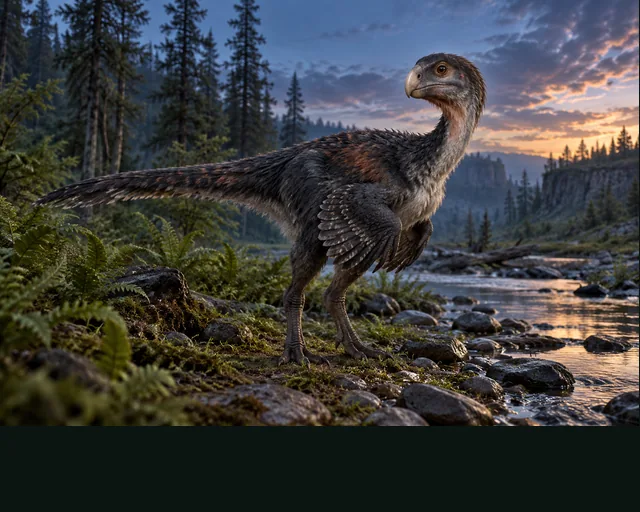
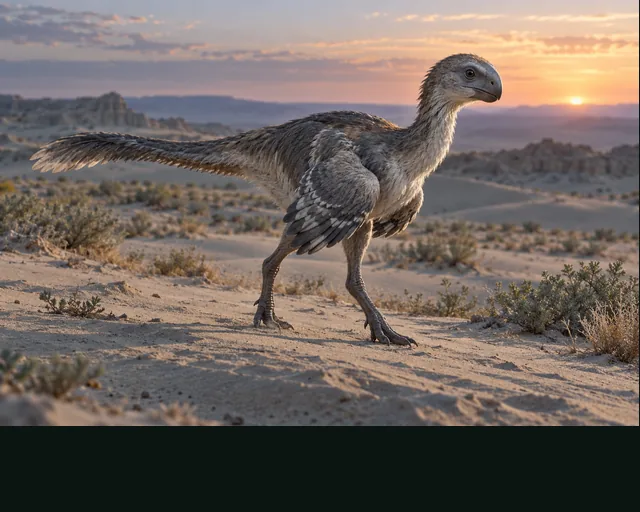
Citipati was one of the larger oviraptorids, roughly emu-sized. Published estimates are about 2.5 to 2.9 metres long and 75 to 110 kilograms, while the Natural History Museum lists around 2.1 metres, so exact size is uncertain. It had a long neck and a short tail that ended in a pygostyle, a stub of fused tail bones that in birds supports tail feathers. The skull was short and ended in a toothless beak, with a tall crest compared to that of a living cassowary.
What did Citipati eat?
Citipati’s diet is not settled. A 2022 bite-force study scored its bite among the strongest of the oviraptorosaurs tested. The jaw movements point to plant-eating in most of the group, probably tougher vegetation than that eaten by other plant-eating theropods. The Natural History Museum calls Citipati omnivorous, and the idea of mixed feeding was supported by two tiny skulls in a Citipati nest, which might have been prey. Later suggestions are that the skulls were washed in, so the evidence is weak. The skulls are discussed under Byronosaurus.
Is Citipati the same as Oviraptor?
No. Citipati and Oviraptor are separate genera, though they are close relatives and many Citipati fossils were first thought to be Oviraptor. A tall-crested skeleton from Zamyn Khondt, another locality, was long shown in books as Oviraptor because the real Oviraptor skull was crushed. Researchers have pointed out that it shares more skull features with Citipati, and a 2020 study found it to be Citipati’s sister taxon.
The same 2020 work placed Oviraptor on an earlier branch and named the subfamily Citipatiinae. Another oviraptorid from the same area is Khaan.
Where and when Citipati lived
Citipati comes mainly from the Djadochta Formation at Ukhaa Tolgod, dated to the Late Cretaceous. Sources give slightly different ages, about 75 to 71 million years ago in one dating and 81 to 75 million years ago in the Natural History Museum listing. The setting is interpreted as sand dunes with short-lived pools of water and an arid to semi-arid climate. Neighbours included the oviraptorid Khaan and the troodontids Almas and Byronosaurus.
Classification and fossil record
The Paleobiology Database taxonomic record catalogues Citipati under Citipatinae. This is the immediate parent in that catalogue, rather than a complete list of evolutionary relationships.
Discovery and naming history
Citipati osmolskae was named in 2001. Particularly informative specimens preserve adults in positions over egg nests, supplying fossil evidence relevant to reproduction rather than support for a stereotyped egg-stealing story. Historical overview.
The corroborated occurrence sample includes Mongolia; those are modern discovery locations, not a complete ancient geographic range.
The sourced length estimate for Citipati is 2.1–2.9 metres. This is an estimate for the reconstructed animal, not a measurement shared by every individual. See the body-size discussion and linked evidence for context.
Research starting point
The catalogue links Citipati to Clark and Norell, 2001, published in Journal of Vertebrate Paleontology. This identifies a research starting point; the catalogue’s citation alone does not verify every later reconstruction or species assignment.
For the meaning of taxonomic terms and how evidence is checked, see the glossary and editorial policy.
Quick answers
- Is Citipati a dinosaur?
- Yes. Citipati was a feathered, bird-like theropod dinosaur, an oviraptorid, from the Late Cretaceous of Mongolia.
- When did Citipati live?
- It lived in the Late Cretaceous, roughly 75 to 71 million years ago in one dating, though the Natural History Museum lists 81 to 75 million years ago.
- How big was Citipati?
- Citipati was about emu-sized: estimated at 2.5 to 2.9 metres long and 75 to 110 kilograms, with a lower length of 2.1 metres given by the Natural History Museum.
- Is Citipati the same as Oviraptor?
- No. They are separate genera of close relatives. Several fossils once called Oviraptor, including nesting adults, are now assigned to Citipati.
- What did Citipati eat?
- Unknown for certain. Tough plants are likely, but the Natural History Museum calls it omnivorous and some evidence suggests it may have eaten small animals.
- Where was Citipati found?
- Mainly at Ukhaa Tolgod in the Djadochta Formation of the Gobi Desert in Mongolia.