Jurassic Dinos editorial · Updated · Source-based review
What is Khaan?
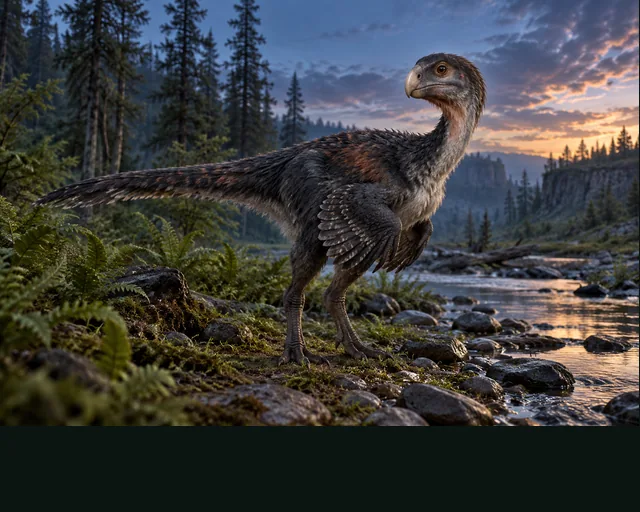
Khaan was a Late Cretaceous Mongolian oviraptorid from the Djadokhta Formation.
Distinctive features and evidence
Specimen nicknames such as Romeo and Juliet are informal identifiers. They should not be read as evidence that the animals were a mating pair or that their social relationship is directly known.
Genus overview and research references.
Khaan fossil discoveries and the “Romeo and Juliet” pair
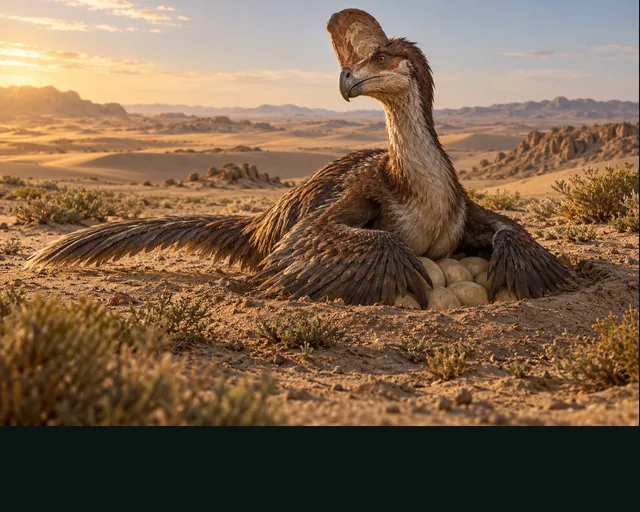
Khaan is known from three skeletons with skulls, found in the Djadokhta Formation of Mongolia. The type specimen is an almost complete skeleton that lay beside a second, similar one, and researchers nicknamed the two “Romeo and Juliet”. Both animals were only about four feet (roughly 1.2 metres) long. A third specimen, much larger, was later referred to the same species. James Clark and colleagues described the genus in 2001, and the species name mckennai honours the palaeontologist Malcolm McKenna.
The nickname is only a label. A 2014 study found that the pair’s tail bones differ in the shape of the small V-shaped bones under the tail, even though the two were the same size and apparently the same age. The authors proposed that this might reflect a difference between the sexes, but that is a hypothesis about bone shape, not evidence of how the two animals lived.
How big was Khaan?
Khaan was a small theropod. The Natural History Museum lists a length of about 1.8 metres, while the pair nicknamed “Romeo and Juliet” were shorter, and the sources do not explain the gap. No body mass is given by the sources checked for this account, so it is best to treat any weight figure for Khaan with caution.
What did Khaan eat?
Nobody knows for certain. The diet of oviraptorids has been argued over, with plants and molluscs both proposed. One account suggests Khaan was probably at least partly a meat eater, taking small animals such as mammals and lizards. A 2022 study of bite force found that Khaan had a very strong bite and a moderate jaw opening, which fits mostly plant eating, though on tougher or more varied vegetation than other plant-eating theropods of its habitat could handle. That is why this account describes it only broadly, as an omnivore, until more direct evidence appears. One source says it was probably feathered, but the sources checked here do not describe preserved feathers.
Is Khaan an oviraptorid?
Yes. At first its bones were assigned to Ingenia, but the hand bones lacked the widened third metacarpal seen in that genus, so Khaan was given its own name. It is placed in the family Oviraptoridae and was probably most closely related to Conchoraptor. The Natural History Museum describes it as a beaked dinosaur very similar to Oviraptor, Ingenia and Conchoraptor, and Citipati is another oviraptorosaur that researchers have compared with it.
Where and when Khaan lived
Khaan lived in the Campanian stage of the Late Cretaceous in what is now Mongolia. Ages differ between sources: 75 to 71 million years ago in one, 81 to 75 in the museum directory, and 83.6 to 72.2 in the Paleobiology Database occurrence record. These are broad windows for the rock unit, so it is safer to say Khaan lived during the Campanian than to give a single date.
Classification and fossil record
The Paleobiology Database taxonomic record catalogues Khaan under Heyuanninae. This is the immediate parent in that catalogue, rather than a complete list of evolutionary relationships.
The corroborated occurrence sample includes Mongolia; those are modern discovery locations, not a complete ancient geographic range.
Research starting point
The catalogue links Khaan to Clark and Norell, 2001, published in Journal of Vertebrate Paleontology. This identifies a research starting point; the catalogue’s citation alone does not verify every later reconstruction or species assignment.
For the meaning of taxonomic terms and how evidence is checked, see the glossary and editorial policy.
Quick answers
- Is Khaan a dinosaur?
- Yes. Khaan was a small, beaked oviraptorid theropod dinosaur from the Late Cretaceous of Mongolia.
- What does Khaan mean?
- The name comes from the Mongolian word khaan, meaning lord or ruler.
- How big was Khaan?
- The Natural History Museum gives a length of about 1.8 metres, though the two best-known skeletons, nicknamed Romeo and Juliet, were only about 1.2 metres long.
- What did Khaan eat?
- The diet of oviraptorids is debated. A beak and strong bite suggest tough plants, while some accounts add small animals, so Khaan is best described as a possible omnivore.
- Is Khaan an oviraptorid?
- Yes. Khaan belongs to Oviraptoridae and is thought to be most closely related to Conchoraptor, according to its describers.